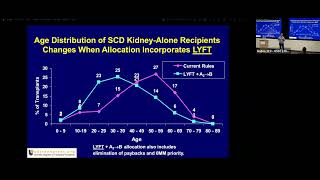
Voices in the Code - A Story About People, Their Values, and the Algorithm They Made
Explore the development of a kidney transplant algorithm, examining ethical considerations, public participation, and the challenges of creating fair and transparent high-stakes software systems.

AI, Archaeology, and Archives - How Data Science is Helping to Reveal Past Epidemics
Exploring malaria's impact through data science, integrating archaeological, historical, and genetic datasets to reveal socio-political influences on disease spread over the last 300 years.
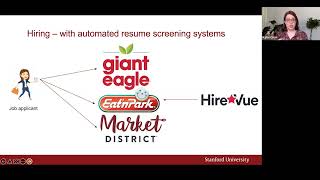
Picking on the Same Person - Does Algorithmic Monoculture Homogenize Outcomes?
Explore algorithmic monoculture's impact on decision outcomes, examining data sharing effects, ethical implications, and potential risks to fairness and individual autonomy.
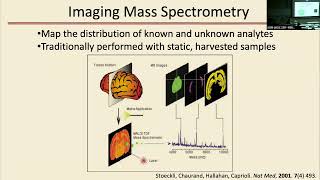
Spatial SILAC - Developing Isotopic Zip Codes for Drug Development in 3D Cell Cultures
Explore innovative drug development techniques using Spatial SILAC in 3D cell cultures, presented by Prof. Amanda Hummon from Ohio State University.
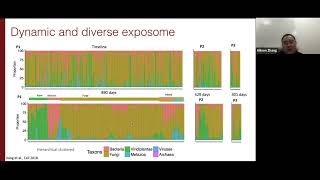
Precision Environmental Health Exposome Tracker - Fall 2022
Explore a powerful Personal Exposome Tracker for precision environmental health, focusing on innovative approaches to monitor and analyze individual environmental exposures.
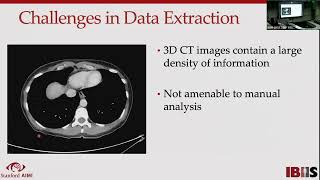
Disease Prediction Using Medical Imaging and Deep Learning - Summer 2022
Explore innovative techniques for predicting diseases using medical imaging and deep learning, focusing on opportunistic approaches with existing data for improved patient outcomes.
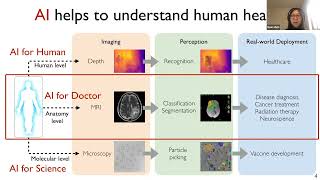
Time Before Birth: A Look at Developing Human Brain
Explore the developing human brain before birth through advanced imaging techniques and machine learning models, offering insights into fetal neurodevelopment and potential clinical applications.

Human-Centered AI for Mental Health Prediction in Social Media Data
Exploring human-centered machine learning for ethical and compassionate mental health predictions on social media, combining Media Studies and Computer Science approaches.

Insider's Guide to Clinical Trials
Explore real clinical trial case studies with experts, analyzing successes, mistakes, and improvement opportunities to enhance your research skills and trial design knowledge.
Regulating Problematic Behaviors Through Environmental Change - Stanford Seminar
Explore how social environments shape misinformation exposure and out-party animosity, and learn strategies for designing interventions to reduce problematic behaviors.
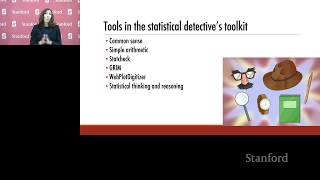
How to Be a Statistical Detective
Learn to detect statistical errors in medical literature using common sense, arithmetic, and online tools. Improve research quality and address the reproducibility crisis in science.
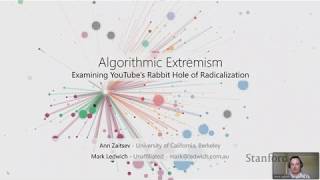
Stanford Seminar - Algorithmic Extremism- Examining YouTube's Rabbit Hole of Radicalization
Examination of YouTube's recommendation algorithm, challenging claims of far-right radicalization. Data analysis reveals a preference for mainstream media over fringe content, with implications for online political discourse.
Federated Learning in Medicine - Breaking Down Silos to Advance Medical Research
Explore federated learning's potential to revolutionize medical research by breaking data silos, enhancing privacy, and fostering collaboration across healthcare institutions.
Jupyter Notebooks and Academic Publication
Explore Jupyter Notebooks for scientific research with Python creators. Learn about its history, benefits, and future in academic publishing and data presentation.
Stanford Seminar - Virtual & Mixed Reality for Security of Critical City-Scale Cyber-Physical Systems
Explore VVateR, a virtual 3D world for visualizing cyber-physical systems and attacks on critical infrastructure. Learn about its applications in research, training, and security enhancement.

Stanford Seminar - Forecasting and Predicting the Future
Explore forecasting challenges, including misinformation, scientific issues, and geopolitical events. Learn to navigate complex information landscapes and identify reliable sources for accurate predictions.
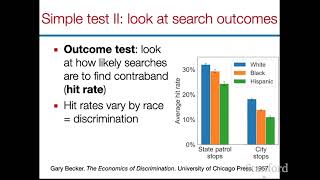
Inequality in Healthcare: Using AI and Data Science to Reduce Disparities
Exploring AI and data science applications to address healthcare inequality, featuring insights from experts on challenges and potential solutions in improving healthcare access and outcomes.
What's Next in Virus Detection and Vaccine Tech?
Explore cutting-edge virus detection methods, including wearable devices, and learn about vaccine technologies. Gain insights into the future of viral testing, telehealth, and precision health.
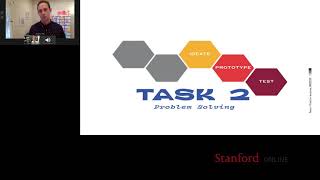
Your At Home Guide to Building Customer Empathy
Learn practical techniques for understanding customer needs, improving communication, and building trust in remote business interactions.
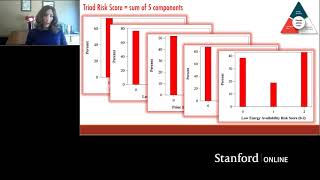
How to Analyze Research Data - Kristin Sainani
Practical guide to analyzing research data using real mental health data in athletes, with tips for improving rigor and reproducibility in research.
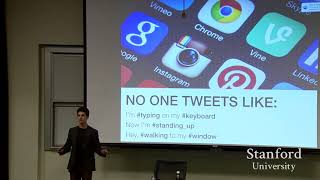
Stanford Seminar - Capturing Human Behavior and Language for Interactive Systems
Exploring how to enhance human-machine interaction through data-driven models that interpret human behavior and language, with applications in policy, bias detection, and community-shaping interfaces.