ALSEP Program and Analysis of the Apollo Seismic Data by Yosio Nakamura
Explore Apollo's seismic experiments on the Moon, analyzing data to understand lunar structure and seismology. Gain insights into pioneering lunar geophysics research.
Multi-Messenger Observations of Decihertz GW Sources by Enrico Cappellaro
Explore multi-messenger observations of decihertz gravitational wave sources, focusing on lunar detection methods and their potential for breakthrough discoveries in astrophysics.
White Dwarf - Neutron Star Binaries and Their Gravitational Wave Signatures by Alexey Bobrick
Explore gravitational wave signatures of white dwarf-neutron star binaries, examining their unique characteristics and implications for astrophysics and gravitational wave detection.
Observing EM Counterparts to Decihertz GW Sources by Varun Bhalerao
Exploring electromagnetic counterparts to decihertz gravitational wave sources, covering infrared to high-energy observations, mission comparisons, and challenges in detecting various astrophysical phenomena.
LION - Laser Interferometer on the Moon by Marie-Sophie Hartig and Pau Amaro Seoane
Explore lunar gravitational-wave detection concepts, technologies, and scientific potential. Discuss mission ideas, payload innovations, and implications for multi-messenger astronomy and lunar geophysics.
GW Signals from Tidal Disruption Events in the Decihertz Regime by Martina Toscani
Explore gravitational wave signals from tidal disruption events in the decihertz regime, focusing on lunar detection methods and their potential for breakthrough observations in astrophysics.
Lunar Surface Composition by Shyama Narendranath
Explore lunar surface composition and its implications for gravitational-wave detection on the Moon. Learn about cutting-edge research and mission concepts in lunar exploration and astrophysics.
The Lunar South Pole Landing Mission - Joint Program of JAXA-ISRO by Dai Asoh
Explore Japan and India's joint lunar mission, focusing on the South Pole landing. Learn about spacecraft design, mission objectives, and international collaborations in lunar exploration.
Moon- Science and Exploration at ESA by Luigi Cacciapuoti
Explore ESA's lunar science and exploration initiatives, focusing on gravitational-wave detection opportunities and breakthrough multi-messenger observations in the decihertz band.
A New Approach to the Binary Inspiral Problem - IPAM at UCLA
Explore modern scattering theory applications to gravitational wave calculations, focusing on advances in quantum scattering amplitudes and their relevance to binary black hole inspiral problems.
Multi-Messenger Aspects of Characteristic Evolution
Explore characteristic evolution in astrophysics, focusing on gravitational and electromagnetic fields, radiation extraction, and late-time effects in multi-messenger astronomy.
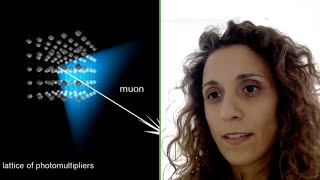
A Machine Learning Application in Multi-Messenger Astrophysics
Explore machine learning techniques for detecting gravitational waves from supernovae, connecting multiple messengers like neutrinos and electromagnetic signals for improved signal identification and classification.
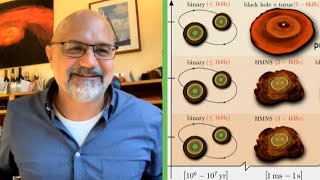
Binary Neutron Stars: From Gravitational to Particle Physics - IPAM at UCLA
Explore binary neutron stars as a rich laboratory blending gravity, astrophysics, and particle physics. Learn about recent modeling progress and insights into nuclear matter equations of state and phase transitions.
Multi-Dimensional Modeling of Core-Collapse Supernovae - IPAM at UCLA
Explore 3D modeling of core-collapse supernovae, focusing on neutrino and gravitational-wave signatures to unravel the long-standing mystery of the explosion mechanism.
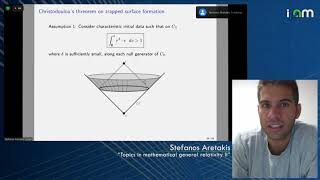
Topics in Mathematical General Relativity II - IPAM at UCLA
Explore black hole stability, linear wave equations, and Newman-Penrose constants in mathematical general relativity. Delve into extremal and subextremal cases, and examine key non-linear results in this field.
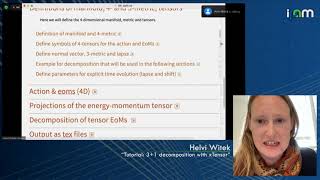
Tutorial: 3+1 Decomposition with xTensor - IPAM at UCLA
Learn to derive ADM-York equations for Einstein's equations using xTensor, an open-source tool for tensor algebra with Mathematica. Explore abstract tensor computations in gravitational wave astronomy.
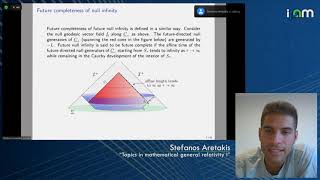
Topics in Mathematical General Relativity I
Explore key conjectures, problems, and methods in mathematical general relativity, including cosmic censorship, double null foliation, and short pulse method for studying trapped surfaces and Cauchy horizons.
Machine Learning for Gravitational Wave Astronomy - Concepts & Terminology
Explore machine learning concepts and terminology for gravitational wave data analysis, enhancing your understanding of this cutting-edge field in astronomy and physics.
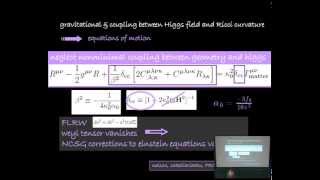
Aspects of the Bosonic Spectral Action
Explores noncommutative spectral geometry, its cosmological implications, scalar fields, and alternative definitions using zeta function regularization to address renormalizability and ultraviolet completeness.
The History of Gravitational Lensing in Cosmology by Nick Kaiser
Explore the evolution of gravitational lensing in cosmology, from Newton to modern weak lensing, with insights on its applications and future prospects in the era of advanced sky surveys.

Largest Cosmological Surveys and Big Data Science - Session 3
Explore cutting-edge cosmological surveys and big data techniques in this session, focusing on large-scale structures, CMB observations, and multi-messenger cosmology advancements.