Understanding Matter Distribution with the Sunyaev Zel'dovich Effect
Explore matter distribution in the universe using the Sunyaev Zel'dovich Effect. Learn about this powerful tool for studying cosmic structures and its applications in modern cosmology research.
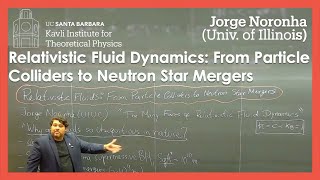
Relativistic Fluid Dynamics - From Particle Colliders to Neutron Star Mergers
Explore relativistic fluid dynamics and its applications in particle colliders and neutron star mergers. Gain insights into theoretical physics concepts and their real-world implications.
Cosmic Dawn through 21-cm Bispectrum by Suman Manjumdar
Explore the early Universe through 21-cm bispectrum analysis, uncovering insights into cosmic dawn and large-scale structure formation in this advanced cosmology lecture.
Getting the Most Out of Cosmological Surveys - Synergies in Intensity Mapping by Hamsa Padmanabhan
Explore synergies in intensity mapping for cosmological surveys, enhancing our understanding of the Universe's large-scale structure and evolution through advanced data analysis techniques.

Massive Stars and Supernovae – With Thomas Haworth
Explore the formation, life, and explosive death of massive stars, their impact on galaxies, and recent discoveries in planetary science through engaging demonstrations and simulations.

Shedding Light on the Dark Universe
Nobel laureate James Peebles discusses dark matter, dark energy, and the big bang with Brian Greene, exploring humanity's quest to understand the cosmos and its mysteries in this engaging conversation.
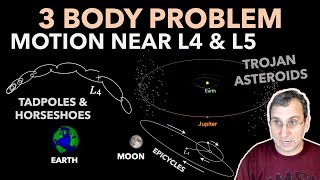
Motion Near L4, L5 Stable Lagrange Points - Tadpole, Horseshoe Orbits, Trojan Asteroids, Lucy Mission
Explore stable Lagrange points L4 and L5, analyzing motion types like tadpole and horseshoe orbits. Discover applications in celestial mechanics, including Trojan asteroids and the Lucy mission.

What Do Gravitational Waves Sound Like? - With Tessa Baker
Explore gravitational waves, their detection, and cosmic implications with cosmologist Tessa Baker. Learn about Einstein's theories, black holes, and cutting-edge astronomical research in this comprehensive lecture.
Modern Numerical Methods in Computational Relativity - Lecture 5
Explore advanced numerical techniques in computational relativity, focusing on simulating black hole mergers and other high-energy astrophysical phenomena for gravitational-wave astronomy.
James Webb Space Telescope - Comets, Planets, and the Origin of Life
Explore JWST's groundbreaking discoveries about comets, planets, and Earth's water origins. Join Brian Greene and lead scientist Stefanie Milam for cutting-edge insights into our cosmic neighborhood.
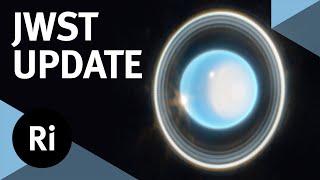
What Has the James Webb Space Telescope Discovered in Its First Year? – With Naomi Rowe-Gurney
Explore the James Webb Space Telescope's groundbreaking discoveries in our Solar System, from Mars to the Kuiper Belt, and learn about its unique capabilities, launch, and future missions in this comprehensive presentation.
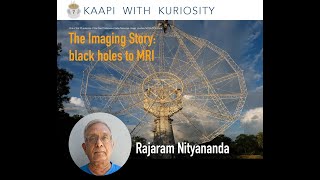
The Imaging Story - Black Holes to MRI by Rajaram Nityananda
Explore modern imaging techniques beyond traditional cameras, from medical MRI to radio telescopes. Learn how optics, computation, and statistics revolutionized image creation across various fields.

Quantum to the Cosmos - A Brief Tour of Everything
Join Sean Carroll and Brian Greene for a captivating exploration of the universe, from quantum mechanics to cosmic scales, offering insights into the fundamental nature of reality and our place within it.
Modern Numerical Methods in Computational Relativity - Lecture 2
Explore advanced numerical techniques for solving Einstein's equations in computational relativity, focusing on applications in gravitational-wave astronomy and astrophysical simulations.
Modern Numerical Methods in Computational Relativity - Lecture 3
Explore advanced numerical techniques for solving Einstein's equations in computational relativity, focusing on modeling gravitational waves from merging black holes and neutron stars.

Modern Numerical Methods in Computational Relativity - Lecture 1
Explore modern numerical methods for solving Einstein's equations in computational relativity, essential for modeling gravitational waves from black hole and neutron star mergers.

Mapping the Universe - Dark Energy, Black Holes, and Gravity – With Chris Clarkson
Explore the cosmos with Chris Clarkson as he unravels the mysteries of dark energy, black holes, and gravity, discussing cutting-edge cosmological surveys and their impact on our understanding of the universe's structure and evolution.
Numerical Relativity: Mathematical Formulation - Lecture 4
Explore mathematical foundations of Numerical Relativity, essential for modeling gravitational waves from black hole mergers and other high-energy astrophysical phenomena.
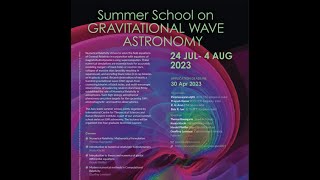
Introduction to Numerical Relativistic Hydrodynamics - Lecture 5
Explore advanced concepts in numerical relativistic hydrodynamics, focusing on computational techniques for modeling high-energy astrophysical phenomena and gravitational wave sources.

Numerical Relativity: Mathematical Formulation - Lecture 5
Explore mathematical foundations of Numerical Relativity, essential for modeling gravitational waves from black hole mergers and other high-energy astrophysical phenomena.
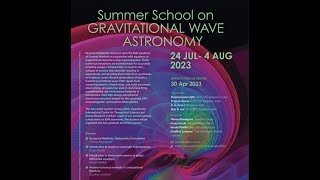
Introduction to Numerical Relativistic Hydrodynamics - Lecture 2
Explore advanced concepts in numerical relativistic hydrodynamics, focusing on mathematical formulations and computational techniques for modeling high-energy astrophysical phenomena.