Shedding New Light on Dark Matter
Explore groundbreaking insights on dark matter with physicists Brian Greene and Priyamvada Natarajan, discussing new research, mapping techniques, and the future of cosmic simulations.
Discovering Gravitational Waves - LIGO's Latest Massive Source
Explore the latest gravitational wave discoveries with physicists Brian Greene and Gabriela González, discussing LIGO's groundbreaking findings and their implications for our understanding of the cosmos.
100 Years of Gravitational Waves - From Einstein to LIGO
Nobel laureate Rai Weiss explores the history of LIGO, from Einstein's theories to the groundbreaking detection of gravitational waves, highlighting the technology and challenges behind this remarkable scientific achievement.

Entropy and the Arrow of Time - Your Daily Equation Episode 32
Explore entropy, the second law of thermodynamics, and their connection to the arrow of time. Discover why events happen in one direction and how these concepts relate to the Big Bang and our understanding of the universe.

Black Holes - Why Time Slows Down Near Them - Your Daily Equation 31
Explore black holes and their mathematical foundations with Brian Greene, delving into Einstein's general relativity and the strange phenomena of time dilation near these cosmic enigmas.

The Planck Length and String Theory Testing Challenges - Your Daily Equation 15
Explore the Planck scale with Brian Greene, understanding its significance in quantum mechanics and gravity, and its implications for testing string theory.
Testing the Limits of Cosmology
Leading physicists explore cutting-edge experiments and theories pushing the boundaries of cosmology, from recreating the Big Bang to searching for multiverses, challenging our understanding of the universe's origins and nature.
Darkness Visible - Shedding New Light on Black Holes
Explore cutting-edge techniques to observe and understand black holes, including radio telescope arrays and mathematical models. Learn how these methods reveal fundamental truths about the universe and bridge general relativity with quantum mechanics.
2018 Kavli Prize Announcement and Scientific Discussion
Live announcement of the 2018 Kavli Prize winners in astrophysics, nanoscience, and neuroscience, followed by expert discussions on the laureates' achievements and future research prospects in these fields.
The Kavli Prize 2016 - Advances in Astrophysics, Nanoscience, and Neuroscience
Renowned scientists discuss groundbreaking research in astrophysics, nanoscience, and neuroscience following the announcement of the 2016 Kavli Prize winners, exploring future opportunities in these fields.
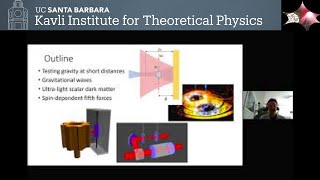
Experimental Tests of Novel Short Range Forces with AMO Methods - Andy Geraci
Exploring novel short-range forces using atomic, molecular, and optical methods. Geraci discusses experimental techniques and their potential for advancing fundamental physics research.
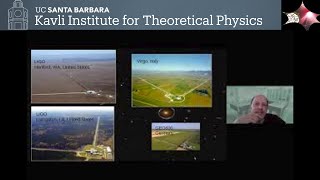
Quantum-Enhanced Interferometry for New Physics - Hartmut Grote
Explore quantum-enhanced interferometry for fundamental physics experiments, discussing advancements in precision measurements and potential applications in dark matter detection and gravitational wave research.
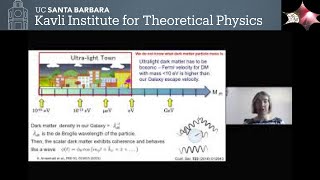
Fundamental Physics with Atoms and Molecules - Marianna Safronova
Explore cutting-edge experiments in fundamental physics using atoms and molecules. Learn about advancements in testing dark matter, symmetry violations, and gravitational waves through cold atom techniques and interferometry.
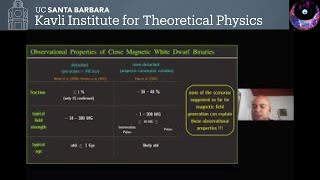
Formation and Evolution of Close Magnetic White Dwarf Binaries - Diogo Belloni
Explore the formation and evolution of close magnetic white dwarf binaries, their impact on astrophysics, and implications for stellar remnants and galactic populations.

Pioneers in Science - Ellen Stofan, NASA Chief Scientist and Planetary Geologist
Engage with NASA chief scientist Ellen Stofan as she discusses her career, inspirations, and NASA's science programs, offering insights into planetary geology and space exploration.
Introductory Astronomy - Star Formation and the Lifetimes of Stars
Explore the fascinating process of star formation and discover how long stars live in their main hydrogen-fusing phase in this concise astronomy lecture.
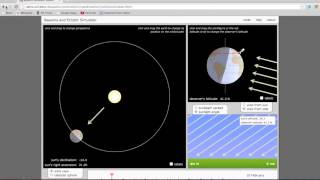
Introductory Astronomy - Causes of the Seasons
Explore Earth's seasonal changes through an in-depth examination of astronomical factors, utilizing interactive simulations and expert insights to enhance understanding of this natural phenomenon.
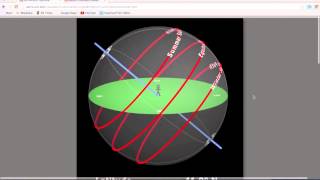
Introductory Astronomy - Path of the Sun in the Daytime Sky
Explore the Sun's changing path across the daytime sky throughout the year, enhancing your understanding of celestial movements and seasonal variations.
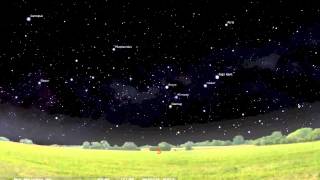
Introductory Astronomy: Star Motions at Different Latitudes
Explore celestial movements across Earth's latitudes using Stellarium, a free sky simulator, to understand how star motions appear differently from various global positions.

Medicine and Health in Extreme Environments - From Space to Everest
Astronaut and mountaineer Scott Parazynski explores medicine and health in extreme environments, drawing insights from space and Everest expeditions.
Quantum Gravity and Cosmology - Eva Silverstein (Stanford)
Explore quantum gravity and cosmology with Stanford's Eva Silverstein in this Snowmass Theory Frontier Conference talk, covering recent advances and future opportunities in high-energy physics theory.