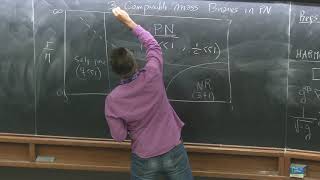
Black Holes, Binary Systems, and Gravitational Waves - Comparable-Mass Binaries
Explore comparable-mass binary systems, post-Newtonian theory, and relaxed Einstein equations in the context of gravitational waves and black hole physics.
Black Holes, Binary Systems, and Gravitational Waves - Kerr Black Hole
Explore Kerr black holes, binary systems, and gravitational waves with expert Nicolas Yunes. Delve into advanced concepts like Killing tensors and zero angular momentum observers in this comprehensive lecture.

Feynman's Lost Lecture on Planetary Orbits
Explore Feynman's elegant proof of planetary elliptical orbits, featuring 3Blue1Brown's visualizations. Uncover the beauty of physics through this captivating demonstration of celestial mechanics.
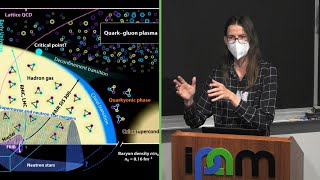
Gravitational-Wave Observations of Neutron-Star Mergers - IPAM at UCLA
Explore gravitational-wave observations of neutron-star mergers, their impact on understanding dense matter and stellar evolution, and future prospects in gravitational-wave astronomy.
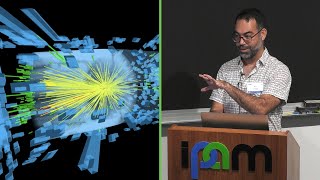
Simulation-Based Inference for Gravitational Wave Astronomy - IPAM at UCLA
Explore simulation-based inference techniques for gravitational wave astronomy, covering frequentist vs. Bayesian approaches, summary statistics, and the role of neural networks and inductive bias.
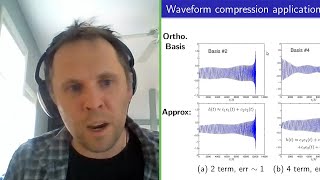
Gravitational Wave Parameter Estimation with Compressed Likelihood Evaluations
Explore advanced techniques for efficient gravitational wave parameter estimation, focusing on Reduced Order Quadratures (ROQs) to accelerate likelihood evaluations and improve Bayesian inference in GW astronomy.
Adventures in Practical Population Inference - IPAM at UCLA
Explore practical population inference in gravitational-wave astronomy, covering computational challenges, novel methods, and techniques for extracting astrophysical information from observations.
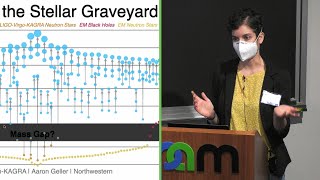
Black Hole Astrophysics With Gravitational-Wave Catalogs - IPAM at UCLA
Explore black hole astrophysics through gravitational-wave data, uncovering insights on mass distribution, spin, and redshift evolution. Learn about pair-instability mass gap and formation-to-merger time delays.
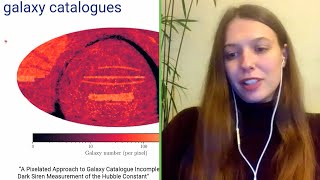
Cosmology with Dark Sirens - Attempting to Solve the Hubble Constant Tension
Explore gravitational waves for cosmology, focusing on dark sirens and galaxy catalogs to address Hubble constant tension. Learn challenges in GW-based cosmological parameter estimation.
Astrophysical Models of Binary Compact Objects - IPAM at UCLA
Explore astrophysical models of binary compact objects, their formation, and implications for gravitational wave astronomy. Discuss key uncertainties and future challenges in the field.
Stochastic Background Searches in GW Experiments - IPAM at UCLA
Explore stochastic gravitational wave backgrounds, their characteristics, detection methods, and future prospects in ground-based and space-borne observatories with insights from recent LVK collaboration searches.
LISA and the Global Analysis of Galactic Binary Gravitational Wave Signals
Explore LISA's role in detecting galactic binary gravitational waves, including data analysis challenges, global fitting techniques, and future prospects for multi-source gravitational wave detection.
The Mysterious Nature of the Big Bang Singularity - IPAM at UCLA
Explore the enigmatic Big Bang singularity, Einstein's equations, and Kasner solutions in this advanced physics lecture on gravitational theory and cosmological origins.
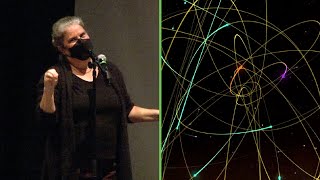
From the Possibility to the Certainty of a Supermassive Black Hole - IPAM UCLA
Explore groundbreaking research on supermassive black holes at the galactic center, including stellar orbit measurements, unexpected environmental discoveries, and new insights into gravity's behavior near these cosmic giants.
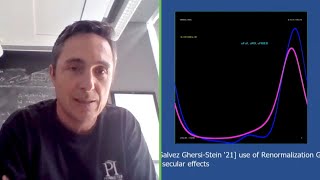
Challenges and Options for Beyond General Relativity Explorations - IPAM at UCLA
Explore challenges in extending General Relativity, including mathematical pathologies and potential solutions, with insights on computational approaches in multi-messenger astrophysics.
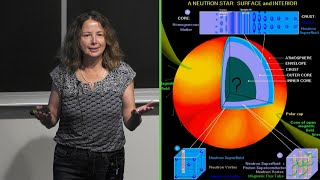
Realistic Binary Neutron Stars Collisions Simulations - Challenges and Opportunities
Explore challenges and opportunities in simulating binary neutron star collisions, focusing on realistic models, electromagnetic counterparts, and remnant properties using open-source codes and parametrized equations of state.
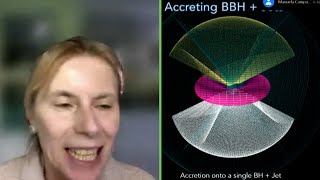
Merging Black Hole Binaries - Accretion Dynamics and Outflows
Explore accretion dynamics and outflows in merging black hole binaries, covering simulations, evolution, and multimessenger astronomy implications.
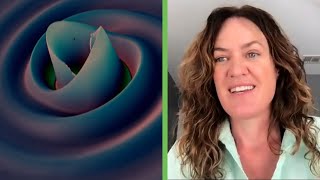
Numerical Relativity and the Next Generation of Gravitational Wave Detections
Explore numerical relativity's role in gravitational wave astronomy, its impact on understanding gravity, and future challenges as detectors improve. Insights into computational and data hurdles in this evolving field.
Computational Challenges with Modeling Core Collapse Supernovae - IPAM at UCLA
Explore computational challenges in modeling core collapse supernovae and gravitational wave emission, covering recent progress, physics requirements, and future directions in multi-dimensional simulations.
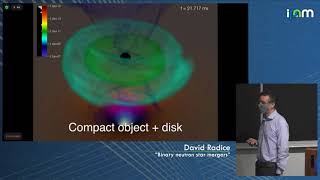
Binary Neutron Star Mergers - IPAM at UCLA
Explore neutron star mergers, their multimessenger emissions, and implications for astrophysics. Gain insights into recent simulations, future challenges, and prospects in this cutting-edge field.
Introduction to Modelling Gravitational Waves from Compact Binaries
Explore gravitational wave modeling techniques for compact binary systems, covering inspiral, merger, and ringdown phases. Learn about semi-analytic models crucial for detection and analysis.