Multi-messenger Astronomy: Progress and Problems in Exploring the Dynamic Sky
Explore the dynamic universe through multi-messenger astronomy, examining cosmic rays, neutrinos, photons, and gravitational waves to understand astrophysical phenomena and recent research developments.
Peering into the Early Universe - Observing Cosmic History Through High-Precision Measurements
Explore high-precision astronomical techniques and custom telescope designs used to study crucial epochs of the early Universe, overcoming observational challenges to reveal our cosmic origins.
Highs and Lows of Accreting Neutron Stars: X-ray Observations and Binary Systems
Explore the fascinating world of X-ray emitting neutron stars, their binary systems, and groundbreaking discoveries including massive planets and orbital period glitches, plus insights into the POLIX instrument.
Outflows from Galaxies - Understanding Gas Ejection and Star Formation
Explore the physics of galactic gas ejection and its impact on star formation through multi-wavelength observations, understanding how this process shapes galaxy evolution.
Overview of SKA Radio Interferometer Telescope Activities - Design and Implementation
Explore the design challenges and scientific activities of the Square Kilometer Array (SKA) radio telescope project, focusing on the low-frequency aperture array and RRI's contributions to pulsar research.

Seeing the High Energy Universe - Understanding Cosmic Rays and Neutrino Detection
Explore high-energy cosmic phenomena, from cosmic rays to neutrinos, and discover cutting-edge detection methods and astronomical observations in this comprehensive physics lecture.
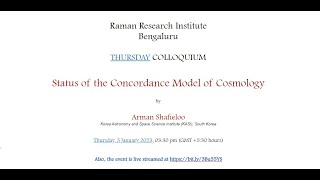
Status of the Concordance Model of Cosmology - Current Tensions and Future Directions
Explore the current state of cosmological models, examining tensions in observations, potential solutions, and future directions in astronomical surveys with Prof. Shafieloo's expert analysis.
Introduction to Exoplanet Detection Using the Transit Method
Discover how to detect exoplanets from your backyard using transit method imaging, with guidance on essential equipment, software, and techniques for contributing to astronomical research.
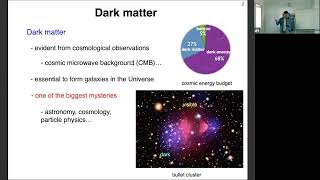
Current Status of Self-Interacting Dark Matter
Explore the latest findings on self-interacting dark matter, examining velocity-dependent cross sections and their implications for dark matter halos across different cosmic scales.
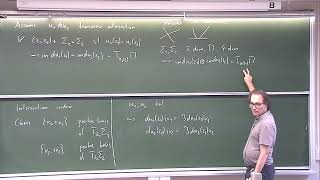
The Restricted Three-Body Problem and Holomorphic Curves - Lecture 3
Delve into advanced celestial mechanics, exploring holomorphic curves and their role in solving the restricted three-body problem through Birkhoff's conjecture and periodic orbits.
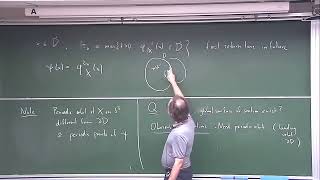
The Restricted Three-Body Problem and Holomorphic Curves - Lecture 1
Explore the dynamics of the restricted three-body problem and its relationship to holomorphic curves, focusing on Birkhoff's conjecture and the mathematical analysis of celestial mechanics.
Atomic Hydrogen in Galaxies Nine Billion Years Ago
Explore the groundbreaking detection of atomic hydrogen in ancient galaxies, tracing 30 years of research that reveals how galaxies evolved through gas-to-star conversion 9 billion years ago.
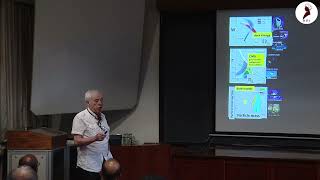
Telescopes on the Moon: The Next Decades - Exploring Space Through Lunar Observatories
Explore groundbreaking astronomical possibilities as lunar-based telescopes revolutionize our understanding of dark ages cosmology, early universe radiation, and exoplanet discoveries in unprecedented detail.
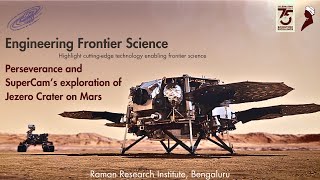
Perseverance and SuperCam's Exploration of Jezero Crater on Mars
Explore the groundbreaking discoveries from Mars as an expert reveals how SuperCam's laser technology analyzes Martian rocks, offering insights into the Red Planet's geological history and composition.

How Much of the Earth Can You See at Once?
Explore Earth's visibility from various perspectives, examining curvature, surface roughness, and how much can be seen from different distances and altitudes.

How Earth Moves
Explore Earth's complex movements, from daily rotation to cosmic travel, and their impact on time, seasons, and our place in the universe. Uncover fascinating celestial phenomena and calendar intricacies.
MIGHTEE-HI - The Relation Between the HI Gas in Galaxies and the Cosmic Web - Madalina Tudorache
Explores the relationship between neutral hydrogen gas in galaxies and the cosmic web, discussing observations, data sources, and implications for galaxy formation and evolution.
Formation of Thin and Thick Discs of Galaxies - Sukyoung Yi (Yonsei)
Explore galaxy disc formation, evolution, and structure through simulations and observations, examining factors like cosmic web influence, mergers, and stellar populations.
How Cosmological Filaments Reset the Formation of Disc Galaxies - Florent Renaud
Explore how cosmic filaments influence disc galaxy formation, examining the interplay between the cosmic web and galaxy evolution across time and its implications for cosmology.
Cold Streams in the Hot CGM of High Z Galaxies - Han Aung
Explore cold streams in hot CGM of high-redshift galaxies, their properties, and implications for galaxy formation. Gain insights into cosmic web evolution and its impact on early universe structures.
Tracking Halo Orbits and Their Mass Evolution Around Large-Scale Filaments - Hannah Jhee
Explore halo orbits and mass evolution around cosmic filaments, examining their dynamics, virialization, and impact on galaxy formation across cosmic time.