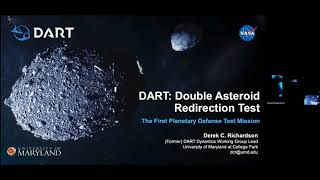
DART: Successful Deflection of an Asteroid by a Kinetic Impactor
Explore NASA's groundbreaking DART mission, its successful asteroid deflection, and the implications for planetary defense strategies. Gain insights into the mission's dynamics and future follow-up plans.
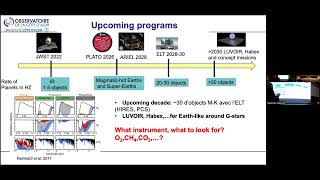
Coupling Planetary and Ecosystem Modeling to Assess Habitability and Inhabitation
Explore innovative approaches to assess planetary habitability and potential life, combining atmospheric, interior, and ecosystem modeling for various celestial bodies in our solar system and beyond.
Big Questions in Lunar Science and Exploration
Explore key lunar science questions and discoveries with Dr. Parvathy Prem, covering topics from remote sensing to polar volatiles and impact cratering.

Sharing Planetary Science: Adapting Your Talks
Learn effective strategies for adapting planetary science presentations to diverse audiences, enhancing communication skills and maximizing impact in various settings.
Efficient Degassing of Early-Formed Planetesimals and the Ureilite Parent Body
Explore water delivery to Earth through unmelted material and efficient degassing of early-formed planetesimals, focusing on the Ureilite Parent Body.
Nanomineralogy of Meteorites: Discovery of New Minerals Representing Extreme Conditions of Formation
Explore 45 new minerals discovered in meteorites, including refractory and high-pressure minerals, revealing insights into solar system formation and extreme conditions in space.
Apollo 16 and 17 Missions - Scientific Success and Lunar Geology Retrospective
Explore the scientific achievements of Apollo 16 and 17 missions, including lunar geology, site selection, and insights from returned samples.
Smashing Saturn: Insights from Impact Crater Analysis on Saturn's Satellites
Explore impact crater analysis on Saturn's moons, uncovering geological insights and planetary formation processes through cutting-edge research and data interpretation.
Assessing Reaction Pathways on Mars - From Meteorites to Sample Return
Explore Mars' geological evolution through meteorite analysis and sample return missions, uncovering reaction pathways and planetary processes.
Managing Stress Fatigue for Planetary Scientists - Professional Development Webinar
Explore strategies to recognize, prevent, and manage stress fatigue in scientific careers. Learn practical techniques for maintaining well-being and professional success.
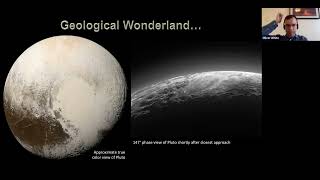
A Global Geologic Map of Pluto
Explore Pluto's complex geological history through high-quality images from NASA's New Horizons spacecraft, revealing diverse terrains and crater densities.
Optimizing Your Conference Experience - Tips for Planetary Science Events
Discover expert strategies for maximizing your science conference experience, from networking to presenting, with insights from planetary science veterans.
A Revolution in Solar System Astronomy with JWST
Explore groundbreaking JWST observations of solar system bodies, from gas giants to asteroids, and their impact on our understanding of planetary formation and evolution.
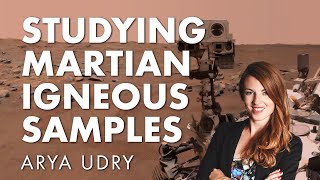
Studying Martian Igneous Samples to Constrain the Evolution of the Martian Interior
Explore Mars' interior evolution through igneous sample analysis, combining meteorite data with Perseverance rover findings from Jezero crater to unravel Martian geological history.
What Might Artemis Astronauts Encounter at the Lunar South Pole?
Explore potential challenges and discoveries awaiting Artemis astronauts at the Moon's South Pole, including unique geological features and resource opportunities.
ExMASS 2023-2024 Final Presentations
Explore lunar and asteroid research as high school students present their findings in NASA's ExMASS program, showcasing innovative scientific investigations and discoveries.

Machine-Learning Enabled Imaging: From Microscopy to Medical Imaging to Astronomy - Kirk Lecture
Explore machine learning's impact on imaging across microscopy, medical imaging, and astronomy. Learn how neural networks leverage training data and physical models for improved image quality and resolution.
From Black Holes to Holographic Spacetime - Rothschild Lecture
Explore the concept of holographic spacetime, tracing its origins from Hawking's black hole discoveries to implications for our understanding of quantum reality and dimensions.
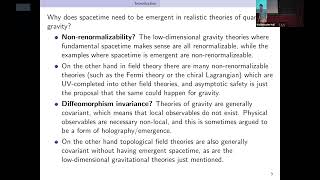
Quantum Information and Spacetime Emergence
Explore the intersection of quantum information and spacetime emergence with insights from MIT physicist Daniel Harlow, delving into cutting-edge theories and their implications for our understanding of the universe.
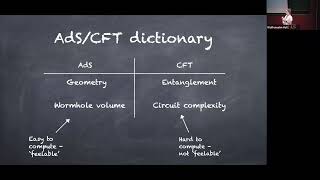
Complexity and Gravity
Explore the intricate relationship between complexity theory and gravitational physics in this advanced workshop, delving into cutting-edge research at the intersection of quantum information and theoretical physics.
Discussion on Possible Quantum Simulation of Black Holes
Explore quantum simulation of black holes with Juan Maldacena, delving into cutting-edge physics research and its potential implications for our understanding of the universe.