Formation of Quiescent Big Bang Singularities
Explore general relativity's big bang singularities, recent stability results, and a new condition for big bang formation in Einstein-non-linear scalar field settings.
Haunted Einstein-Yang-Mills Wormholes in Nonlinear Waves and Relativity
Explore infinite sequences of static spherically symmetric wormhole solutions in SU(2) Einstein-Yang-Mills equations, featuring phantom field "hauntings" in traversable tunnels between universes.
Waves on Kerr-de Sitter Space
Explore wave propagation on Kerr-de Sitter spaces in the subextremal range, featuring updates on joint research with Peter Hintz and Oliver Petersen.
Festina Lente and Branes in Quantum Gravity
Explore universal bounds on brane tension in de Sitter space using the Festina Lente conjecture, cosmic censorship, and charged black hole evolution in quantum gravity.
Quintessence: From String Theory to Observations and Back
Explore quintessence in string theory and its observational implications, bridging theoretical concepts with empirical evidence in cosmology.
Primordial Stochastic Gravitational Wave Backgrounds in Multi-field Inflation
Explore stochastic gravitational wave backgrounds in multi-field inflation, examining frequency profiles and potential visibility in LISA, unlocking insights into early universe processes.
What if String Theory Has a de Sitter Excited State?
Explore the concept of de Sitter space as an excited state in string theory, examining its implications and differences from traditional coherent states.
What if String Theory Has a de Sitter Excited State?
Explore the concept of de Sitter space as an excited state in string theory, examining its implications and differences from traditional coherent states.
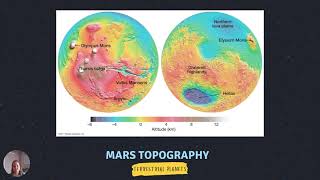
Introduction to Our Solar System
Explore the wonders of our cosmic neighborhood and gain insights into the planets, moons, and other celestial bodies that make up our Solar System.
Planetary Geology: Mars Exploration - Presentation Only
Explore Mars through a graduate student's presentation, delving into the Red Planet's geological wonders and scientific mysteries.
Reconstructing the Early Solar System
Explore early solar system formation through meteoritic analysis, isotopic anomalies, and integrated data to uncover the origins of our cosmic neighborhood.

Improving Education and Career Pathways for Underrepresented Minority Students in the Geosciences
Explore strategies to enhance diversity and inclusion in geoscience education, focusing on underrepresented minority students' pathways to success.
Earth and Planetary Sciences - Lightning Talks
Explore diverse Earth & Planetary Sciences topics through rapid-fire faculty presentations, covering geology, climate change, oceanography, and more in concise 3-minute talks.

Stellar Magnetic Activity with Kepler and TESS
Explore stellar magnetic activity through Kepler and TESS data, uncovering insights into stellar behavior and its impact on exoplanet detection and characterization.
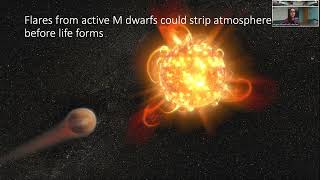
Finding Atmospheres on M Dwarf Terrestrial Planets with JWST
Explore JWST's capabilities in detecting atmospheres on M dwarf terrestrial planets and its implications for the search for habitable exoplanets through secondary eclipse photometry.
Detecting Exo-Earth Candidates with Next Generation Direct Imaging Space Telescopes
Explore cutting-edge techniques for identifying Earth-like exoplanets using advanced space telescopes in direct imaging missions.
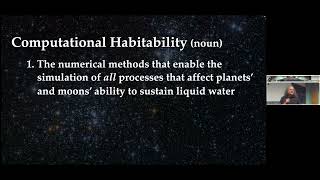
Computational Habitability
Explore computational methods for assessing planetary habitability, covering atmospheric, interior, surface, and system-wide factors in exoplanet research.

Ice Science Advances: From Antarctic Cores to Future Mars Sampling
Explore advances in ice science through Antarctic cores and potential Mars sampling, uncovering insights about Earth and Mars' ancient climates and environments.
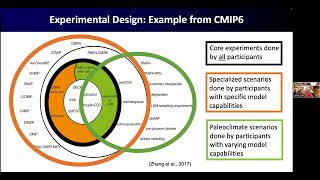
Looking Ahead to the Future of Exoplanet Climate Modeling
Explore the evolution of exoplanet climate modeling, from 1D models to sophisticated 3D simulations, and learn how JWST observations will shape future research and model refinement.

The Origin of Mercury's Structure and Chemical Composition and Their Astrobiological Implications
Explore Mercury's unique composition, formation, and implications for astrobiology. Investigate its metal-rich core, volatile elements, and comparisons to chondrites through experimental data and spacecraft observations.
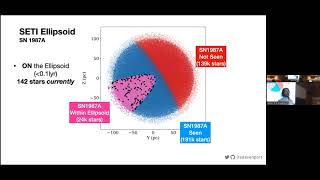
Searching the SETI Ellipsoid
Explore the concept of the SETI Ellipsoid and its role in the search for extraterrestrial intelligence with Astrobiology/Astronomy expert Jim Davenport.