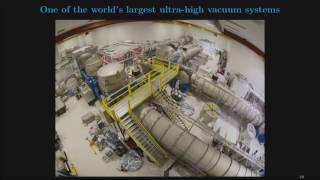
LIGO - The Dawn of Gravitational Wave Astronomy
Explore the groundbreaking discovery of gravitational waves by LIGO, its significance in astronomy, and the crucial role Python played in this scientific milestone.
Python in Astronomy
Explore Python's role in modern astronomy, from data analysis to visualization. Learn about AstroPy and see real-world applications in astronomical research and computation.
Unveiling the Universe with Python
Explore how Python and Monte Carlo simulations unveil the mysteries of the Universe, from analyzing cosmic microwave background data to revealing the surprising dominance of dark matter and energy.
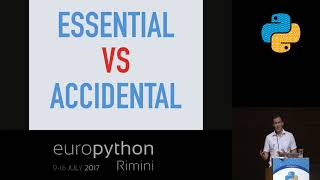
Solid Snakes
Learn strategies to enhance software reliability, minimize manual interventions, and reduce the need for emergency fixes, ensuring more peaceful nights and stress-free vacations for developers and system administrators.
White Mars - Living Far Away From Any Form of Life
Explore life and scientific research at Concordia Station in Antarctica, an isolated environment mimicking extraterrestrial conditions, and its implications for space exploration and human adaptation.

Astro Pi - Python on the International Space Station
Explore Python programming on the International Space Station with Astro Pi, a collaboration between Raspberry Pi Foundation and ESA, offering exciting opportunities for students to conduct space experiments.

Radio Astronomy with Python
Explore radio astronomy using Python, focusing on redshift studies, galaxy distribution analysis, and machine learning techniques for processing large astronomical datasets.
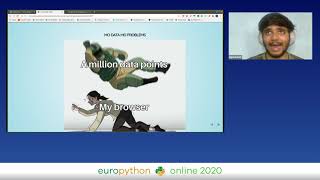
Interactive Mapmaking with Python
Explore interactive mapmaking using Python and GeoDataframes. Learn to create visually appealing maps with libraries like Folium, Kepler.gl, and Plotly, and discover Geopatra for simplified geodata visualization.
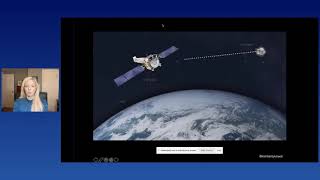
Our Universe through Sight, Sound & Touch
Explore the cosmos through innovative sensory experiences: listen to stellar explosions, walk through the Milky Way in VR, and feel vibrations of stellar nurseries. Transform 2D data into immersive, multi-dimensional encounters with our universe.
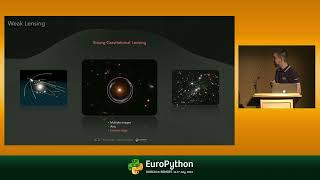
ShapePipe - A Modular Weak-Lensing Processing and Analysis Pipeline
Explore a Python-based pipeline for analyzing weak gravitational lensing, aiding cosmologists in understanding dark matter and dark energy through precise galaxy shape measurements.
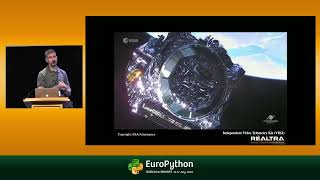
Python's Role in Unlocking the Secrets of the Universe with the James Webb Space Telescope
Explore how Python powers data processing for the James Webb Space Telescope, enabling groundbreaking discoveries about the Universe's origins, star formation, and exoplanets.
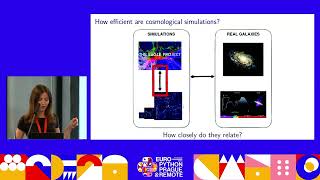
How Well Do We Understand Our Universe? Let's Python It Out!
Explore cosmic evolution using Python and machine learning to model the Universe's history, train AI on simulations, and apply findings to real galaxies, shedding light on their cosmic past.
Why Humans Need to Move to Mars
Explore potential Earth-ending scenarios and the urgent need for Mars colonization. Learn about space travel, Martian living, and terraforming in this futuristic vision of human expansion beyond Earth.
Hubble - eBPF Based Observability for Kubernetes
Explore Hubble, an open-source platform for Kubernetes network observability using eBPF technology. Learn to troubleshoot complex issues and create custom metrics without modifying applications.
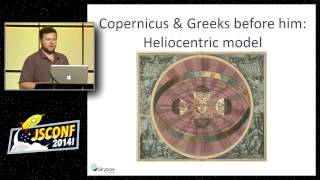
Realtime Satellite Tracking in the Browser
Explore real-time satellite tracking in browsers using JavaScript, learning orbital mechanics concepts and mapping techniques with Leaflet.js and satellite.js.

How to Calculate the Phase of the Moon
Learn to calculate moon phases using JavaScript, combining coding with astronomy in a unique and accessible approach to programming concepts.
Uncovering the Universe - Latest News from the LHC
Explore groundbreaking discoveries from the Large Hadron Collider, including insights on antimatter, dark matter, and the Higgs particle. Learn how this powerful machine recreates post-Big Bang conditions.
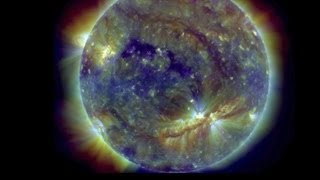
Our Dynamic Sun
Explore the Sun's 11-year activity cycle, solar flares, and their impact on Earth. Learn about space observations and cutting-edge spacecraft studying our star's dynamic nature.

Antimatter - Why the Anti-World Matters
Explore the mysteries of antimatter, its scarcity in the Universe, and recent scientific discoveries with physicist Tara Shears in this engaging lecture on particle physics and cosmology.

The Path to Mars - NASA's Exploration Programme
NASA's plans for human exploration of Mars, including asteroid missions. Insights from Chief Scientist Dr Ellen Stofan and Deputy Chief Technologist Jim Adams on science and technology shaping space exploration and international cooperation.

Our Mathematical Universe
MIT physicist Max Tegmark explores the radical idea that our universe is fundamentally mathematical, proposing that reality itself is a mathematical structure and examining the implications for our understanding of the cosmos.