Fun Research in Computer Vision and Robotics
Explore computer vision and robotics research, from face analysis to smart headlights, with insights on making research fun and productive using the "Think like an amateur, do as an expert" approach.
Complex Time - Cognitive Regime Shift II - When-Why-How the Brain Breaks
Exploring brain function loss through complexity science, from cellular to cognitive levels, discussing indicators, mechanisms, and analytical approaches for understanding aging and diseased brains.
Artificial Intelligence: A Guide for Thinking Humans
Explore AI's achievements, failures, and ethical implications with researcher Melanie Mitchell. Gain insights into machine learning, self-driving cars, and the challenges of imbuing computers with human-like qualities.
The Collective Computation of Reality in Nature and Society
Explore how nature computes through collective processes, challenging traditional views on complexity and information processing in biological and social systems.
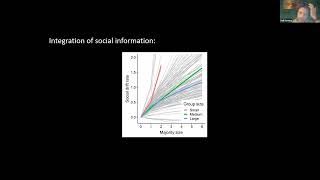
From Individual-Level Cognition to Collective Dynamics - Ralf Kurvers
Explore collective dynamics in social systems through evidence accumulation models, evolutionary algorithms, and real-world applications in resource finding, predictions, and robotics.
James Evans on Social Computing and Diversity by Design
Exploring social computing's impact on scientific research, team diversity, and human-AI collaboration in the pursuit of novel insights and wisdom.
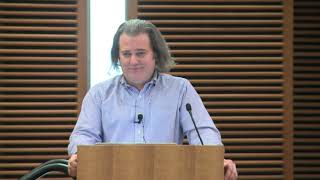
Demonology - Intelligence in Physics & Biology
Explore the historical role of intelligence in physics and biology, from Laplace's demon to modern information theory, and its implications for understanding natural phenomena.
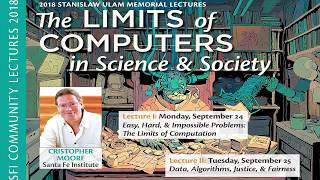
Ulam Lectures - Cris Moore - Limits of Computers in Science and Society Part 1
Explore computational limits, problem complexity, and algorithmic challenges in science and society. From easy puzzles to impossible problems, delve into the nature of computation and its societal impact.
Intelligent Systems
Explore diverse perspectives on intelligence, from individual to collective, natural to artificial. Delve into cultural transmission, machine learning, empathy for AI, and the ethical implications of evolving technological systems.
Tokens and Complex Systems - Part 1
Explore complex systems, tokenized ecosystems, and AI DAOs. Learn how blockchains function as life forms and democratize AI access. Discover evolutionary algorithms in token design and agent-based systems for simulation.
Swarm Engineering Across Scales
Explore swarm intelligence in nature and AI, from bird flocks to nanoparticles. Learn how collective behaviors emerge and their applications in robotics, communication, and medicine.
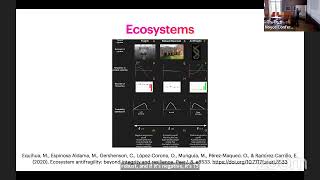
Antifragility - Dynamical Balance
Explore antifragility, dynamical balance, and their applications in software, creativity, and AI. Gain insights into measuring fragility and understanding robust systems.
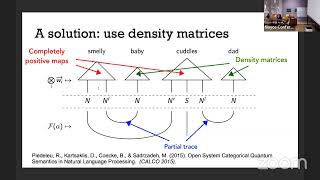
Compositionality in Vector Space Models of Meaning
Explore compositional structures in vector space models of meaning, focusing on deep neural networks, grammar, and role-filler bindings to understand language representation.
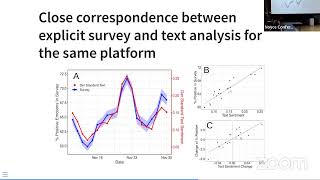
Validating Daily Social Media Macroscopes of Emotions
Explore how social media sentiment analysis can accurately measure daily emotional dynamics of online communities, validated through surveys and applied to COVID-19 impact studies.
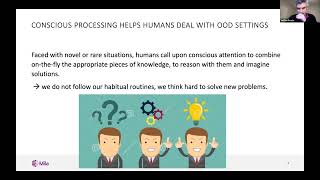
Yoshua Bengio- System 2 GFlowNets- Induction Biases Towards Machines that Understand and Think
Explore Yoshua Bengio's insights on System 2 GFlowNets, examining induction biases for AI that understands and thinks. Delve into deep learning, cognitive theories, and innovative approaches to machine intelligence.
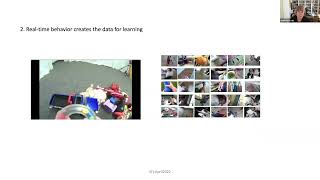
Why "Self-Generated Learning" May Be More Radical and Consequential Than First Appears
Explore self-generated learning's radical impact on cognitive development through data-driven insights, experiments, and complex dynamic systems analysis with Linda Smith.
Could a Purely Self-Supervised Foundation Model Achieve Grounded Language Understanding?
Exploring the potential of self-supervised foundation models for grounded language understanding, discussing semantics, multi-modal streams, and causal abstraction in large networks.
Penny Pexman - Multimodal Grounding for Concrete and Abstract Concepts
Explore multimodal grounding for concrete and abstract concepts with Professor Penny Pexman, examining lexical-semantic processing, sensorimotor experience, and dimensions of meaning in language comprehension.
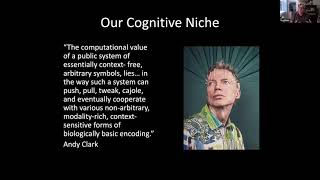
Guy Dove- Language Is a Neuroenhancement
Explore how language enhances cognitive abilities, examining embodied cognition, abstract concepts, and the elastic mind. Gain insights into human intelligence and its implications for AI development.
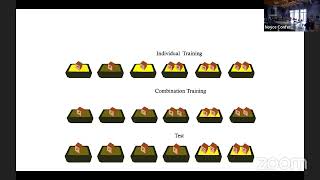
Imitation vs Innovation: Large Language and Image Models as Cultural Technologies
Explore the impact of large language and image models as cultural technologies, examining the balance between imitation and innovation in AI development.
Physical Computation in Insect Swarms
Explore the fascinating world of collective behavior in insect swarms and discover how physical principles govern their complex interactions and decision-making processes.