Linguistics by CrashCourse
In 16 episodes, Taylor Behnke teaches you linguistics! The content is based on an introductory university-level curriculum, curated by a team of linguists: Lauren Gawne, Jessi Grieser, and Gretchen McCulloch.
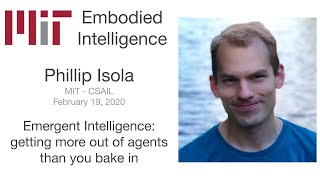
MIT EI Seminar - Phillip Isola - Emergent Intelligence- Getting More Out of Agents Than You Bake In
Explore emergent intelligence in AI through unsupervised learning, generative modeling, and self-assembling agents. Discover surprising outcomes beyond explicit programming in representation, video generation, and creature development.
Could a Purely Self-Supervised Foundation Model Achieve Grounded Language Understanding?
Exploring the potential of self-supervised foundation models for grounded language understanding, discussing semantics, multi-modal streams, and causal abstraction in large networks.
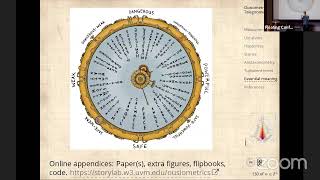
Ousiometrics and Telegnomics - Measuring Essential Meaning and Remote Knowledge
Explore the study of essential meaning and remotely sensed knowledge through innovative frameworks, examining language patterns, storytelling, and temporal dynamics in various contexts.
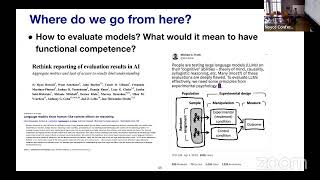
Formal and Functional Competence in Large Language Models - A Cognitive Perspective
Explore cognitive perspectives on large language models, examining formal and functional competence, linguistic confidence, and implications for AI development and evaluation.

Dimensions of Meaning and Understanding - Raphaël Millière
Explore dimensions of meaning and understanding, from lexical semantics to complex reasoning, with insights on knowledge acquisition and cognitive pitfalls.
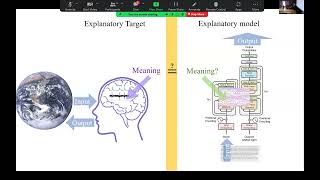
Do AI Systems Model Meaning and Understanding?
Explore the philosophical question of whether AI systems truly model meaning and understanding, delving into the nature of intelligence and consciousness in artificial systems.
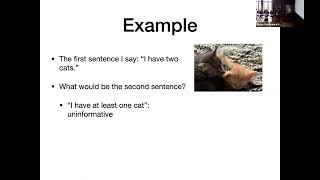
Language Models Could Learn Semantics - No Matter How You Define It
Explore how language models can acquire semantic understanding through form, entailment, and Gricean principles, with insights on practical limitations and future possibilities.
Cosa Significa Prendere le Parole per la Coda - Importanza del Linguaggio
Esplorazione dell'importanza delle parole nella vita quotidiana e nel pensiero. Riflessione su come la scelta attenta del linguaggio possa migliorare la comunicazione e la comprensione di sé e degli altri.

The Dark Side of Communication
Explore effective communication by identifying words to avoid, understanding listening barriers, and learning techniques to speak engagingly. Discover how to navigate communication challenges in modern society and organizations.

Meaning in the Age of Large Language Models
Exploring how large language models reshape theories of human language, grammar, and semantics, challenging traditional views on language acquisition and conceptual representation.
Modeling American Sign Language via Linguistic Knowledge Infusion
Explore innovative approaches to modeling American Sign Language, enhancing recognition accuracy and addressing challenges in sign language research through linguistic knowledge infusion.
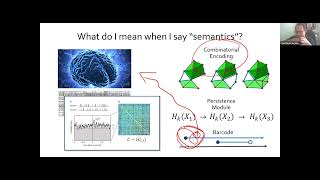
An Approach to Assigning Semantics to Persistent Homology Classes
Explore a novel approach to interpreting persistent homology classes in applied settings, overcoming traditional limitations by leveraging comparative measurements against known models.
Triposes and Gödel's Dialectica Interpretation
Exploring semantic presentation of Gödel's Dialectica interpretation using triposes, addressing previous work and suggesting solutions to related questions in mathematical logic.

HTML Crash Course for Beginners
Comprehensive introduction to HTML basics, covering syntax, structure, tags, forms, and more. Ideal for beginners starting web development, with practical examples and clear explanations.
Certificates
Learn about digital certificates, their role in secure internet communication, and key concepts like validation, GDPR, and trust. Explore real-world scenarios and security implications.

Semantics I - Session Preview for POPL 2023
Explore key concepts in semantics, including type-based approaches, rewriting, game semantics, and category theory, with expert Ugo Dal Lago.

Type Theory Session Preview - POPL 2023
Explore type theory fundamentals and recent advancements in this expert-led session preview for POPL 2023, enhancing accessibility of upcoming talks.
Languages with Decidable Learning: A Meta-theorem
Explore finite-aspect checkable languages and their role in decidable learning, connecting expression syntax tree evaluation to finite tree automata for new learning results.
Homotopy Type Theory for Sewn Quilts
Explore PieceWork, an innovative programming language for quilt design inspired by Homotopy Type Theory. Learn how computational methods can enhance diversity in sewn designs and bridge programming theory with quilting craft.
CMU Advanced NLP: Semantics and Discourse
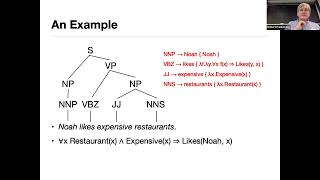
Explore advanced NLP concepts like semantic parsing, discourse coherence, pragmatics, and reference resolution in this comprehensive lecture on natural language understanding.