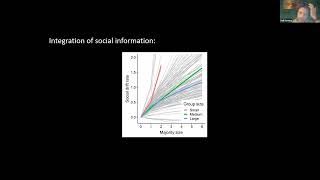
From Individual-Level Cognition to Collective Dynamics - Ralf Kurvers
Explore collective dynamics in social systems through evidence accumulation models, evolutionary algorithms, and real-world applications in resource finding, predictions, and robotics.
Tokens and Complex Systems - Part 1
Explore complex systems, tokenized ecosystems, and AI DAOs. Learn how blockchains function as life forms and democratize AI access. Discover evolutionary algorithms in token design and agent-based systems for simulation.
Tokens and Complex Systems - Part 2
Explore the intersection of complex systems and blockchain technology, including AI DAOs, token design, and agent-based simulations for innovative ecosystem development.
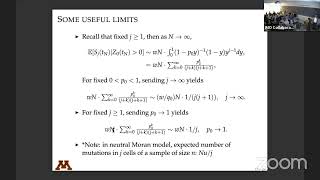
Computational Methods for Inferring Tumor Evolution and Heterogeneity
Explore computational techniques for analyzing tumor evolution and heterogeneity, enhancing understanding of cancer progression and treatment strategies.
Symbolic Regression for Discovery of a DFT Functional - IPAM at UCLA
Explore symbolic regression for DFT functional discovery, combining AutoML ideas to improve existing models in computational chemistry and materials science.
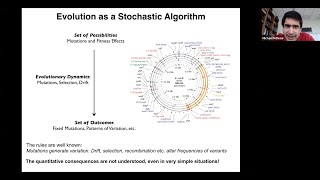
Evolution as a Stochastic Algorithm
Explore stochastic algorithms in evolution with Harvard's Michael Desai, examining probabilistic processes shaping genetic changes and adaptations in populations.
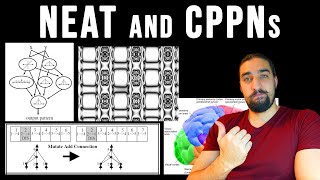
NeuroEvolution of Augmenting Topologies and Compositional Pattern Producing Networks
Explore NEAT and CPPN algorithms for evolving neural network architectures and weights, and their applications in developmental biology modeling and image generation.
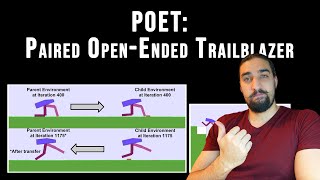
POET - Paired Open-Ended Trailblazer - Paper Explained
Explore POET algorithm: generating complex learning environments and solutions. Dive into evolutionary search, environment encoding, agent modeling, and curriculum comparison for AI advancement.

Gaming for Military Precision Decisions - Simon Lucas
Explore how Game AI and statistical forward planning algorithms can enhance military decision-making and operational planning, with insights from Simon Lucas.

Advanced Tutorials - Runtime Analysis of Population-Based Evolutionary Algorithms
Explore advanced techniques for runtime analysis of population-based evolutionary algorithms, covering selection mechanisms, random family trees, and level-based analyses to optimize algorithm performance.
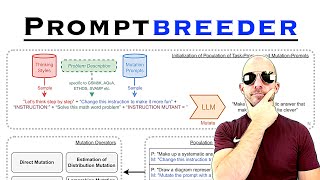
Promptbreeder- Self-Referential Self-Improvement Via Prompt Evolution
Explore Promptbreeder, an evolutionary system for automated prompt engineering. Learn how it self-improves to generate optimal prompts for various tasks, outperforming traditional strategies in reasoning and classification.
Fueling Innovation Engines - Creating, Collecting, and Improving Stepping Stones
Explore innovative AI algorithms for problem-solving, including Quality Diversity and Goal Switching, and their applications in overcoming complex challenges in various domains.

Emerging Tech Trends for 2020
Futurist Amy Webb explores crucial tech trends for 2020, including AI algorithms, synthetic media, and their implications. Scenarios for 2035 range from dystopian to optimistic futures.

Teach Your Computer to Code FizzBuzz
Interactive workshop on evolutionary algorithms, using Java to implement solutions for FizzBuzz. Covers biological evolution concepts, JCLEC framework, and Genetic Programming for evolving source code and automatic bug fixing.
Incubating Ecosystems - Evolutionary Swarm Robotics - Enable More EVs by Better Access
Explore cutting-edge tech: ecosystem incubation, evolutionary swarm robotics, and improving EV charging accessibility. Gain insights into innovative solutions shaping the future of technology and sustainability.
Distributed Parametric Optimization with the Geneva Library
Explore Geneva, an open-source library for distributed optimization algorithms, leveraging Boost libraries to solve large-scale parametric problems on multi-core systems, clusters, and cloud environments.
Calibration of Microscopic Traffic Simulation in Urban Environments Using GPS Data
Discover how to calibrate microscopic traffic simulations using GPS data through a two-step optimization process, combining integer linear programming with evolutionary algorithms for accurate urban traffic modeling.
Neural Architecture Search - Part I
Explore neural architecture search techniques, focusing on automated design of efficient deep learning models for various applications.
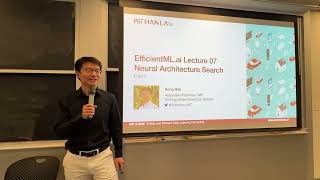
Neural Architecture Search - Part I (EfficientML.ai) - Lecture 7
Explore neural architecture search techniques for optimizing deep learning models, covering fundamentals, methods, and applications in AI efficiency.
Neural Architecture Search - Part II - Lecture 8
Explore advanced neural architecture search techniques, including gradient-based methods and hardware-aware NAS, to optimize deep learning models for efficiency and performance.
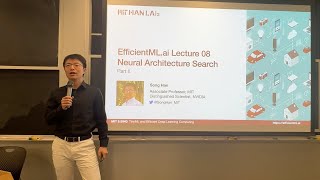
Neural Architecture Search (Part II) - Lecture 8
Explore advanced neural architecture search techniques, including evolutionary algorithms and reinforcement learning, to optimize deep learning models for efficiency and performance.