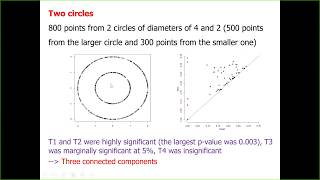
Modeling and Replicating Persistence Diagrams
Explore modeling and replicating persistence diagrams for statistical inference in topological data analysis. Learn about RST approach, parametric modeling, and improvements for clustered data.
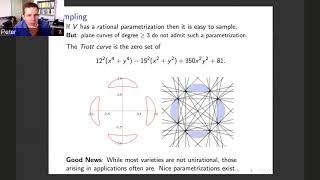
Bernd Sturmfels - Learning Algebraic Varieties from Samples
Explore algebraic varieties through sampling, focusing on topology and geometry. Learn algorithms for determining dimensions and polynomials, with practical applications in Julia.
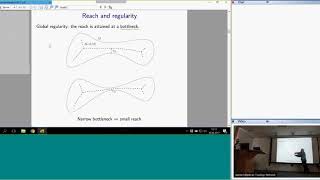
Estimating the Reach of a Manifold
Explore estimating manifold reach in geometric inference, covering problem formulation, statistical models, and minimax estimates for global and local cases.

Larry Wasserman - Robust Topological Inference
Explore robust topological inference with Larry Wasserman, covering persistence, confidence bands, bootstrap methods, and optimal tuning for data analysis and statistical modeling.
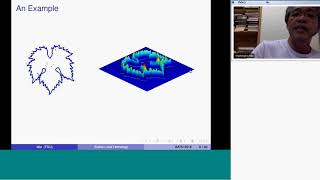
Washington Mio - Stable Homology of Metric Measure Spaces
Explore stable homology in metric measure spaces, covering Wasserstein distance, local homology stability, and applications in data analysis and taxonomic classification.
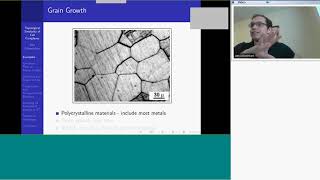
Benjamin Schweinhart - Statistical Topology of Random Cell Complexes, and Applications
Explore statistical topology of random cell complexes, covering curvature flow, grain growth, graph limits, and computational evidence for steady state hypothesis.
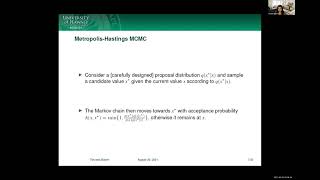
Farzana Nasrin - Random Persistence Diagram Generator
Explore a method for generating random persistence diagrams using parametric models and Markov chain Monte Carlo algorithms, with applications in material science and topology.
Role of Mathematics in Data Science and How to Learn - Data Science
Explore the essential mathematical concepts for data science, including statistics, probability, and normal distribution, with practical examples and problem-solving exercises.
Persistence and First-Passage Properties of Stochastic Processes by Satya N Majumdar
Explore stochastic processes, focusing on persistence and first-passage properties. Covers applications in chemistry, finance, astrophysics, and more. Examines Markov processes and run-and-tumble particle models.

The Selberg Sieve - Lecture 1
Explore the Selberg sieve method in number theory, covering heuristics, probability, and applications to twin primes. Learn about sieve techniques for detecting primes in sequences.
Ricci Curvature and Functional Inequalities for Interacting Particle Systems
Explore entropic Ricci curvature bounds and their applications to interacting particle systems, focusing on functional inequalities and convergence rates to equilibrium in nonnegative curvature scenarios.
Random Matrices and the Uses of Dyson-Schwinger Equations - III
Explore advanced topics in random matrix theory, including Dyson-Schwinger equations, operator algebra, and central limit theorems, with applications in mathematical physics.
Determinantal Point Processes - II
Exploration of determinantal point processes, covering theorems, Young graphs, Markov chains, and related mathematical concepts with applications in random matrix theory.
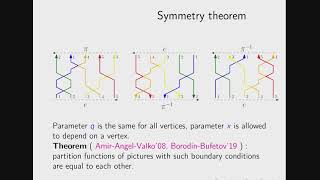
Color-Position Symmetry in Interacting Particle Systems
Explore color-position symmetry in particle systems, covering probability, partition functions, and stochastic processes. Gain insights into ASEP and simulation techniques.
Uncertainty Quantification for Kinetic Equations I
Overview of uncertainty quantification for kinetic equations, covering Monte Carlo methods, multi-fidelity techniques, and stochastic Galerkin particle methods. Explores computational challenges and recent advancements in the field.
Alexander Volberg - Poincaré Inequalities on Hamming Cube - Analysis, Combinatorics, Probability
Explore improved L^1-Poincaré inequality constants on Hamming cube, comparing with Gaussian space. Discuss proofs, estimates, and related mathematical concepts in analysis, combinatorics, and probability theory.
Regularity of Free Boundaries in Obstacle Problems - Lecture III
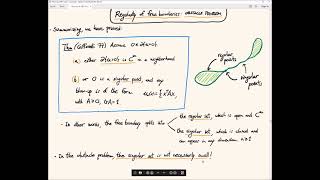
Explore free boundary problems in PDE, focusing on regularity of solutions and interfaces. Learn about Stefan and obstacle problems, key results, and current research challenges.
Regularity of Free Boundaries in Obstacle Problems Lecture I
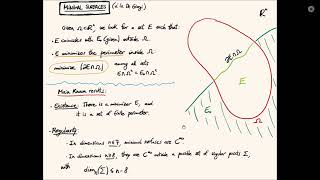
Explore regularity of free boundaries in obstacle problems, covering key concepts, proofs, and current research in this mathematical field of PDE and Geometric Measure Theory.
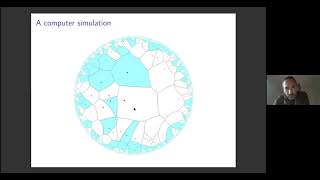
Percolation on Hyperbolic Poisson-Voronoi Tessellations
Explore percolation on hyperbolic Poisson-Voronoi tessellations, resolving conjectures about critical probability behavior and its dependence on Poisson process intensity.
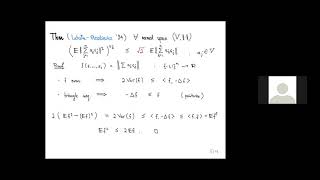
Tomasz Tkocz - Khinchin Inequalities With Sharp Constants
Explore sharp moment comparison inequalities for weighted sums of i.i.d. random variables, covering classical and recent results on Khinchin inequalities and their applications.
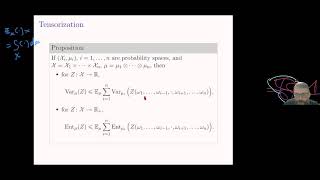
Functional Inequalities and Concentration of Measure I
Explore concentration inequalities in probability and geometric analysis, focusing on functional inequalities and their applications to Lipschitz functions in continuous and discrete settings.