Deep Learning and Computations of PDEs by Siddhartha Mishra
Explore deep learning applications in PDEs, uncertainty quantification, and optimization. Learn about operator learning, DeepOnet decomposition, and high-dimensional PDEs in this advanced lecture.

Introduction to the Normal Distribution - Probability and Statistics
Explore the normal distribution in statistics, understanding its key concepts and applications. Learn to analyze data patterns and make informed predictions using this fundamental probability model.

Normal Distribution Excel Exercise - Probability and Statistics - Khan Academy
Explore how normal distribution approximates binomial distribution for large trials using Excel. Gain practical insights into probability concepts through hands-on spreadsheet analysis.
Measuring Speed - Average and Instantaneous Velocity - Part 1
Explore average and instantaneous velocity concepts through practical examples and data analysis techniques in this engaging calculus lesson.
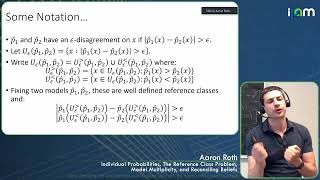
Individual Probability, Reference Class Problem, Model Multiplicity, Reconciling Belief
Explore individual probabilities, reference class problem, and model multiplicity in machine learning. Gain insights on reconciling beliefs and addressing challenges in probability estimation for individuals and groups.
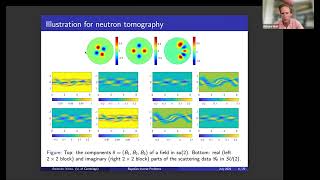
Statistical Inverse Problems and PDEs: Progress and Challenges
Explore statistical inverse problems and PDEs, covering Bayesian approaches, computational challenges, and mathematical guarantees for algorithms in high-dimensional settings.
Enhancing Markov Chain Monte Carlo Sampling Methods with Deep Learning
Explore advanced techniques combining Markov Chain Monte Carlo sampling with deep learning, focusing on importance sampling, normalizing flows, and non-equilibrium methods for enhanced efficiency in high-dimensional problems.

George Willis, Pierre-Emmanuel Caprace - A Totally Disconnected Invitation to Locally Compact Groups
Explore topological groups, focusing on locally compact and totally disconnected types. Discover recent advances in theory, simple groups, local structure, and comparisons with linear groups.
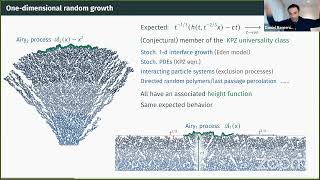
Integrable Fluctuations in One-Dimensional Random Growth
Explores recent findings on asymptotic fluctuations in KPZ universality class, covering random growth models, directed polymers, and particle systems. Discusses solvability, explicit formulas, and integrable differential equations.
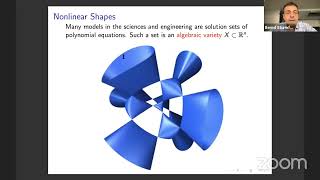
Beyond Linear Algebra
Explore advanced mathematical concepts beyond linear algebra, including critical point equations, nonlinear algebra in PDE, and geometric interpretations in optimization and statistics.
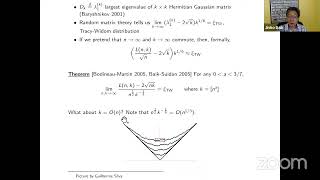
KPZ Limit Theorems
Explores KPZ universality in particle systems, growth models, and polymers, discussing limit theorems, integrable methods, and recent results on periodic domains.
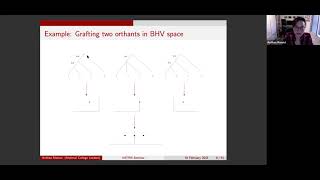
Tropical Geometry of Phylogenetic Tree Spaces
Explore tropical geometry's application to phylogenetic tree spaces, examining BHV space, tropical Grassmannians, and their implications for computational biology and statistics.
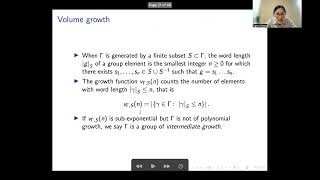
Tianyi Zheng- Asymptotic Behaviors of Random Walks on Countable Groups
Explore asymptotic behaviors of random walks on countable groups, covering Kesten's theorems, entropy, and applications to group theory and graph analysis.
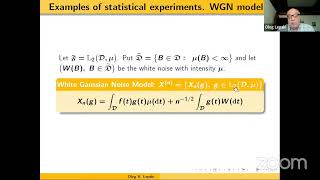
Theory of Adaptive Estimation
Introduction to modern adaptive estimation theory, focusing on universal estimation procedures and oracle inequalities. Explores commutativity properties, upper functions, and applications to various statistical models.
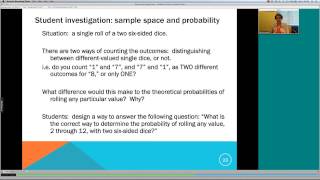
Probability Topics in Middle Grades - Simulation and Data Collection
Explore probability concepts through simulations and data collection, using various technologies to enhance understanding of middle-grade mathematics topics.
Distinguishing Between Linear and Exponential Growth in Mathematics - Real-World Applications
Explore real-world applications of linear and exponential growth through population and food production data, using calculators for analysis and modeling in mathematics.
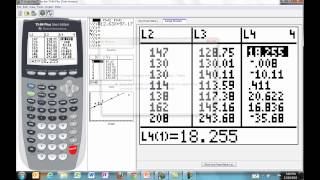
Linear Data Analysis for Math Common Core Standards - Part 3
Explore linear functions for real-world data modeling, focusing on slope and intercept interpretation, linear regression, and residual analysis using interactive tools and practical examples.
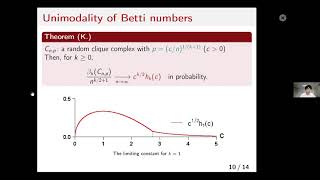
A Limit Theorem for Betti Numbers of Random Simplicial Complexes
Explore asymptotic behavior of Betti numbers in homogeneous and spatially independent random simplicial complexes, extending previous work on Linial-Meshulam complexes using local weak convergence.
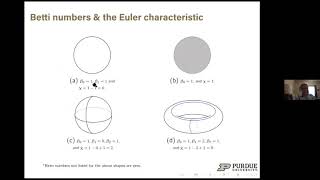
Andrew Thomas - Functional Limit Theorems for Euler Characteristic Processes
Explore functional limit theorems for Euler characteristic processes in Vietoris-Rips complexes, covering strong law of large numbers and central limit theorem in the thermodynamic regime.
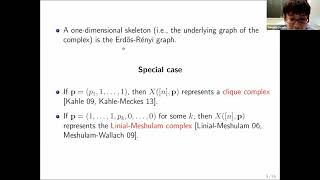
Takashi Owada - Limit Theorems for Topological Invariants of the Dynamic Multi-Parameter Simplicial Complex
Explore topological invariants in dynamic multi-parameter simplicial complexes, covering connectivity, probability, and limiting processes in applied algebraic topology.
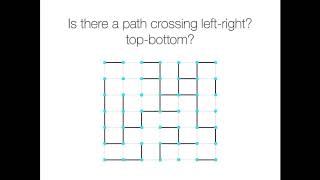
Homological Percolation: The Formation of Giant Cycles
Explore homological percolation, analyzing giant cycles in random structures and their phase transitions. Learn to differentiate signal from noise in persistence diagrams and discover connections to Euler characteristic curves.