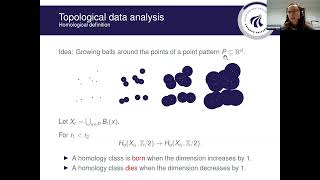
Analyzing Point Processes Using Topological Data Analysis
Explore point processes using topological data analysis, covering models, statistical techniques, and applications in spatial statistics. Learn to distinguish between process types and understand central limit theorems.

Comprehensive Introduction to Probability Theory and Applications
Comprehensive overview of probability concepts, from basic definitions to advanced distributions, with real-world examples and formulas for practical application in data science and statistics.

IPL Data Analysis Using EDA - EDA Case Study - What Is EDA? - Great Learning
Practical guide to IPL data analysis using EDA, covering key concepts, techniques, and real-world applications in Python for extracting insights from cricket statistics.
Statistics for Data Science - Probability and Statistics
Learn essential statistical concepts for data science, including types of analysis and practical implementation using Python, to build a strong foundation for advanced data science applications.
Probability and Its Interpretation - Foundations of Humanities Analytics
Explore probability theory, its historical development, and interpretations in this humanities analytics lecture, focusing on frequency and subjective approaches to understanding uncertainty.
Transformations in FMCG Through Data Science
Explore how data science transforms FMCG industry through market evolution, digital manufacturing optimization, and key roadmap development. Gain insights from real-world scenarios and industry experts.
Finding Environmental Measures Sensitive to Halo Properties Using Neural Networks
Exploring neural networks to identify environmental measures that reveal halo properties in galaxy formation studies, enhancing our understanding of cosmic structure evolution.
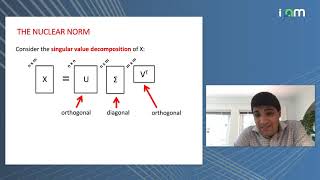
Tensor Decompositions and Their Applications
Explore advanced tensor decomposition techniques and their applications in latent variable models, phylogenetics, mixture models, and orbit retrieval with MIT's Ankur Moitra.
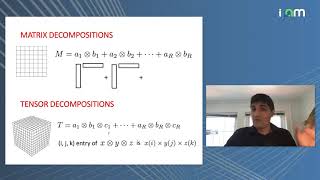
Tensor Decompositions and Their Applications
Explore tensor decompositions and their applications in latent variable models, focusing on Jennrich's algorithm and its use in various fields like phylogenetics and mixture models.
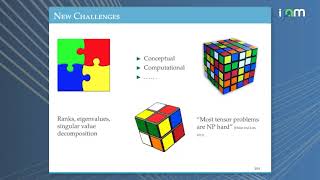
Low Rank Tensor Methods in High Dimensional Data Analysis
Explore low rank tensor methods for analyzing high-dimensional data in various fields. Learn about recent progress, challenges, and applications in extracting information from multilinear arrays.
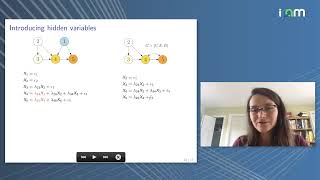
Hidden Variables in Linear Non-Gaussian Causal Models
Explore hidden variables in linear non-Gaussian causal models, using high-order cumulant information to uncover causal structures in data science applications with multiple observed variables.

Robust, Interpretable Statistical Models - Sparse Regression with the LASSO
Explore sparse regression and LASSO algorithm for building interpretable, robust models with minimal variables. Learn key concepts and applications in data science and machine learning.

Workshop on Parameter Estimation with Bilby by Greg Ashton
Learn parameter estimation techniques for gravitational wave analysis using bilby software, focusing on Bayesian inference and practical applications in astrophysics.
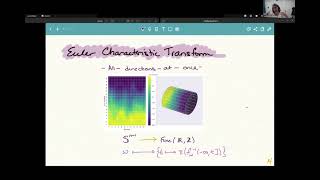
The Directional Transform
Explore the directional transform in topological data analysis, its applications in understanding complex structures, and its potential for enhancing machine learning models and data shape quantification.
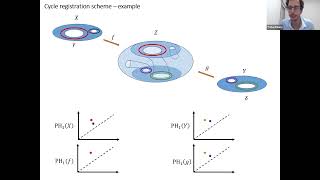
Persistent Cycle Registration and Topological Bootstrap
Novel approach for comparing persistent homology representations, utilizing spatial placement of persistent cycles. Demonstrates application in topological inference to differentiate signal from noise in point cloud data.
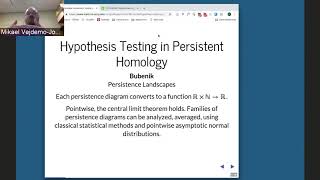
Multiple Hypothesis Testing with Persistent Homology
Exploring methods for multiple hypothesis testing in persistent homology, including family-wise error rates and false discovery rates, with applications to Mapper complex validation.
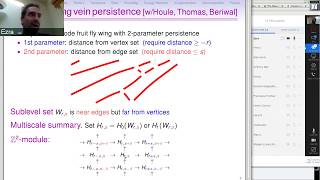
Real Multiparameter Persistent Homology
Explores real multiparameter persistent homology, addressing challenges and practical applications in data science. Introduces topological tameness and its implications for algebraic concepts and computational methods.
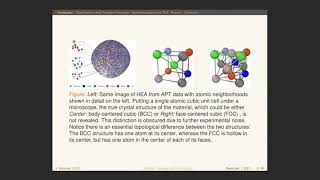
Statistics, Topology and Data Analysis
Explore the synergy between statistics and topological data analysis for solving real-world problems, with a focus on supervised learning and applications in materials science.
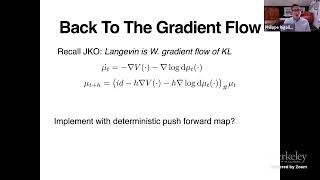
Geometric Aspects of Sampling and Optimization
Explore geometric perspectives on sampling and optimization techniques, uncovering insights for data science applications and algorithm design.
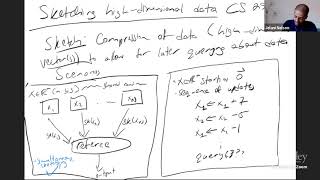
Sketching High-Dimensional Data
Explore techniques for efficiently summarizing and analyzing large datasets in high-dimensional spaces, focusing on probability, geometry, and computational methods.

The 17 Best Traps in the London System
Discover 17 powerful traps in the London System to gain a strategic advantage. Learn clever tactics and surprising moves to outmaneuver your opponents and improve your chess game.