Statistical Inference I
Explore statistical inference fundamentals, including models, estimation, minimax risk, and Bayesian approaches, with UC Berkeley's Will Fithian.
Sketching for Linear Algebra - Basics of Dimensionality Reduction and CountSketch I
Explore dimensionality reduction and CountSketch techniques for efficient linear algebra computations, focusing on regression analysis and subspace embeddings.

Foundations of Data Science II
Explore advanced data science concepts including SVD, Gaussian mixtures, and Markov chains. Learn about randomized algorithms and low-rank approximations for efficient data handling.
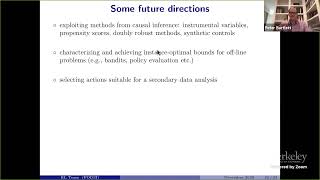
Reinforcement Learning
Explore reinforcement learning's foundations, applications, and advanced concepts, including Q-learning, exploration-exploitation trade-offs, and instance-optimality in policy evaluation.

Time Series Forecasting - ARIMA Models and Regression Analysis
Learn to predict future values using ARIMA, covering AutoReg, data handling, and model creation. Gain practical skills in time series forecasting with real-world examples and comprehensive explanations.

Getting Started with Technical Analysis 2 - Bollinger Bands and Advanced Indicators
Learn advanced technical analysis techniques including Bollinger Bands, moving averages, support/resistance lines, and candlestick patterns using Python and data science libraries for stock market analysis.
Technical Analysis: MACD and Stochastic Oscillator Using Python
Learn to use Python for stock market technical analysis, focusing on MACD and Stochastic Oscillator. Covers data retrieval, chart creation, and multiple technical indicators using various data science libraries.

Technical Analysis with Python for Stock Market Predictions
Learn Python-based technical analysis for stock market predictions, covering data retrieval, chart patterns, moving averages, and advanced visualization techniques using data science libraries.

Python for Data Science - Mastering NumPy, Pandas, and Plotly
Comprehensive tutorial on using NumPy, Pandas, and Plotly for data science in Python. Covers core concepts and practical applications with hands-on examples and free resources.

Best Stocks to Buy Now - Python for Finance - Part 6
Learn to automate stock market predictions using Python, focusing on regression analysis to identify high-momentum stocks and forecast potential returns across the entire market.

Stock Market Prediction Using Regression Analysis - Python for Finance
Learn stock market prediction using Python, covering regression analysis, forecasting, and ARIMA models to guide investment decisions based on past performance.
Linear Regressions with StatsModels - Data Science Tutorial
Learn to create linear regressions using StatsModels, exploring datasets and examples with NumPy, Pandas, Matplotlib, and Seaborn. Analyze professor ratings and tipping strategies through practical applications.
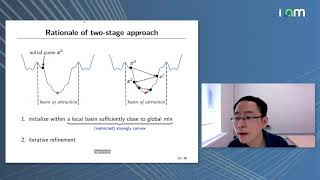
The Effectiveness of Nonconvex Tensor Completion - Fast Convergence and Uncertainty Quantification
Explores nonconvex optimization for tensor completion, proposing a two-stage algorithm with guaranteed success, linear convergence, and statistical accuracy. Discusses distribution characterization and confidence interval construction.
Simulated Greeks for American Options
Explore simulated Greeks for American options, covering hedging strategies, state variables, and regression techniques. Compare with European options for comprehensive understanding.
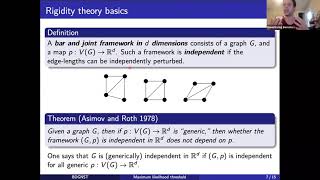
Rigidity Theory for Gaussian Graphical Models - The Maximum Likelihood Threshold of a Graph
Explore rigidity theory's application to Gaussian graphical models, focusing on maximum likelihood thresholds and their implications for data analysis in genomics and other fields.
Nonlinear Data Analysis for Teachers - Professional Development
Explore nonlinear data analysis techniques for real-world applications, including residual assessment, inverse function linearization, and implementation of CCSS Mathematical Practices with web resources.
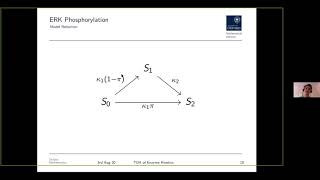
Geometric and Topological Data Analysis of Enzyme Kinetics
Explore geometric and topological data analysis techniques applied to enzyme kinetics, focusing on ERK molecular dynamics and its implications for cancer and developmental defects.
Ronen Eldan- Revealing the Simplicity of High-Dimensional Objects via Pathwise Analysis
Explore high-dimensional geometry through pathwise analysis, revealing simple structures in complex spaces and their applications in probability theory and statistical physics.
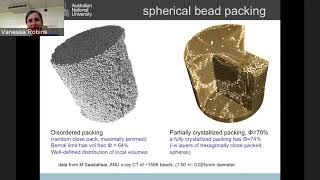
Vanessa Robins - Persistence Diagrams of Bead Packings
Exploring grain-scale mechanisms in granular crystallization using X-ray tomography and persistent homology, revealing key formation processes of tetrahedral and octahedral pores in spherical bead packings.
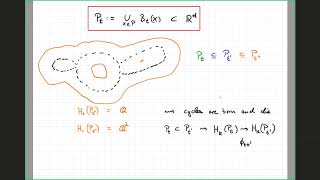
Limit Theorems in Topological Data Analysis
Explore limit theorems in topological data analysis, focusing on barcodes, persistence modules, and random persistence modules. Learn about convergence proofs and expectations for uniform distributions on compact submanifolds.
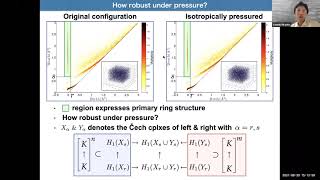
On Characterizing Rare Events in Persistent Homology
Explore rare events in persistent homology, focusing on indecomposables in multi-parameter settings. Learn about large deviation principles and laws of large numbers in topological data analysis.