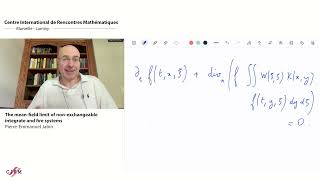
The Mean-Field Limit of Non-Exchangeable Integrate and Fire Systems
Explore mean-field limits in non-exchangeable integrate and fire systems with Pierre-Emmanuel Jabin. Delve into advanced mathematical concepts and their applications in this specialized conference talk.
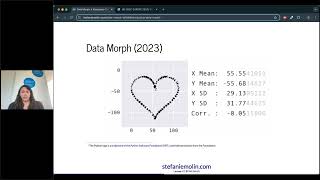
Data Morph: A Cautionary Tale of Summary Statistics
Explore Data Morph, an open-source tool challenging summary statistics assumptions. Learn to uncover hidden truths in datasets through innovative visualization techniques and reshape your approach to data analysis.

Critical Phenomena Through the Lens of the Ising Model
Explore critical phenomena through the Ising model with Hugo Duminil-Copin's lecture at IMPA's 70th anniversary conference, featuring insights from a renowned mathematician.

Spontaneous Stochasticity
Explore spontaneous stochasticity in mathematics with Alexei Mailybaev's lecture at IMPA's 70th anniversary conference, featuring cutting-edge research and international collaboration.

The Largest Common Subtree of Uniform Attachment Trees
Explore the largest common subtree of uniform attachment trees in this advanced mathematics workshop, featuring expert talks and collaborative sessions on network analysis and discrete probability.

Climbing the Ladder of Causation Toward Mid-Level Vision
Explore mid-level visual concepts and their origins through Counterfactual World Models, examining how unsupervised algorithms can enhance machine and biological vision understanding.
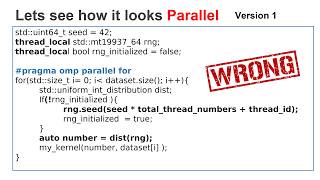
Guide to Random Number Generation in C++ - C++Now 2024
Explore modern alternatives to Mersenne Twister for random number generation in C++. Learn when and why to use newer techniques for improved performance and quality.
The Anomalous Transport of Tracers in Active Baths
Explore anomalous transport of tracers in active baths, focusing on long-time dynamics, ratchet effects, and unique friction properties in low-dimensional systems.
Packets of Diffusing Particles Exhibit Universal Exponential Tails
Explore universal exponential tails in diffusing particle packets, extending large deviation theory for continuous time random walks and uncovering general behaviors in transport phenomena.
Engineered Swift Equilibration: Applications and Optimization - Lecture
Explore Engineered Swift Equilibration (ESE) applications in physics, including particle compression, first passage time optimization, and atomic force microscopy enhancements.
Stochastic Resetting: Overview and Recent Developments
Explore stochastic resetting in dynamical processes, its impact on system behavior, and applications in chemical reactions and search processes.
Entropy Growth During Free Expansion of an Ideal Gas
Explore entropy growth in free expansion of ideal gas, examining macrostates, irreversibility, and factors influencing entropy increase in non-equilibrium systems.
Uniqueness and Non-Uniqueness for Percolation on Groups
Explore percolation theory on groups, examining uniqueness and non-uniqueness of infinite clusters and their connections to group-theoretic concepts.

Ergodic Results for the Stochastic Nonlinear Schrödinger Equation with Large Damping
Explore ergodic results for stochastic nonlinear Schrödinger equations with large damping, focusing on uniqueness of invariant measures in Rd (d≤3).
Brownian Motion at Interfaces - Experimental and Theoretical Studies
Explore Brownian motion near interfaces using experimental, theoretical, and numerical methods. Analyze microparticle trajectories, probability densities, and non-Gaussian behavior to infer nanoscale properties.
BiCEP and TROUT: Objective Methods for Reanalysis of MagIC Measurement Data
Explore objective methods for reanalyzing MagIC paleomagnetic data using BiCEP and TROUT, improving interpretation of legacy data and enhancing understanding of Earth's magnetic field history.
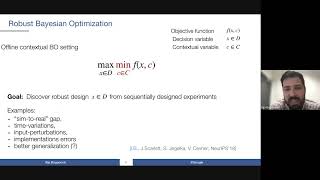
Robust Design Discovery and Exploration in Bayesian Optimization
Explore data-driven methods for robust design discovery and optimization, focusing on Bayesian techniques that efficiently handle uncertainties and adversarial scenarios in various scientific domains.
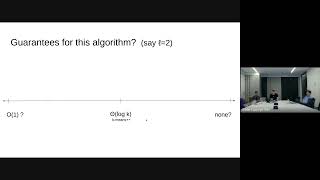
A Nearly Tight Analysis of Greedy k-means++
Explore the greedy k-means++ algorithm's performance, analyzing its approximation guarantees and comparing it to the original k-means++ method for solving the k-means problem.
High-Dimensional Prediction for Sequential Decision Making
Explore efficient algorithms for online high-dimensional predictions, enabling no-regret guarantees, fairness, and uncertainty quantification in multiclass settings for improved decision-making.
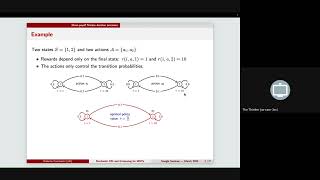
Fixed-point Error Bounds for Mean-payoff Markov Decision Processes
Explore optimal transport techniques for deriving finite-time error bounds in reinforcement learning, focusing on mean-payoff Markov decision processes and stochastic fixed point iterations.

Robust Distortion-free Watermarks for Language Models
Explore robust watermarking techniques for language models, focusing on edit-resistant methods that preserve text distribution. Learn about key-based protocols and their applications.