10 Data Science Uberhacks to Turbocharge Your Workflow
Discover 10 powerful data science techniques to dramatically boost productivity and efficiency in your workflow.
Geo Experimentation at ASOS - Measuring Advertising Effectiveness for Data-Driven Marketing
Explore geo-experimentation for measuring digital marketing impact. Learn ASOS's framework for evaluating campaign effectiveness across markets and channels using geographical regions as test units.
Top 4 Python Libraries for Data Science
Explore four essential Python libraries for data science: NumPy, Pandas, Matplotlib, and Seaborn. Learn their key benefits and practical applications in fundamental data science concepts.
Better Photos - Leveraging Product Insights to Optimize Machine Learning Models
Explore advanced analytical techniques for optimizing photo selection in dating apps. Learn about statistical considerations, product insights, and impact on engagement and revenue metrics.

Making MMM Work for B2B Marketing
Explore B2B marketing strategies using Marketing Mix Modeling (MMM). Learn from Twilio experts about adapting MMM techniques traditionally used in B2C for B2B applications.

Functional Neuronal Networks
Explore functional data analysis integration in deep neural networks, enhancing interpretability and prediction for scalar responses with functional and scalar covariates.
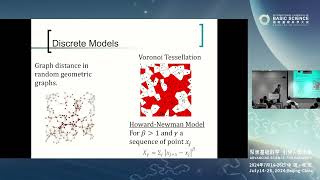
Rotationally Invariant First Passage Percolation: Scaling Relations and Chaos - ICBS 2024
Explore rotationally invariant first passage percolation, scaling relations, and chaos in KPZ universality class through multi-scale analysis and geodesic behavior.
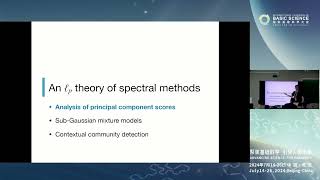
An ℓp Theory of PCA and Spectral Clustering
Explore an advanced $\ell_p$ theory of PCA, improving upon vanilla PCA for heteroscedastic noises and yielding optimal bounds for spectral clustering and community detection.
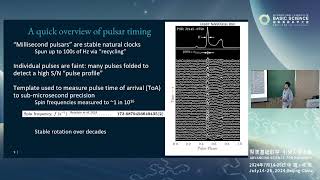
The Parkes Pulsar Timing Array Third Data Release: Overview and Search for an Isotropic Gravitational-wave Background
Explore the Parkes Pulsar Timing Array's latest data release, focusing on gravitational wave detection techniques and results from isotropic stochastic background searches.
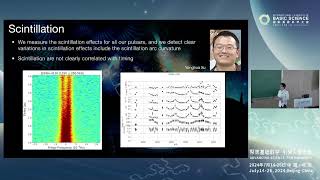
Searching for Gravitational Wave Background with Chinese Pulsar Timing Array Data Release I
Explore gravitational wave detection using Chinese Pulsar Timing Array data. Learn about millisecond pulsar observations, data analysis techniques, and key findings in the search for nanohertz gravitational wave backgrounds.
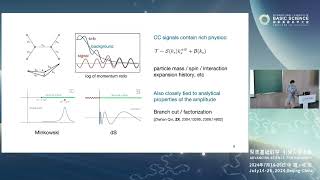
Family Tree Decomposition of Cosmological Correlators
Explore analytical methods for computing cosmological correlators, including family tree decomposition for nested time integrals in dS and FRW universes.

A Geometrical Interpretation of Universally Quantified Inequalities and Its Applications to Mathematics
Explore a geometrical interpretation of universally quantified inequalities and its applications across mathematics, focusing on Shannon entropy and connections to various mathematical branches.
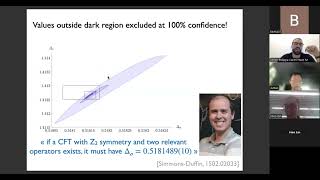
Analyticity in Spin and Causality Constraints in Conformal Bootstrap - ICBS 2024
Explore analyticity in spin and causality constraints in conformal bootstrap, including applications to operator spectrum and AdS/CFT duality.
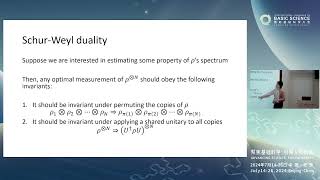
Recent Advances in Learning Quantum Phenomena
Explore recent advances in learning quantum phenomena, focusing on statistical inference and applications in quantum computation verification.
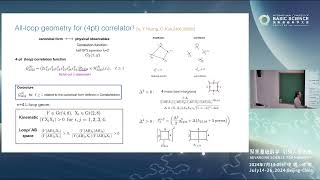
From Combinatorics to Real World Scattering - ICBS 2024
Explore combinatorial geometries in QFT and string theory, focusing on a new formulation for scattering of colored scalars, pions, and gluons.
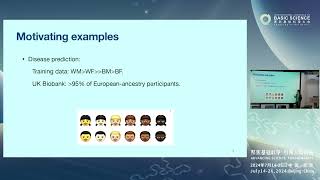
Multi-dimensional Domain Generalization with Low-Rank Structures
Explore novel tensor-based approach for robust domain generalization in linear regression, addressing challenges in underrepresented populations and achieving reliable, interpretable results with theoretical guarantees.
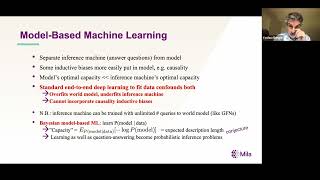
Large Neural Nets for Amortized Probabilistic Inference in Highly Multimodal Distributions
Explore amortized probabilistic inference using large neural networks for complex distributions. Learn about GFlowNets and their potential to improve AI systems with Bayesian and causal understanding.
Machine Learning for Chronic Disease Management - Focus on Precision Oncology
Explore machine learning applications in chronic disease management, focusing on precision oncology, statistical modeling for multiple myeloma, and deep learning for risk stratification.
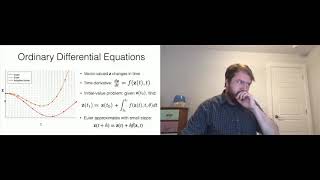
A Cookbook for Deep Continuous-Time Predictive Models
Explore deep continuous-time predictive models for irregularly-sampled time series, from feedforward approaches to latent-variable stochastic differential equations.

A.I. in the Multiverse - Measuring ROI When A/B Tests Are Not Possible
Explore deep learning techniques for assessing AI's revenue impact in e-commerce without A/B testing. Learn to measure and monitor ML pipeline performance in various business settings.

Efficient Multi-Prompt Evaluation Explained
Explore PromptEval, a novel method for estimating LLM performance across multiple prompts, enhancing evaluation accuracy within practical budgets. Gain insights from University of Michigan researcher Felipe Polo.