The CHSH Game - Quantum Computer Programming - Lesson 77
Explore the CHSH Game, a cooperative challenge for separated players using colored coins, in this quantum computing lesson.
Classical Win Probability of CHSH Game - Quantum Computer Programming Lesson 78
Explore the classical win probability limit of 75% in the CHSH Game, a key concept in quantum computing and information theory.
Correlation in Boolean Functions - Quantum Computer Programming - Lesson 32
Explore the concept of correlation between Boolean functions in quantum computing, enhancing your understanding of this fundamental relationship in programming logic.
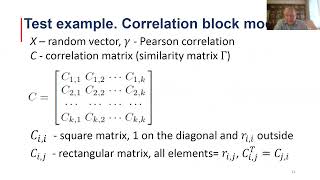
Uncertainty of Clustering in Networked Markets
Explore the complexities of clustering in networked markets, focusing on uncertainty factors and their implications for market analysis and decision-making.
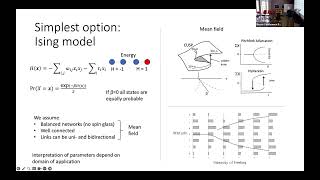
Modeling Psychological Systems with Ternary Spin Models
Explore how ternary spin models enhance psychological research by extending binary network models to include neutral states, offering richer dynamics for analyzing depression, intelligence, and attitude changes.
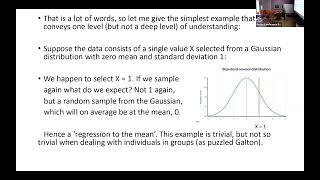
Understanding and Misunderstanding Models - From Linear Regression to Complex Systems
Explore the complexities of scientific modeling, from linear regression to complex systems, examining different levels of understanding and the challenges of explanation in scientific communication.
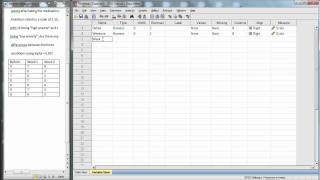
SPSS
Learn essential statistical techniques using SPSS, including ANOVA, regression, t-tests, and descriptive statistics for effective data analysis and interpretation.

What Is Quantum Machine Learning?
Friendly introduction to quantum computing and machine learning, covering qubits, quantum gates, entanglement, and their applications in generative modeling and optimization.

A Friendly Introduction to Deep Learning and Neural Networks
Explore neural networks and deep learning concepts, from gradient descent to activation functions, in this friendly introduction to AI fundamentals.

A Friendly Introduction to Machine Learning
Explore key machine learning algorithms through clear examples, from linear regression to neural networks and clustering techniques, in this beginner-friendly introduction.
Machine Learning in the Real World
Explore real-world challenges in IoT and big data, focusing on data quality, precision, and practical considerations before diving into machine learning algorithms.

Monte Carlo Pi Methods: Technical Editing - Lecture ME3256
Enhance technical writing skills for Monte Carlo pi methods. Learn effective editing techniques to improve clarity and precision in scientific reports.
Homogenization of Markovian Processes and Application to Quantum Continuous Measurement
Explore Markovian processes with time scale separation, deriving effective dynamics on reduced state spaces. Apply to quantum systems with strong continuous measurement.
Nonconvex Stochastic Programs: Chance Constraints
Explore nonconvex stochastic programs and chance constraints with Jong-Shi Pang, delving into advanced mathematical concepts for optimization under uncertainty.
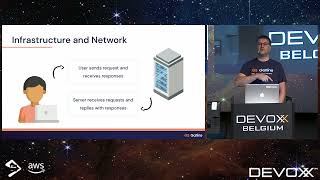
Load Testing Crash Course with Gatling
Learn load testing basics, avoid common pitfalls, and build efficient tests using Gatling and Java. Covers network protocols, application behavior, and stats for robust production-ready applications.

Complex Event Flows in Distributed Systems
Explore event-driven architectures in distributed systems, focusing on event chains, orchestration, and workflow engines to improve system design and reduce coupling.
Machine Learning for Developers
Explore predictive capabilities and voice recognition for developers. Learn to build smart apps using AWS Machine Learning and Amazon Alexa, enabling voice-powered experiences and custom skills.

Adaptive Threat Modelling
Explore dynamic threat modeling to adapt security strategies based on real-time data, enhancing risk assessment and defense mechanisms for evolving cyber landscapes.
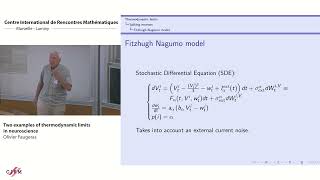
Two Examples of Thermodynamic Limits in Neuroscience
Explore thermodynamic limits in neuroscience through two examples, gaining insights into stochastic analysis and numerical probability in mathematical biology.

Respect Estimates: Recognizing and Eliminating Software Development Cults
Explore common software development pitfalls, including misguided practices in estimation, testing, and architecture. Learn to identify and eliminate ineffective "cults" in your projects.
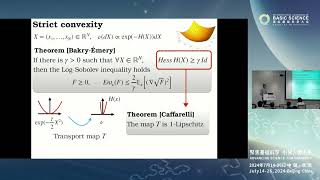
A Renormalisation Group Perspective on Functional Inequalities - ICBS 2024
Explore multiscale analysis for decomposing high-dimensional measures, deriving functional inequalities using renormalization group methods in statistical physics.