
Causality Constraints on Effective Field Theories
Explore causality's role in constraining higher derivative corrections to Einstein Maxwell theory through photon scattering off charged shock waves, examining gravitational effects and IR divergences.
Scientific Feasibility (ScFy)
Explore scientific feasibility with Erica Briscoe, delving into the concept of ScFy and its applications in research and innovation.

Correlation is Not Causation - Finding Patterns in Software Health Data
Explore patterns in Kubernetes/OpenShift alerting data to uncover relationships between software health metrics, applicable to various services and data science tasks.
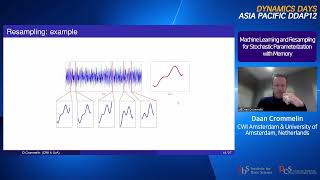
Machine Learning and Resampling for Stochastic Parameterization with Memory
Explore machine learning and resampling techniques for stochastic parameterization with memory in multiscale dynamical systems, focusing on overcoming challenges in long-memory scenarios.
PEtab.jl - Efficient Parameter Estimation for Dynamic Models
Explore efficient parameter estimation for dynamic models in biology using PEtab.jl. Learn to import problems, set up estimations, and choose optimal gradient computation methods.

Neural Probabilistic Logic Programming in Discrete-Continuous Domains - UAI 2023 Oral Session 1
Explore neural-symbolic AI integration with DeepSeaProbLog, combining logic, probability, and neural networks for discrete and continuous domains. Learn about its semantics, inference, and unbiased learning algorithm.
Human-in-the-Loop Mixup: Aligning Synthetic Data with Human Perception - Oral Session 2
Explore human-aligned synthetic data in machine learning, focusing on mixup regularization. Discover how perceptual judgments and uncertainties can enhance model reliability and generalization.
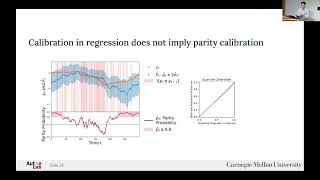
Parity Calibration in Sequential Regression - Forecasting Increase-Decrease Events
Explore parity calibration in sequential regression, focusing on predicting increase-decrease events rather than exact values. Learn its applications in epidemiology, weather forecasting, and nuclear fusion control.
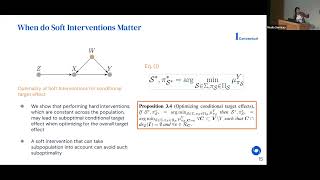
Functional Causal Bayesian Optimization - Lecture 3
Explore functional causal Bayesian optimization for optimizing interventions in causal graphs. Learn about extending CBO methods, modeling with Gaussian processes, and maximizing expected improvement.
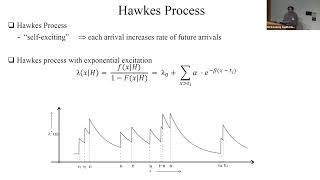
Keep-Alive Caching for the Hawkes Process - UAI 2023 Oral Session 4
Explore optimal caching policies for serverless computing, focusing on Hawkes processes. Learn to balance cache retention costs with miss costs and evaluate performance using simulations and Azure Functions data.
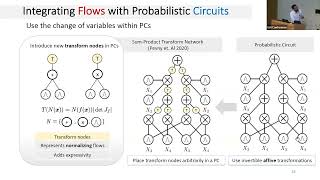
Probabilistic Flow Circuits: Towards Deep Models for Tractable Inference - Oral Session 6
Explore a novel approach combining probabilistic circuits with normalizing flows for enhanced expressivity while maintaining tractable inference in deep probabilistic models.
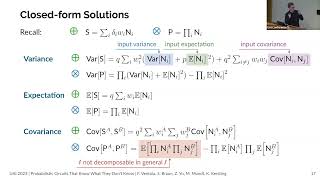
Probabilistic Circuits That Know What They Don't Know - UAI Oral Session 6
Explore probabilistic circuits' robustness to out-of-distribution data and learn about tractable dropout inference for improved uncertainty quantification in a single forward pass.
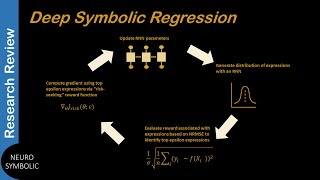
Deep Symbolic Regression - Petersen et al.'s 2021 ICLR Paper
Explore deep symbolic regression through Petersen et al.'s 2021 ICLR paper, covering innovative techniques at the intersection of symbolic methods and deep learning.
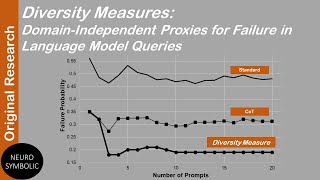
Diversity Measures: Domain-Independent Proxies for Failure in Language Model Queries
Explore domain-independent diversity measures to detect uncertainty in language model outputs, enhancing error detection and improving AI reliability.

ME3255 - Evaluating a NYSE Monte Carlo Model
Evaluate a NYSE Monte Carlo model using advanced statistical techniques. Gain insights into financial modeling and risk assessment for stock market analysis.

Combined Stochastic Models for Cancer Patient Trajectories
Integrating diverse clinical data into a unified stochastic model for cancer patient trajectories, combining tumor growth, metastasis, and survival data using Julia for simulation and Bayesian inference.
NetSurvival.jl - A Glimpse into Relative Survival Analysis
Explore relative survival analysis in cancer studies using NetSurvival.jl, a Julia package offering fast, reliable tools for extracting net survival curves and integrating with StatsModels.jl API.
Cognitive Computational Modeling Made Easy with Julia
Explore cognitive computational modeling using Julia, featuring ActionModels.jl for flexible simulations and HierarchicalGaussianFiltering.jl for advanced learning and perception models.

Covariate Shift - Challenges and Good Practice in Machine Learning
Explore challenges and best practices in covariate shift, a crucial concept in machine learning, with insights on improving model performance and adaptability in changing data distributions.
ServiceLab: Preventing Tiny Performance Regressions at Hyperscale through Pre-Production Testing
Explore Meta's ServiceLab platform for detecting minute performance regressions in large-scale systems, addressing challenges in noisy cloud environments through statistical analysis and machine factor studies.

Config-Snob: Tuning for the Best Configurations of Networking Protocol Stack
Optimizing web server performance through dynamic tuning of networking protocol stack configurations, addressing challenges in configuration space and network dynamics.