
Probabilistic Inference - Session Preview at POPL 2023
Explore probabilistic inference concepts with expert Alexandra Silva in this POPL 2023 session preview, enhancing accessibility of advanced programming language topics.

Bayesian Inference Using Probabilistic Programming
Explore Bayesian inference techniques and probabilistic programming concepts with expert insights from Hong Ge at LAFI'24.
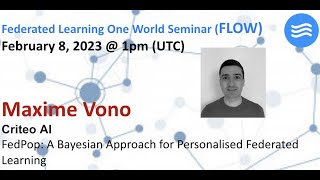
A Bayesian Approach for Personalized Federated Learning - Seminar 93
Discover how Bayesian approaches enhance personalized federated learning through innovative statistical methods and practical applications in distributed machine learning environments.
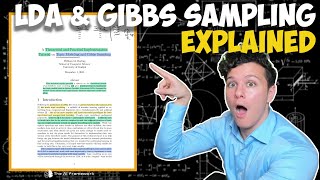
Latent Dirichlet Allocation with Gibbs Sampling Explained
Comprehensive explanation of Latent Dirichlet Allocation (LDA) with Gibbs Sampling, covering topic modeling, posterior inference, and implementation details. Ideal for those interested in understanding this classic machine learning technique.
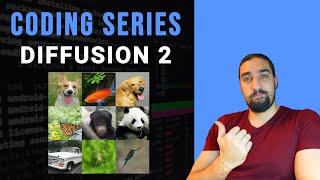
Diffusion Models Beat GANs on Image Synthesis - ML Coding Series - Part 2
Explore diffusion models for image synthesis, focusing on classifier guidance, training, and sampling techniques. Includes code walkthrough and paper analysis.

Machine Learning with Flax - From Zero to Hero
Comprehensive guide to Flax, a JAX-based ML library. Learn basics, custom models, optimization, and practical examples like linear regression and CNN on MNIST. Ideal for ML enthusiasts.
Logistic Regression and Ensemble Learning - Bagging and Boosting - AdaBoost
Explore logistic regression, ensemble learning, bagging, and boosting in this AI/ML course. Learn AdaBoost and decision stumps for strong non-linear classification.
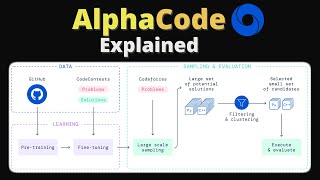
AlphaCode Explained - AI Code Generation
Explore DeepMind's AlphaCode, a powerful AI model for code generation. Learn its workings, competitive programming applications, and key insights from recent research.

The Spelled-Out Intro to Language Modeling - Building Makemore
Comprehensive tutorial on building a bigram character-level language model, covering tensor operations, neural networks, and PyTorch fundamentals for natural language processing tasks.
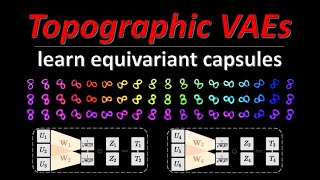
Topographic VAEs Learn Equivariant Capsules - Machine Learning Research Paper Explained
Explore Topographic VAEs: a novel approach to deep generative models with organized latent variables, bridging topographic organization and equivariance in neural networks for improved feature learning and transformation handling.
Reproducible Machine Learning and Experiment Tracking Pipeline with Python and DVC
Learn to build reproducible machine learning pipelines using Python and DVC. Track experiments, manage data versions, and compare model metrics for improved ML workflow efficiency.
Build Your First Model with PyTorch and Python - PyTorch Tutorial for Beginners
Learn to implement a Simple Linear Regression model using PyTorch, covering data exploration, model creation, tensor conversion, training, and prediction analysis in this beginner-friendly tutorial.
Preprocessing Data for Machine Learning - Deep Dive
Comprehensive guide to preprocessing data for logistic regression, covering standardization, encoding, data imbalance, correlation, multicollinearity, and missing data handling techniques.

Build Your First Machine Learning Model in Python
Learn to build a machine learning model in Python using scikit-learn. Covers data loading, splitting, model building with linear regression and random forest, comparison, and visualization.

PyTorch Crash Course - Getting Started with Deep Learning
Comprehensive introduction to PyTorch, covering tensor basics, autograd, linear regression, neural networks, and CNNs. Ideal for beginners in deep learning.
OpenAI Embeddings Explained With Code Examples - How to Use OpenAI GPT-3 ADA Vectorized Embeddings API
Explore OpenAI's ADA vectorized embeddings API for advanced NLP, search, and machine learning applications with practical code examples and visualizations.
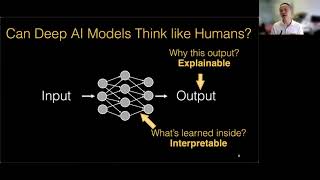
Human-Centric AI for Computer Vision and Machine Autonomy - ICCV'21 Tutorial
Explore human-centric AI in computer vision, covering explainable models, interpretable neural networks, and interactive machine learning for improved AI systems and autonomous machines.
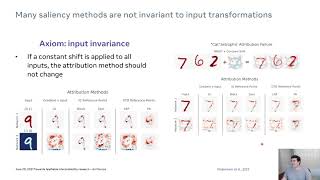
Towards Falsifiable Interpretability Research in Machine Learning - Lecture
Explore techniques for falsifiable interpretability in machine learning, focusing on saliency, individual neurons, and populations. Learn to build stronger hypotheses for more robust research.
Continuous Algorithms - Sampling and Optimization in High Dimension
Explore high-dimensional sampling and optimization techniques, including cutting plane methods, interior-point algorithms, and Riemannian Hamiltonian Monte Carlo, with insights on complexity and open problems.

Regression Trees, Clearly Explained
Clear explanation of regression trees, their applications, and step-by-step construction process. Covers differences from classification trees and use with multiple variables.
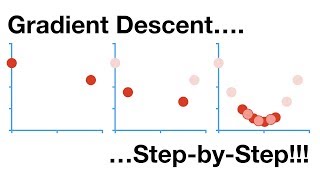
Gradient Descent, Step-by-Step
Comprehensive step-by-step explanation of Gradient Descent, covering its application in Machine Learning, optimization techniques, and variations like Stochastic Gradient Descent.