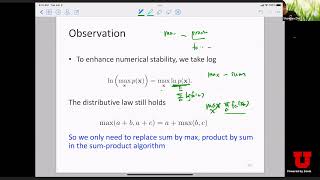
Probabilistic Machine Learning - Lecture 16
Dive into advanced data science concepts through a comprehensive graduate-level lecture covering key theoretical and practical aspects of modern data analysis and machine learning techniques.
Introduction to Probably Approximately Correct (PAC) Learning
Dive into computational complexity and PAC-learning concepts through an in-depth seminar discussion at the prestigious Kolmogorov seminar series on complexity theory.
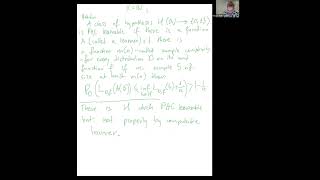
Computable PAC Learning - Part 2
Dive into advanced concepts of computable PAC learning through an in-depth exploration of theoretical frameworks and computational complexity in machine learning theory.
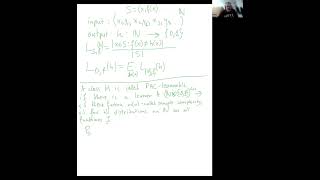
Computable PAC Learning - Part 1
Dive into computational complexity and PAC learning theory through an in-depth exploration of foundational concepts, statistical learning frameworks, and algorithmic approaches.

Vapnik-Chervonenkis Theorem and Statistical Learning Theory
Dive into the fundamental Vapnik-Chervonenkis theorem, exploring how VC-dimension relates to machine learning generalization and error rates in hypothesis spaces.
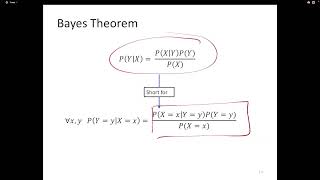
Bayesian Learning and Maximum Likelihood Methods - Lecture 23
Explore probabilistic learning criteria through maximum a posteriori and maximum likelihood approaches, with practical examples of Bayesian learning applications.
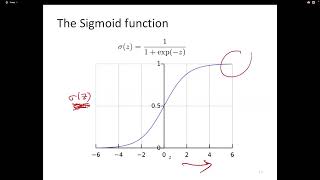
Logistic Regression - Machine Learning Lecture 24
Master logistic regression classification through maximum likelihood and maximum a posteriori criteria, building practical skills for effective machine learning model development.
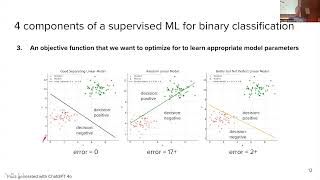
Machine Learning Foundations - Logistic Regression
Master logistic regression fundamentals through hands-on practice, exploring core concepts, implementation techniques, and practical applications in machine learning and data analysis.
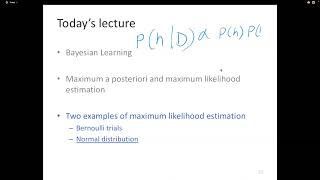
Maximum Likelihood Estimation for Regression in Machine Learning - Lecture 24
Dive into maximum likelihood estimation for regression through practical examples and explore its connection to loss minimization in Bayesian learning frameworks.
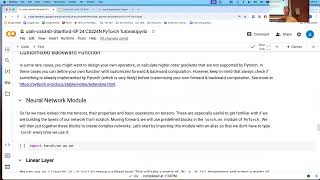
Language Modeling - Fundamentals and Applications
Master the fundamentals of language modeling, exploring statistical and neural approaches, probability distributions, and practical applications in natural language processing.
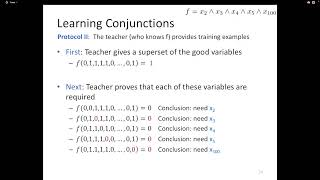
How Good is a Learning Algorithm? Quantifying the Learning Process - Lecture 7B
Explore the quantitative aspects of machine learning by examining how many examples are needed to effectively discover and validate hypotheses.
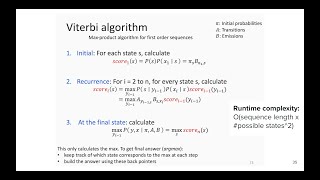
Hidden Markov Models - Parameter Estimation and Efficient Inference
Master parameter estimation and efficient inference techniques for Hidden Markov Models, exploring key algorithms and mathematical foundations for probabilistic sequence modeling and pattern recognition.
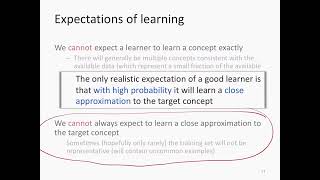
PAC Learning in Machine Learning Theory - Lecture 13
Explore the fundamental concepts of PAC (Probably Approximately Correct) learning theory and its applications in theoretical machine learning frameworks.
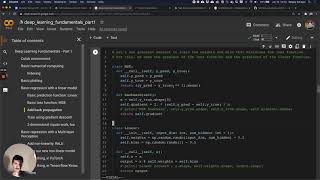
Coding a Neural Network - Full Stack Deep Learning - Spring 2021
Code a neural network from scratch using Google Colab, NumPy, PyTorch, and Keras. Learn linear regression and multi-layer perception models through hands-on implementation and visualization.
Innovations in Theoretical Computer Science 2020 - Session 9
Cutting-edge research in theoretical computer science, covering topics like distribution testing, random object sampling, probability distribution learning, agreement expansion, neural networks, and influence maximization.

Diffusion, Probability, and the Age of Creative AI
Explore diffusion models in AI art generation, their information-theoretic foundation, and improvements in density estimation, interpretability, and sampling speed.
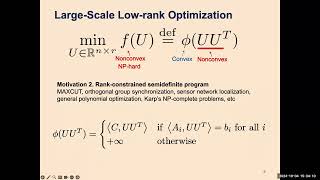
Rank Overparameterization and Global Optimality Certification in Low-Rank Matrix Estimation
Explore rank overparameterization in nonconvex optimization, its impact on spurious local minima, and methods for certifying global optimality in large-scale problems.

Test Time Compute: Verifiers and Parallel Sampling - Part 2
Explore advanced inference techniques using verifiers, parallel sampling, and prompt optimization to enhance language model performance and accuracy.
OpenTelemetry's Path to Observability's Future
Explore OpenTelemetry's role in shaping observability's future. Learn core concepts, instrumentation, data collection, and industry adoption for enhanced system monitoring and troubleshooting.
Chaos Engineering in Action - Building Fault-Tolerant Systems
Explore chaos engineering principles and practices to build resilient systems. Learn to plan, execute, and analyze experiments for improving fault tolerance and system reliability.
Towards Understanding Generalization Properties of Score-Based Losses
Explore score-based losses as alternatives to maximum likelihood in generative models, examining their statistical efficiency and connections to diffusion algorithms for improved model design.