Modern Algebra
Explore fundamental concepts and advanced topics in modern algebra through a comprehensive series of lectures by Prof. Manindra Agrawal, covering key principles and applications.
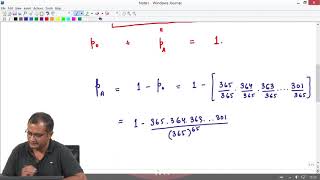
Statistical Mechanics
Comprehensive exploration of probability, statistical ensembles, and quantum mechanics, covering discrete and continuous distributions, entropy, and applications to physical systems.
Discrete Mathematics
Comprehensive exploration of discrete mathematics concepts, covering set theory, relations, group theory, and functions, ideal for exam preparation and university-level study.
Linear Regression Analysis and Forecasting
The accuracy of forecasting depends upon the goodness of obtained model. What are the steps and checks required to obtain a good model and in turn, how to do forecasting is being aimed to be taught in this course.
Sidney Redner on Statistics and Everyday Life
Explore everyday phenomena through statistical analysis, revealing hidden patterns in parking, elevators, and sports. Learn how complex systems research uncovers universal principles in daily life.
Collective Behavior of Honeybees & Fireflies
Explore collective behavior in honeybees and fireflies, revealing how diversity and self-organization lead to emergent intelligence and adaptive swarm dynamics in insect communities.
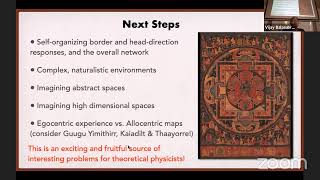
Imagining Space
Explore the neuroscience of spatial perception, from neurons to grid patterns, and discover how the brain constructs our sense of place and navigation.
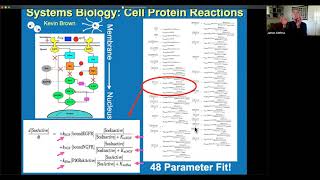
Sloppy Models, Differential Geometry, and Why Science Works
Explore how complex systems can be modeled despite parameter uncertainties, using differential geometry to understand 'sloppiness' and its implications for scientific comprehension and prediction.
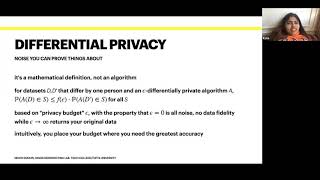
Privacy in Census Data - Math Meets Policy
Explore the impact of differential privacy on Census data, focusing on redistricting implications and the balance between data protection and accuracy in demographic statistics.
A Statistical Physicist Looks at Some Complex Systems
Explore complex systems through statistical physics, examining random walks, lead changes in sports, and data analysis techniques for understanding dynamic processes.
Exponentials, Economics, and Ecology with David Krakauer
Explore exponential changes, nonlinear dynamics, and interconnected systems in ecology and economics. Gain insights on aligning individual and public good in a complex world.
Topology of Networks in Generalized Musical Spaces
Explore generalized musical spaces through network topology, examining pitch classes, scales, and chord progressions. Gain insights into rhythmic spaces, notation, and perception in music theory.
Prediction in Immune Repertoires
Explore how the adaptive immune system predicts future threats by balancing new pathogen encounters with past infection experiences, using a dynamic Bayesian approach.
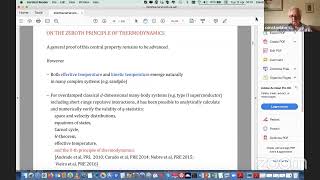
Nonadditive Entropies and Statistical Mechanics at the Edge of Chaos - Cornerstones
Explore nonadditive entropies and statistical mechanics at chaos' edge. Delve into Boltzmann-Gibbs entropy, Q-logarithm, and complex networks, challenging traditional thermodynamic principles.
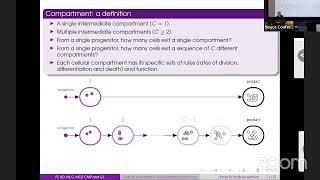
Why Are Cell Populations Maintained via Multiple Intermediate Compartments?
Explore the efficiency of multiple intermediate compartments in maintaining cell populations, minimizing clonality, and optimizing division rounds from progenitors to product cells.

Environment X Everything Interactions - From Evolution to Epidemics and Beyond
Explore environment-actor interactions across various fields, from evolution to epidemics, using mathematical frameworks and simulations to understand complex systems and their impacts.

Rational Ignorance - Optimal Learning from Complex Mechanistic Models
Explore optimal Bayesian learning from complex models, challenging traditional approaches and proposing a new method to maximize expected information while avoiding bias in multiparameter systems.
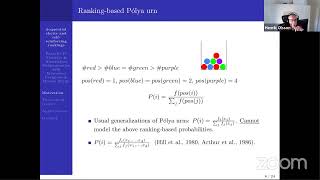
Sequential Choice and Self-Reinforcing Rankings
Explore the mathematical consequences of choice systems where option rankings influence selection probabilities, and popularity determines rankings, leading to potential convergence and unpredictability.
Tyler Marghetis on Breakdowns & Breakthroughs - Critical Transitions in Jazz & Mathematics
Exploring critical transitions in jazz and mathematics, from creative leaps to societal shifts. Examines universal patterns in breakdowns and breakthroughs across various scales, from individual cognition to collective innovation.
What Beer and Running Taught Me About the Scientific Process - Christie Aschwanden at SFI
Christie Aschwanden explores the scientific method through beer and running, revealing insights on statistics, methodology, and reproducibility while emphasizing the importance of skepticism in science journalism.
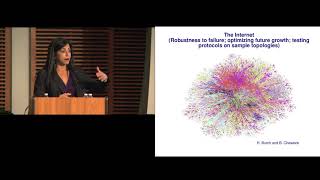
The Science of Networks - C4 Public Lectures
Explore the emerging science of networks, their structure, and function across diverse systems. Learn about phase transitions, interdependence, and mathematical models for predicting network behavior and consequences.