Introduction to Electromagnetism
This course introduces students to handling electromagnetic theory using vector calculus. This enables students to handle problems that are more complicated than they are used to from their school days.
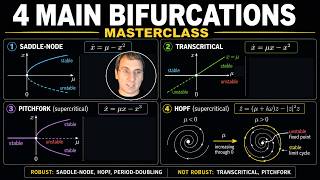
Bifurcation Theory - Saddle-Node, Hopf, Transcritical, Pitchfork
Explore saddle-node, transcritical, pitchfork, and Hopf bifurcations in dynamical systems. Learn how these phenomena affect phase portraits and system behavior as parameters change.

Introductory Calculus - Oxford Mathematics 1st Year Student Lecture
Comprehensive introduction to calculus at Oxford, covering differential equations, integration techniques, and problem-solving methods for first-year mathematics students.

Modeling and Simulation of Dynamic Systems
Learn MATLAB techniques for solving ODEs, analyzing spring-mass-damper systems, and applying Laplace transforms in dynamic system modeling and simulation.

Applications of Differential Equations - Calculus 2
Explore practical applications of differential equations in finance, forensics, biology, and engineering through engaging examples and problem-solving techniques.
Ordinary Differential Equations
Comprehensive introduction to ordinary differential equations, covering key concepts, methods, and applications in physics and engineering.

Taylor Series and Power Series Made Easy - Review of Calculus
Comprehensive review of Taylor and Power Series with visual aids and coding examples in Python and Matlab. Covers definitions, expansions for sine and cosine, and practical implementations.
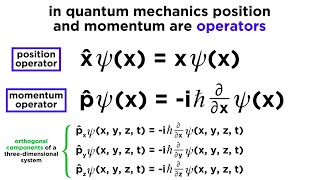
Position and Momentum Operators in Quantum Mechanics
Explore position and momentum operators in quantum mechanics, delving into advanced mathematics and key concepts like the Heisenberg Uncertainty Principle and Wave-Particle Duality.
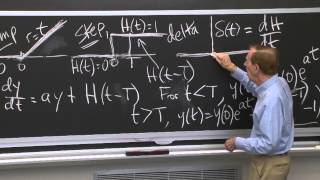
Engineering Mathematics: Linear Algebra and ODEs, Fall 2014
Explore linear algebra and ODEs, covering numerical solutions for equation systems. Learn first and second-order equations with renowned instructor Gilbert Strang.
Simple Harmonic Motion and Introduction to Waves - Lecture 18
Explore harmonic motion and wave behavior through problem-solving and derivations. Learn about oscillations, driving forces, resonance, and different types of waves in this physics lecture.
Engineering Mathematics
Explora matemáticas avanzadas en ingeniería mecánica, desde ODEs y sistemas dinámicos hasta transformadas de Fourier y Laplace, con aplicaciones prácticas en Matlab y análisis de sistemas no lineales.
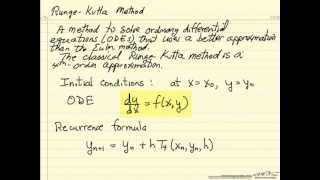
Numerical Analysis
Explore differential equations, numerical integration, and root-finding methods using software tools. Learn practical techniques for solving complex mathematical problems in engineering and science.
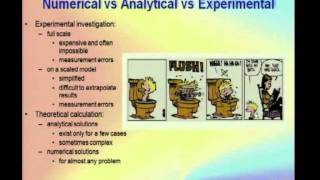
Computational Fluid Dynamics
This course provides an introduction to Computational Fluid Dynamics (CFD) with an emphasis on the fundamental principles that govern the implementation of CFD in practical applications.
Signals and Systems
This course is a study of signals and systems, covering topics: formal definition of 'signal' and 'system', continuous and discrete signals, continuous and discrete-time systems, Linear Time-Invariant (LTI) systems, representation of continuous and discr…
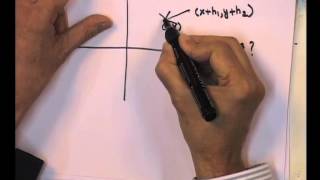
Electromagnetic Theory
Comprehensive exploration of electromagnetic theory, covering fields, potentials, Maxwell's equations, waves, and applications in waveguides and radiation. Ideal for advanced physics students.

Computational Fluid Dynamics
Comprehensive exploration of computational fluid dynamics, covering mathematical foundations, discretization methods, and numerical techniques for solving fluid flow problems.
Transform Calculus and Its Applications in Differential Equations
Comprehensive exploration of integral transforms, focusing on Laplace and Fourier transforms, their properties, and applications in solving differential equations and boundary value problems.

The Dynamics of Computation and the Computational Power of Dynamics
Explore the intersection of computation and dynamics, examining computational models, physical systems, and mathematical concepts to understand the nature of computation and its manifestation in various forms.
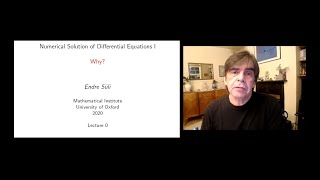
Numerical Solution of Differential Equations - Oxford Mathematics 3rd Year Student Lecture
Explore numerical methods for solving differential equations in scientific applications, focusing on Euler's method and its applications in cosmological simulations.
Mathematical Modelling in Biology - Infectious Disease Modelling - Lecture 3
Explore infectious disease spread using the Kermack McKendrick model, deriving the 'R' number and its significance in epidemiology. Gain insights into mathematical biology applications.
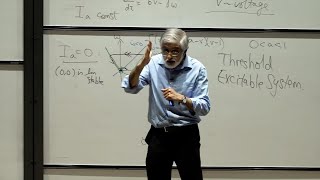
Mathematical Modelling in Biology - Neuronal Signalling
Explore Nobel Prize-winning neuronal signalling models, including Hodgkin-Huxley and Fitzhugh-Nagumo, to understand how neurons generate and propagate electrical signals vital for bodily communication.