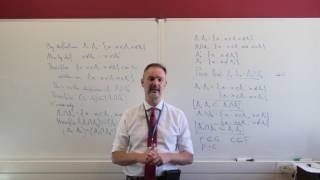
Abstract Algebra
Explore fundamental concepts of abstract algebra, including sets, relations, operations, groups, and advanced topics like homomorphisms, cosets, and group actions.

Abstract Algebra
Comprehensive introduction to abstract algebra, covering symmetries, groups, isomorphisms, and more. Follows Gallian's text with accompanying slide decks for in-depth understanding.

Abstract Algebra
Explore fundamental concepts of abstract algebra, including groups, rings, fields, and vector spaces, with a focus on definitions, examples, and key theorems.
Modern Algebra
Explore fundamental concepts and advanced topics in modern algebra through a comprehensive series of lectures by Prof. Manindra Agrawal, covering key principles and applications.
Discrete Mathematics
Comprehensive exploration of discrete mathematics concepts, covering set theory, relations, group theory, and functions, ideal for exam preparation and university-level study.
Effective Theories for Computational Systems - Lecture 2
Explore effective theories for computational systems, covering aggregation, finite state machines, regular languages, and emergence in complex systems modeling.
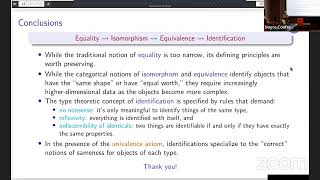
On the Art of Giving the Same Name to Different Things - Higher Dimensional Mathematics
Explore the mathematical concept of sameness, from isomorphism to equivalence, and its evolution in higher-dimensional mathematics. Discover new foundations that align with centuries of mathematical practice.

An Introduction to Smooth Manifolds
The course will start with a brief outline of the prerequisites from topology and multi-variable calculus. After that a large class of examples, including Lie groups, will be presented. The course will culminate with proof of Stokes' theorem on manifolds.
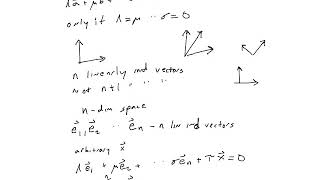
Linear Algebra
Explore fundamental concepts of linear algebra, including vector spaces, linear transformations, and group theory, enhancing mathematical problem-solving skills.
A Polynomial Bogolyubov-Type Result for the Special Linear Group
Explore a mathematical lecture on a polynomial Bogolyubov-type result for the special linear group. Delve into the analogy between subset properties in finite dimensional vector spaces and the special linear group over a finite field. Learn about the ach…
Quantum Computing for Quantum Chemistry
Explore quantum computing's potential in solving complex quantum chemistry problems, focusing on electronic structure and Hamiltonian partitioning techniques.
Closure of Orbits of the Pure Mapping Class Group on the Character Variety
Explore the pure mapping class group's action on character varieties, examining orbit closures and their implications for various mathematical contexts and applications.
Subgroup Tests and the Aldous-Lyons Conjecture
Explore the refutation of the Aldous-Lyons conjecture through novel interactive proof systems and subgroup tests, connecting complexity theory to probability theory and group theory.
Representations of Reductive Groups Over Local and Global Fields
Dive into Langlands' theory of reductive groups and their representations in number theory, exploring local and global fields and their connections to arithmetic and geometry.
Methods for Studying Abelian Actions and Centralizers - Lecture 5: Transitive Centralizer and Fibered Partially Hyperbolic Systems
Explore transitive centralizers and fibered partially hyperbolic systems in dynamical systems. Gain insights into advanced concepts in smooth ergodic theory and their applications to centralizer rigidity.
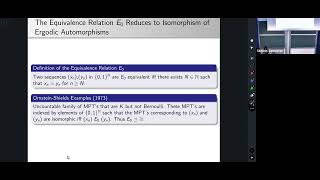
Non-classifiability of K-automorphisms - Lecture on Measure-Preserving Transformations
Delve into K-automorphisms, exploring their mixing properties, classification challenges, and the impossibility of Borel invariant classification. Gain insights into measure-preserving transformations and descriptive set theory.
Methods for Studying Abelian Actions and Centralizers - Lecture 3
Explore two methods for studying abelian actions and centralizers: linearization and non-linearization. Delve into cohomology concepts and their applications in dynamical systems analysis.
Methods for Studying Abelian Actions and Centralizers - Lecture 6
Explore centralizer rigidity and classification in accessible examples of dynamical systems. Gain insights into the non-generic situations where smooth centralizers form larger groups, particularly in algebraic systems.
Algebraic Structure of Area-Preserving Homeomorphism Groups - Lecture 4
Explore the algebraic structure of area-preserving homeomorphism groups, focusing on Fathi's question and the simplicity conjecture for compact surfaces. Delve into link spectral invariants and Lagrangian Floer homology.
On the Algebraic Structure of Groups of Area-Preserving Homeomorphisms - Lecture 2
Explore the algebraic structure of area-preserving homeomorphism groups, focusing on Fathi's question and the simplicity conjecture for compact surfaces. Discover link spectral invariants and their role in solving this problem.
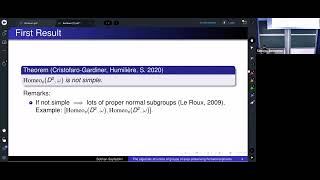
On the Algebraic Structure of Groups of Area-Preserving Homeomorphisms - Lecture 1
Explore the algebraic structure of area-preserving homeomorphism groups, focusing on Fathi's question and the simplicity conjecture for compact surfaces. Gain insights into link spectral invariants and their role in solving this problem.