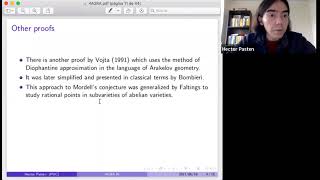
Ecuaciones Diofantinas con Pocas Soluciones - Lecture 4
Explora teoremas y aplicaciones en ecuaciones diofantinas, incluyendo el teorema de Faltings para curvas y ejemplos prácticos, profundizando en la teoría de números.
Introduction to Stacks and Principal G-Bundles in Algebraic Geometry - Talk 1
Dive into algebraic stacks theory and principal G-bundles on algebraic curves, exploring their moduli stack properties and connections to geometric representation theory.
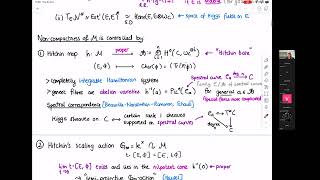
Moduli Spaces of Bundles on Curves with Abelian Motives
Explore the mathematical theory behind abelian motives in bundle moduli spaces, examining motivic formulas and their relationship to cohomological phenomena on curves.
Curves, Functions and Surfaces - Math Terminology - NJ Wildberger
Explore key mathematical concepts including curves, functions, and surfaces. Learn about conic sections, exponential and trigonometric functions, and their applications in calculus and three-dimensional geometry.
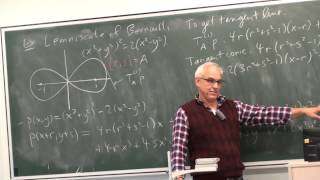
The Differential Calculus for Curves - Differential Geometry
Exploring advanced differential calculus for algebraic curves, including tangent lines, conics, and point classification. Extends to 3D surfaces, offering a comprehensive view of curve analysis.
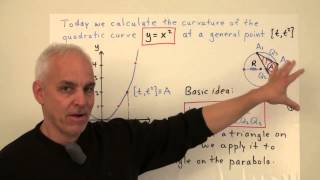
The Curvature of a Parabola, Without Calculus - Rational Geometry Math Foundations
Algebraic approach to calculate parabola curvature without calculus, using circle circumquadrance and triangle properties. Demonstrates wider applicability to various algebraic curves.
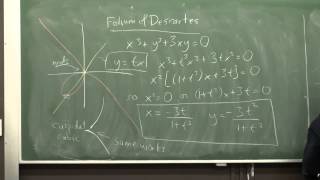
Parametrized Curves and Algebraic Curves - Differential Geometry
Explore parametrization of curves, from ancient Greek conics to 17th-century algebraic curves. Discover fascinating mechanisms generating curves, including four-bar and Watt's linkages.
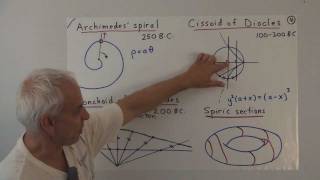
An Introduction to Algebraic Curves - Arithmetic and Geometry Math Foundations
Explore the history and concepts of algebraic curves, from ancient Greek spirals to modern polynomial approaches, setting the stage for generalizing algebraic calculus beyond functions.
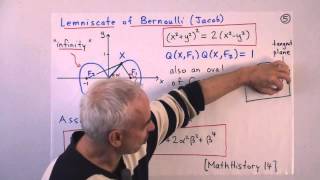
Newton's Method and Algebraic Curves - Real Numbers and Limits Math Foundations
Explore Newton's method for algebraic curves, examining Fermat curves and Bernoulli's Lemniscate. Learn about Taylor expansions, tangent planes, and iterative techniques for approximating curve intersections.
Complex Dynamics and Arithmetic Geometry by Laura DeMarco
Exploring connections between dynamical systems and arithmetic geometry, focusing on periodic points, torsion points, and algebraic curves in genus 2. Insights from polynomial dynamics and Julia sets illustrate key concepts.
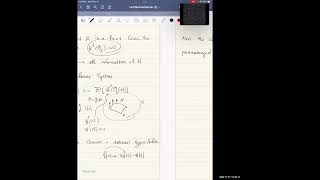
Donaldson-Thomas and Gromov-Witten Invariants - Part 17
Explore moduli spaces of algebraic curves and coherent sheaves, focusing on Gromov-Witten and Donaldson-Thomas invariants in complex algebraic varieties and their relevance to superstring theory.
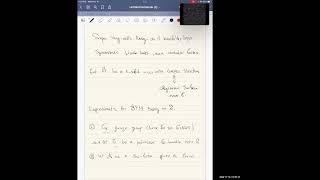
Donaldson-Thomas and Gromov-Witten Invariants - Part 16
Explore moduli spaces of algebraic curves and coherent sheaves, focusing on Gromov-Witten and Donaldson-Thomas invariants in complex algebraic varieties and their relevance to superstring theory.
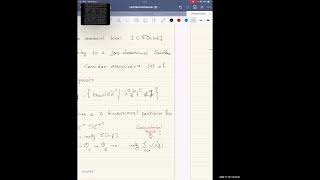
Donaldson-Thomas and Gromov-Witten Theories - Part 14
Explore moduli spaces of algebraic curves and coherent sheaves, focusing on Gromov-Witten and Donaldson-Thomas invariants in complex algebraic varieties and their connections to superstring theory.
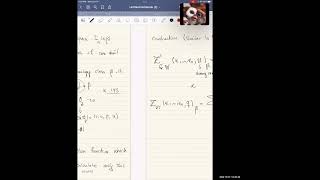
Donaldson-Thomas and Gromov-Witten Theories - Part 13
Explore moduli spaces of algebraic curves and coherent sheaves, focusing on Gromov-Witten and Donaldson-Thomas invariants in complex algebraic varieties and their relevance to superstring theory.
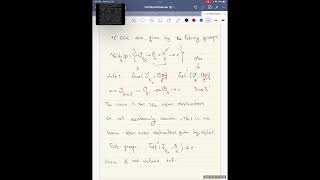
Donaldson-Thomas and Gromov-Witten Theories - Part 12
Explore moduli spaces of algebraic curves and coherent sheaves, focusing on Gromov-Witten and Donaldson-Thomas invariants in complex algebraic varieties and their relevance to superstring theory.
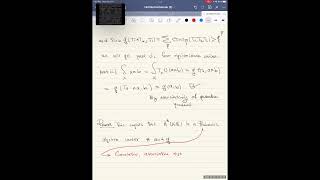
Donaldson-Thomas and Gromov-Witten Theories - Part XI
Explore moduli spaces of algebraic curves and coherent sheaves, focusing on Gromov-Witten and Donaldson-Thomas invariants in complex algebraic varieties and their connections to superstring theory.
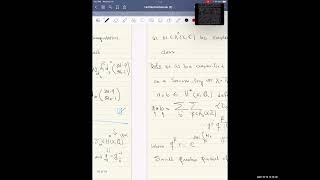
Donaldson-Thomas and Gromov-Witten Theories - Part 10
Explore moduli spaces of algebraic curves and coherent sheaves, their invariants, and connections to geometry, topology, and string theory. Includes computations of Gromov-Witten and Donaldson-Thomas invariants.
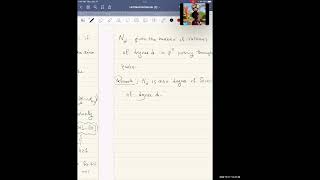
Donaldson-Thomas and Gromov-Witten Theories - Part 9
Explore moduli spaces of algebraic curves and coherent sheaves, their invariants, and connections to geometry, topology, and string theory. Includes computations of Gromov-Witten and Donaldson-Thomas invariants.
Donaldson-Thomas and Gromov-Witten Theories - Part 8
Explore moduli spaces of algebraic curves and coherent sheaves, focusing on Gromov-Witten and Donaldson-Thomas invariants in complex algebraic varieties and their connections to superstring theory.
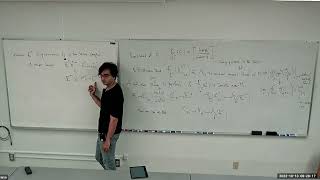
Donaldson-Thomas and Gromov-Witten Theories - Part 7
Explore moduli spaces of algebraic curves and coherent sheaves, focusing on Gromov-Witten and Donaldson-Thomas invariants in complex algebraic varieties and their relevance to superstring theory.
Donaldson-Thomas and Gromov-Witten Theories - Part VI
Explore moduli spaces of algebraic curves and coherent sheaves, focusing on Gromov-Witten and Donaldson-Thomas invariants in complex algebraic varieties and their connections to superstring theory.