Computational Fluid Dynamics
This course looks at all the aspects theoretical, numerical, and application aspects of computational fluid dynamics. Computational fluid dynamics (CFD) has become an essential tool in the analysis and design of thermal and fluid flow systems in a wide r…
Signals and Systems
Comprehensive exploration of signal processing fundamentals, covering continuous and discrete-time systems, Fourier and Laplace transforms, sampling theory, and Z-transforms for practical applications.
Computational Fluid Dynamics
The course deals with the numerical solution of equations governing fluid flow and would be of interest to engineers and scientists. The course deals with the basic techniques that enable the numerical solution of these equations.
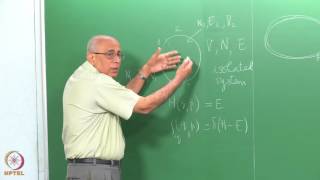
Physics - Nonequilibrium Statistical Mechanics
Explore advanced concepts in nonequilibrium statistical mechanics, including Langevin models, linear response theory, Fokker-Planck equations, and critical phenomena, with practical applications and quizzes.
Topics in Nonlinear Dynamics
Explore nonlinear dynamics through critical points, Hamiltonian systems, bifurcations, limit cycles, discrete-time dynamics, and stochastic processes. Gain insights into complex system behaviors and analysis techniques.
Topics in Nonlinear Dynamics
This is a basic course in classical mechanics at the senior undergraduate/ master's level. It covers the standard topics in this subject, including the Lagrangian and Hamiltonian formalisms. It also places the subject in the broader context of classical…
Basic Linear Algebra
Linear Algebra is a basic course for students intended to go for Engineering studies and higher studies in Mathematics. We will cover the basic tools needed in these branches.
Computational Geometry
Explore fundamental algorithms and data structures for solving geometric problems, including convex hulls, Voronoi diagrams, and range searching, with applications in various fields.
Foundation of Computational Fluid Dynamics
Comprehensive exploration of computational fluid dynamics fundamentals, covering essential concepts and techniques over 8 weeks through structured modules and practical applications.
Transform Calculus and Its Applications in Differential Equations
Comprehensive exploration of integral transforms, focusing on Laplace and Fourier transforms, their properties, and applications in solving differential equations and boundary value problems.
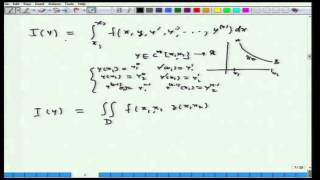
Calculus of Variations and Integral Equations
In this course you will learn, Calculus of Variations, Integral Equations, Concepts of the calculus of variations, Variational problems with the fixed boundaries, Variational problems with moving boundaries, etc.
Integral and Vector Calculus
Comprehensive exploration of integral and vector calculus, covering Riemann integration, improper integrals, multiple integrals, vector functions, and theorems with applications to mechanics and geometry.
Manufacturing Systems Technology
Explore manufacturing systems technology, covering design, material handling, CAD/CAM, process planning, numerical control, and lean production concepts for comprehensive industry knowledge.
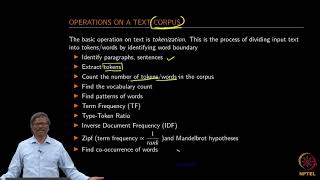
Applied Natural Language Processing
Explore natural language processing techniques, from corpus operations to advanced neural networks, for applications in machine translation, topic modeling, and conversation systems.
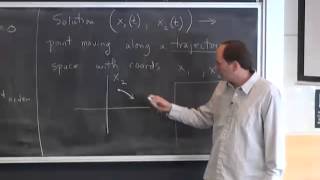
Nonlinear Dynamics and Chaos
Explore nonlinear dynamics and chaos through analytical methods, examples, and applications in physics, biology, and engineering. Develop mathematical theory and gain insights into complex systems behavior.
Basic Algebraic Geometry - Varieties, Morphisms, Local Rings, Function Fields and Nonsingularity
Explore algebraic geometry fundamentals, including varieties, morphisms, local rings, function fields, and nonsingularity. Gain insights into Zariski topology, affine and projective spaces, and geometric calculus.
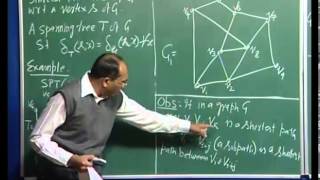
Computer Algorithms - 2
The course discusses efficient algorithms from a large number of domains. This course assumes the knowledge of data structures, the knowledge big-O notation and the concept of time and space complexity of an algorithm.
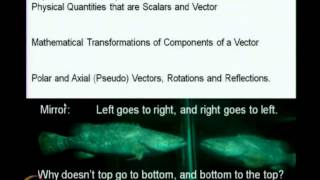
Special - Select Topics in Classical Mechanics
Explore advanced topics in classical mechanics, from equations of motion to chaotic systems. Gain deep insights into oscillators, relativity, fluid dynamics, and electrodynamics.
Special Topics in Classical Mechanics
Comprehensive exploration of advanced classical mechanics topics, including equations of motion, oscillations, relativity, electrodynamics, and chaotic systems.
Probability Methods in Civil Engineering
Comprehensive exploration of probability concepts, distributions, and statistical methods applied to civil engineering problems, enhancing analytical skills for real-world applications.
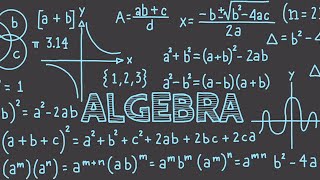
Learn Algebra
Master algebra fundamentals to advanced concepts, including equations, matrices, polynomials, functions, logarithms, and conic sections. Develop problem-solving skills for real-world applications.