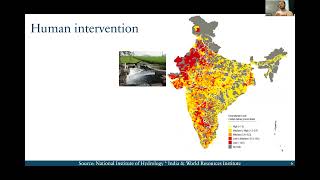
The Sky is Falling - Precipitation Observations and Their Role in Understanding the Earth System
Explore precipitation observations and their impact on Earth system understanding in this seminar for early career atmospheric scientists.
Advanced Time-Integration Methods for Atmospheric Modeling - SIAM MPE Webinar
Explore advanced time-integration methods for atmospheric modeling, focusing on element-based Galerkin methods and horizontally explicit vertically implicit time-integrators for weather and climate prediction.
An Overview of IMDAA Regional Reanalysis
Comprehensive exploration of IMDAA Regional Reanalysis, covering methodology, applications, and significance in atmospheric research and weather forecasting.
Numerical Weather Prediction Methods
Explore numerical weather prediction methods, including data assimilation techniques, uncertainty estimation, and applications in atmospheric and climate modeling.
Satellite Data Assimilation - Techniques and Applications
Explore satellite data assimilation techniques for weather and climate modeling, focusing on theory, methods, and practical applications in atmospheric and oceanic sciences.
Data Assimilation and Dynamical Systems in Earth Sciences - Lecture 2
Explore data assimilation in Earth sciences, focusing on dynamical systems and their applications in weather and climate modeling. Learn theoretical foundations and practical implementations.
Data Assimilation and Dynamical Systems in Earth Sciences
Explore data assimilation in Earth sciences, covering theory, methods, and applications in weather, climate, and environmental monitoring. Gain hands-on experience with various techniques and uncertainty estimation.
Data Assimilation - Basic Theory
Explore fundamental concepts and methods of data assimilation in weather and climate modeling, including uncertainty estimation and applications in atmospheric and oceanic sciences.
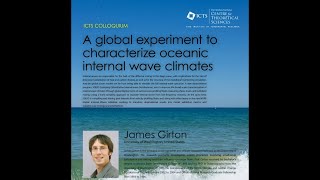
A Global Experiment to Characterize Oceanic Internal Wave Climates
Explore oceanic internal waves' impact on global climate, mixing processes, and circulation patterns through the SQUID program's innovative global observations and data analysis techniques.
Data Assimilation and Dynamical Systems in Earth Sciences - Lecture 3
Explore data assimilation theory and applications in Earth sciences, focusing on dynamical systems. Gain hands-on experience with practical techniques for integrating observations and forecasts in weather and climate models.
Application of Particle Filters on Data Assimilation
Explore particle filters in data assimilation, a powerful technique for integrating observations and forecasts to estimate atmospheric states and uncertainties in weather and climate modeling.
Data Assimilation Experiments for Operational Weather Forecast in NARL
Explore data assimilation techniques for operational weather forecasting, focusing on experiments conducted at NARL. Learn about integrating observations and short-range forecasts to improve atmospheric state estimation.
Modelling Rainfall Extremes and Floods Over Karnataka
Explore modelling techniques for rainfall extremes and floods in Karnataka, focusing on data assimilation methods and their applications in weather and climate prediction.
Bayesian Theory, Cost Function, Minimization, and Incremental Optimization in Data Assimilation
Explore data assimilation in weather and climate models, covering theory, methods, and applications. Gain hands-on experience with various techniques and their use in atmospheric and oceanic studies.
Ocean Data Assimilation - Lecture 2
Explore advanced ocean data assimilation techniques, their applications in climate modeling, and methods for integrating diverse oceanic observations to improve forecasting accuracy and understanding of marine systems.
Ocean Data Assimilation - Applications in Weather and Climate Models
Explore ocean data assimilation techniques, their applications in monitoring and understanding climate variability, and integration with atmospheric and land surface studies.
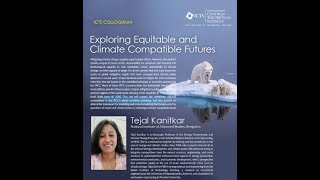
Exploring Equitable and Climate Compatible Futures
Unpack regional assumptions in IPCC climate models and explore alternative frameworks prioritizing equity and justice for achieving climate compatibility globally.

Secrets of the Indian Savanna
Explore the hidden world of Indian savanna grasslands, their unique wildlife, and conservation challenges. Learn about adaptations in human-dominated landscapes and the future of these ecosystems.

There's an Energy Transition Happening in Your Backyard
Explore the challenges and tradeoffs of clean energy development, including environmental impacts and the need for consensus-building among diverse stakeholders in local communities.
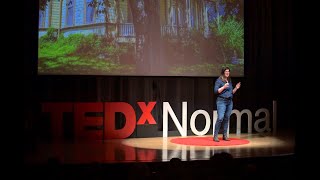
Home for the Climate Crisis
Exploring climate change adaptation at individual and community levels, emphasizing skills needed for a changing world and the importance of local action in global environmental challenges.
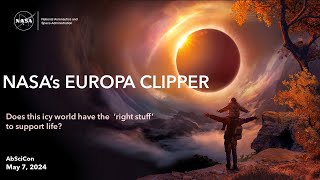
Europa Clipper Mission Preview - NASA's Search for Life on Jupiter's Moon
NASA's Europa Clipper mission: Exploring Jupiter's icy moon to determine its potential for supporting life. Experts discuss the mission's goals, technology, and significance for understanding icy worlds beyond Earth.