Data Assimilation - Basic Theory - Lecture 2
Explore advanced data assimilation theory, methods, and applications in weather and climate modeling. Gain insights into uncertainty estimation and remote sensing observation utilization.
Data Assimilation - Basic Theory - Lecture 1
Explore fundamental concepts and theory of data assimilation in weather and climate modeling, focusing on its applications in atmospheric and oceanic sciences.
The Balance Conundrum in Geophysical Fluid Dynamics
Explore geophysical fluid dynamics, covering eddies, waves, turbulence, and energy transfers in Earth's climate. Gain insights from theory, models, and observations, with tutorials on visualization and machine learning.
Energetically Consistent Climate Modelling - Part 1
Explore energetically consistent climate modeling techniques, focusing on atmospheric and oceanic dynamics, energy transfers, and multi-scale interactions in Earth's climate system.
Exploring Internal Gravity Wave Interactions with Eddies and Waves
Investigación sobre interacciones entre ondas de gravedad internas, remolinos y otras ondas en fluidos geofísicos, examinando su impacto en la dinámica atmosférica y oceánica.
The Geostrophic Eady Problem Revisited - Lecture 1
Revisiting the geostrophic Eady problem: Exploring atmospheric and oceanic dynamics, instabilities, and energy transfers in geophysical fluid systems through theoretical and practical perspectives.
Impact of a Mesoscale Eddy on the M2 Internal Tide in 5km ICON-O
Explore the influence of mesoscale eddies on M2 internal tides using high-resolution ICON-O simulations. Gain insights into complex ocean dynamics and energy transfers in geophysical fluid systems.
On Scaling Theories of Vortex Dynamics in Two-dimensional Turbulence
Explores scaling theories of vortex dynamics in 2D turbulence, examining energy transfers and cascades in geophysical fluid systems. Contributes to understanding multi-scale interactions in atmospheric and oceanic flows.
The Geostrophic Eady Problem Revisited - Lecture 2
Revisiting the geostrophic Eady problem, exploring atmospheric and oceanic dynamics, instabilities, and energy transfers in geophysical fluid systems. Advanced analysis of multi-scale interactions in Earth's climate.
Impact of Tides and Eddies on Ocean Energy Spectra in Submesoscale Resolving Simulations
Explore the influence of tides and eddies on ocean energy spectra at submesoscale resolutions, examining their impact on energy transfers and dynamics in geophysical fluid systems.
Linking Submesoscale Frontal Dynamics to the Large Scale Background Environment
Explore the connection between submesoscale frontal dynamics and large-scale ocean environments. Gain insights into multi-scale interactions in geophysical fluid dynamics and their impact on Earth's climate.
Instabilities in Neural Autoregressive Models of Geophysical Flows
Explores instabilities in neural autoregressive models for geophysical flows, discussing challenges and advancements in predicting complex atmospheric and oceanic dynamics using machine learning techniques.
Primary Productivity Driven by Escalating Arctic Nutrient Fluxes - PEANUTS
Exploring the impact of increasing Arctic nutrient fluxes on primary productivity, with implications for climate change and ecosystem dynamics in the rapidly changing polar region.
Classical 1/3 Nusselt Scaling in Compressible Convection at Extreme Rayleigh Numbers
Explores Nusselt scaling in compressible convection at extreme Rayleigh numbers, examining heat transfer mechanisms and fluid dynamics in extreme conditions relevant to geophysical and astrophysical systems.
Energetically Consistent Ocean Model Parameterisations - Lecture 2
Explores energetically consistent parameterizations for ocean models, focusing on advanced techniques to accurately represent complex oceanic processes and energy transfers across scales.
Busting Climate Change Myths - How Climate Change Actually Works
Debunking common climate change misconceptions, explaining the science behind global warming, and addressing the impact of CO2 on Earth's ecosystems and oceans.

Theropod Dinosaurs of the Nemegt Formation - Upper Cretaceous Mongolia
Explore Late Cretaceous theropod dinosaurs from Mongolia's Nemegt Formation, comparing them with North American counterparts and unraveling the mystery of Deinocheirus.
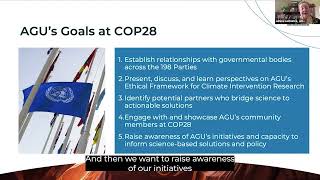
A Scientist's Recap of COP28 and How to Be Part of COP29
Explore COP28 outcomes, scientists' roles in climate conferences, and opportunities for involvement in COP29. Learn from experts about AGU's participation and the impact of science policy on global challenges.

Disaster Relief and Food Justice - Impact on Food Security and Community Resilience
Exploring the impact of disasters on food security, examining policy failures, and discussing innovative strategies to empower communities in rebuilding resilient food systems post-disaster.

Unleashing the Power of Satellites - Understanding Climate Change
Explore how satellite observations and metrological approaches provide crucial data for monitoring climate change and progress towards Net Zero, including the groundbreaking TRUTHS mission.

Why Climate Change May Be Humanity's Greatest Guru
Explore how climate change and inequality can catalyze positive growth, offering holistic solutions through spirituality, education, and business for a sustainable future.