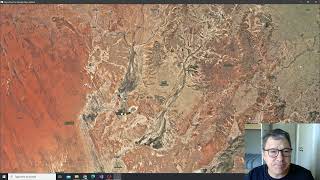
NDVI Analysis Using ProRaster Scientific - Coorabulka Station Case Study - Part 1
Explore vegetation change analysis using ProRaster Scientific, focusing on Coorabulka Station. Learn to build Landsat scene databases, create mosaics, and compute NDVI for comprehensive environmental monitoring.
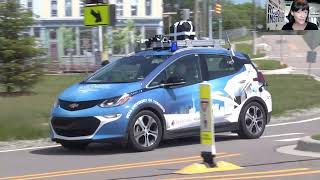
Safe Learning in Robotics
Explore safe learning algorithms for robots in complex environments. Discover data-efficient, online methods guaranteeing safety and adaptability for real-world applications in robotics and AI.
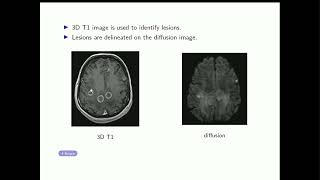
Statistical Methods for Medical Image Processing and Reconstruction
Explore statistical methods for medical image processing and reconstruction, from basic to advanced Bayesian approaches, across various imaging modalities.
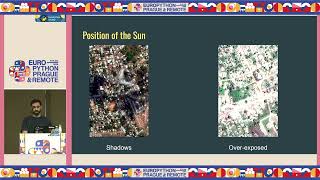
Earth Observation through Large Vision Models
Explore Earth observation using large vision models for infrastructure planning and disaster response. Learn to access satellite datasets, fine-tune models, and apply zero-shot classification and image translation techniques.
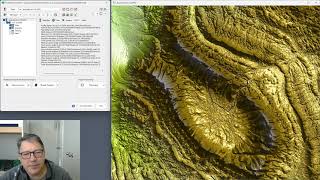
ProRaster Scientific 2.3.0 - New Features and Tools Tutorial
Explore ProRaster Scientific 2.3.0's new features: map tools, profiling, layer management, and image comparison. Master advanced geospatial analysis techniques for enhanced data visualization and interpretation.
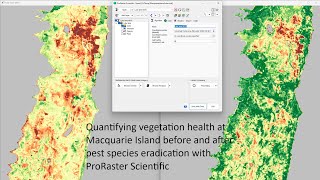
Quantifying Vegetation Health at Macquarie Island Before and After Pest Species Eradication
Analyze vegetation health on Macquarie Island using Landsat imagery and ProRaster Scientific to assess the impact of pest eradication on ecosystem recovery.
Generative Models for Satellite Image Analysis
Explore generative models for analyzing satellite imagery, enhancing understanding of Earth observation data and its applications.
Generative Models for Satellite Image Analysis
Explore generative models for analyzing satellite imagery, enhancing understanding of Earth observation data and its applications.
Wolfram AI in Medical Imaging: Prostate Cancer Detection
Explore AI-powered prostate cancer detection using Wolfram's platform for medical imaging, featuring deep neural networks and MRI diffusion analysis.

RT-2: Vision-Language-Action Models Transfer Web Knowledge to Robotic Control
Explore vision-language-action models for robotic control, enhancing generalization and semantic reasoning through Internet-scale data integration and end-to-end training.

A General-Purpose Robotic Navigation Model
Explore advancements in general-purpose robotic navigation models, including data sharing across robots, generalization capabilities, and applications like kilometer-scale navigation and open-vocabulary instruction following.

From Words to Actions - Foundation Models for Generalist Robot Brains
Explore the potential of Foundation models in robotics, discussing lessons from scaling robot data collection and strategies to leverage these models for practical applications.

Foundation Reward Models for General Robot Skill Acquisition
Explore foundation reward models for general robot skill acquisition, leveraging non-robot data to enhance adaptability in unstructured environments.
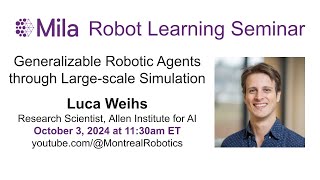
Generalizable Robotic Agents Through Large-Scale Simulation
Explore how large-scale simulation training produces proficient robotic agents capable of real-world navigation and manipulation using only RGB sensors, guided by language instructions.
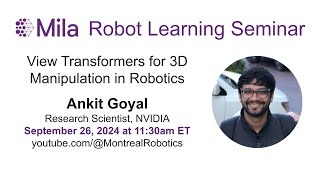
View Transformers for 3D Manipulation in Robotics
Explore state-of-the-art View Transformers for 3D object manipulation in robotics, including RVT and RVT-2, offering improved task success, faster training, and real-world applicability.
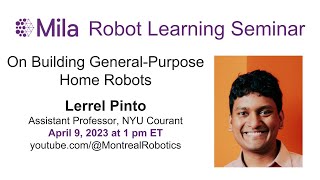
Building General-Purpose Home Robots
Explore advancements in general-purpose home robots, including vision-language models, rapid skill learning, and multi-fingered dexterity. Discover challenges and solutions for creating adaptable, cost-effective domestic assistants.
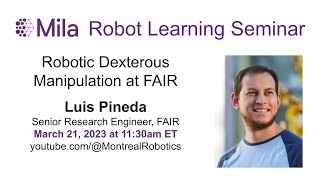
Robotic Dexterous Manipulation - Advances in Learning and Teleoperation
Explore advancements in robotic manipulation, combining classical and learned methods. Discover projects on extrinsic contact learning, visuo-tactile SLAM, and in-hand object rotation using vision and touch.
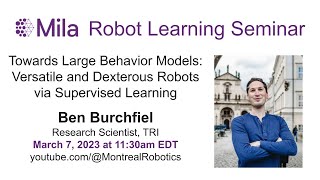
Towards Large Behavior Models: Versatile and Dexterous Robots via Supervised Learning
Explore advancements in machine learning for robotics, focusing on creating versatile and dexterous robots through supervised learning and the development of Large Behavior Models.
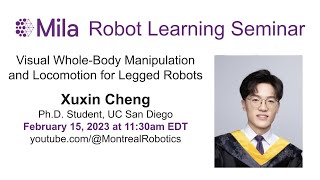
Visual Whole-Body Manipulation and Locomotion for Legged Robots
Explore visual feedback integration for precise legged robot coordination in challenging terrains and manipulation tasks, focusing on dynamic, scalable skills for real-world applications.
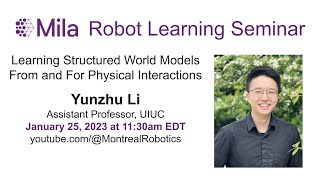
Learning Structured World Models From and For Physical Interactions
Explore structured world models for physical interactions in robotics. Learn novel representations and structural priors for effective model-based planning and complex manipulation tasks.
RoboCat - A Self-Improving Generalist for Robotic Manipulation
Explore RoboCat, a multi-embodiment, multi-task generalist agent for robotic manipulation. Learn about its ability to generalize across tasks and robots, and its potential for autonomous improvement.