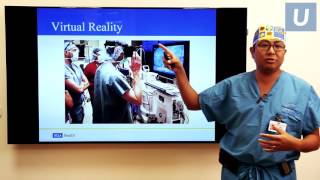
Minimally Invasive Surgery for Superior Semicircular Canal Dehiscence - Isaac Yang, MD - UCLAMDChat
Neurosurgeon explains minimally invasive keyhole craniotomy for Superior Semicircular Canal Dehiscence, showcasing surgical techniques, modern technology, and patient-specific approaches.
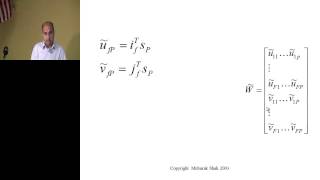
Structure from Motion - Lecture 15
Learn about Shape from X, 3D recovery and applications, Kinect technology, Moving Light Display, and Structure for Motion in computer vision. Explore key concepts and results in this comprehensive lecture.
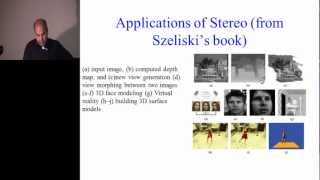
Stereo Vision and Depth Perception in Computer Vision - Lecture 16
Explore stereo vision techniques, including shape reconstruction, rectification, correspondence, and correlation methods for depth perception in computer vision applications.
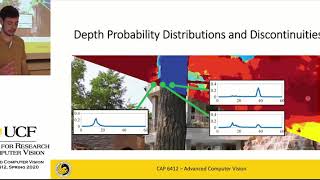
Extreme View Synthesis: Novel Techniques and Challenges
Explore advanced techniques for synthesizing novel views from limited input images, covering multiplane images, patch matching, and depth probability estimation.
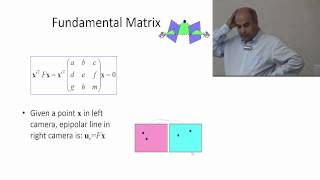
Fundamental Matrix and Stereo Vision - Lecture 13
Explore fundamental matrices, stereo photosynthesis, and random sampling consensus in image processing and computer vision applications.
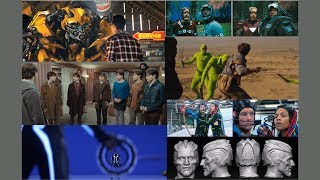
Computer Vision for Visual Effects Lectures Spring 2014
The lectures accompany the textbook Computer Vision for Visual Effects, published by Cambridge University Press in Fall 2012.
A tudomány utat nyit a változás és a megújulás felé
Erdélyi Zsuzsanna bemutatja, hogyan vezethet a tudományos kutatás innovációhoz és társadalmi fejlődéshez, kiemelve saját munkáját a csontpótlás és orvosi képalkotás területén.
Chirurgio - Quo Vadis? The Future of Surgery
Postęp w chirurgii: od wideochirurgii po roboty i symulacje 3D. Nowe technologie poprawiają jakość leczenia i bezpieczeństwo pacjentów, otwierając nowe możliwości w medycynie zabiegowej.
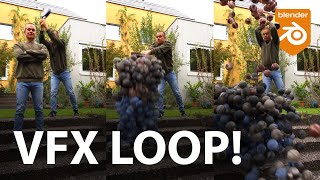
Create Looping VFX Animation with Blender
Learn to create seamless looping VFX animations in Blender. Master techniques for footage preparation, 3D reconstruction, particle systems, shading, and compositing to produce professional-quality visual effects.
Applying Structure-from-Motion Photogrammetry to High-Resolution Terrain Modeling of Barva Volcano's Southeastern Parasitic Cones
Explore high-resolution terrain modeling of Barva Volcano using Structure-from-Motion photogrammetry in this Master's Capstone Defense presentation.
Machine Learning for Determining Protein Structure and Dynamics from Cryo-EM Images
Explore machine learning techniques for analyzing cryo-EM images to determine protein structure and dynamics, focusing on the cryoDRGN algorithm and its applications in structural biology.
High Throughput, High Performance Algorithms for High Resolution Subtomogram Averaging
Explore high-performance algorithms for subtomogram averaging in cryo-electron microscopy, focusing on tools like TomoBEAR and SUSAN to enhance throughput and resolution in structural biology.
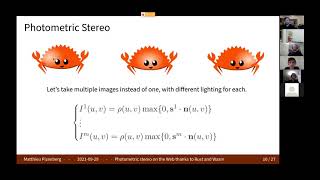
Photometric Stereo on the Web with Rust and WebAssembly
Explore 3D reconstruction techniques, focusing on Photometric Stereo applied to the Bayeux Tapestry, with implementation in Rust and WebAssembly for web-based applications.
Rendering Techniques in Virtual Reality - IEEE VR 2022
Explore cutting-edge rendering techniques for VR, including view synthesis, face reconstruction, mixed reality, foveated rendering, and dynamic projection mapping.
3D Reconstruction, Digital Twinning, and Simulation for Virtual Experiences - ReDigiTS Workshop
Explore cutting-edge methodologies for 3D reconstruction, digital twinning, and simulation in immersive experiences. Learn about state-of-the-art research advancing next-generation virtual reality applications.
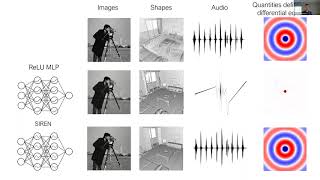
Implicit Neural Scene Representations
Explore implicit neural representations for complex signals, enabling 3D reconstruction from single images and fast inference through gradient-based meta-learning, with applications in scene understanding and semantic segmentation.
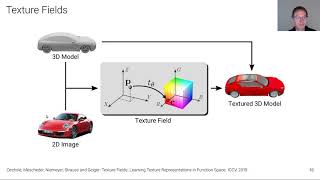
Learning 3D Reconstruction in Function Space
Explore neural implicit 3D representations for geometry and texture reconstruction, discussing their advantages, limitations, and applications in computer vision and graphics.
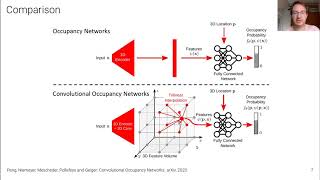
Implicit Neural Representations: From Objects to 3D Scenes
Explore advanced 3D reconstruction techniques using neural representations, from single objects to large-scale scenes. Learn about convolutional occupancy networks, object appearance modeling, and material estimation.
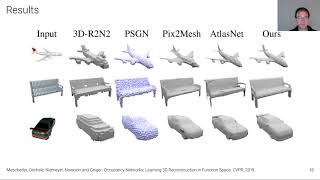
Learning 3D Reconstruction in Function Space - Long Version
Explore neural implicit 3D representations for geometry, texture, and motion reconstruction. Learn innovative techniques for modeling complex 3D shapes using continuous function spaces and 2D supervision.
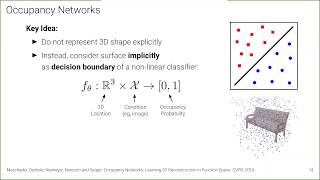
Learning 3D Reconstruction in Function Space
Explore neural implicit models for 3D reconstruction, covering occupancy networks, texture fields, and differentiable rendering. Gain insights into cutting-edge techniques and recent advancements in the field.
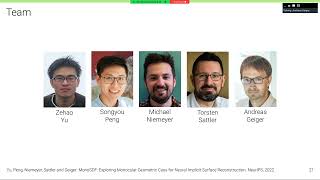
Constraining 3D Fields for Reconstruction and View Synthesis
Explore advanced techniques in 3D field reconstruction and view synthesis, covering RegNeRF, MonoSDF, and TensoRF for improved neural rendering and geometric representation in computer vision.