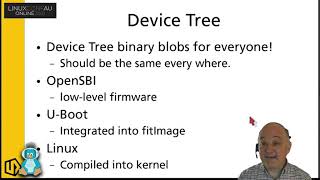
HiFive Unmatched Software and Hardware
Explore RISC-V computing with SiFive's new Linux desktop: hardware specs, software stack, and live demos showcasing free software running on this innovative platform.
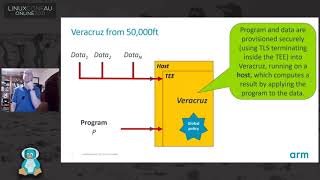
Veracruz - Privacy-Preserving Multiparty Computation Using Trusted Hardware
Explore privacy-preserving computation using secure enclaves, enabling secret data processing on untrusted hosts. Learn about Veracruz's implementation, security measures, and potential applications in multiparty scenarios.
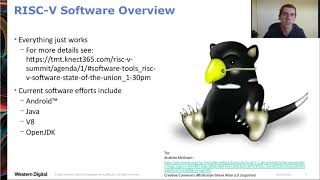
Open ISAs - RISC-V, OpenPOWER, etc
Explore the growth and potential of open CPU architectures like RISC-V and OpenPOWER, discussing recent developments, available hardware, and their importance for the future of open source computing.

Bringing WebM Alpha Support to GStreamer
Explore WebM Alpha support in GStreamer, including retro alpha specification, software and hardware-accelerated decoders, and implementation architecture for transparent video transitions.

Persistent Memory plus RDMA, New Age Remote Device
Explore Persistent Memory and RDMA for remote data access, addressing challenges and solutions for high-speed, non-volatile storage in distributed systems.

Can We Double HTTP Client Throughput?
Discover undici, a new HTTP client for Node.js that doubles application throughput by avoiding head-of-line blocking through keep-alive and pipelining techniques.

Hardware Aided Computing
Explore hardware-aided computing techniques to enhance software performance and efficiency in modern systems.
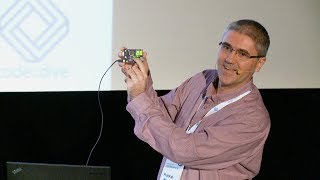
FPGA for Software Developers
Explore FPGA programming for software developers, covering boolean logic, architecture, instruction sets, and practical implementation using open-source tools and hardware connections.
CPU-Friendly Code
Explore CPU architecture, cache locality, branch prediction, and OS concepts to optimize code performance and efficiency beyond Big-O notation.
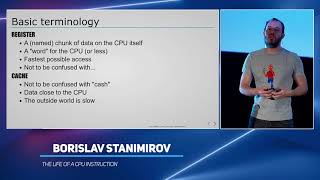
The Life of a CPU Instruction
Explore the journey of a CPU instruction through modern processor architecture, covering out-of-order execution, caching, and branch prediction in this informative talk.
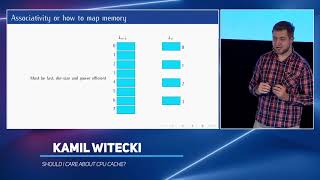
Should I Care About CPU Cache?
Explore CPU cache basics, its impact on performance, and optimization techniques. Learn to measure and improve cache usage for efficient programming.
What Does It Mean to Trust Your Boot Process
Explore boot processes, secure boot, and trust establishment in x86 and ARM architectures. Learn about firmware, TPM, and measured boot to enhance device security from startup.
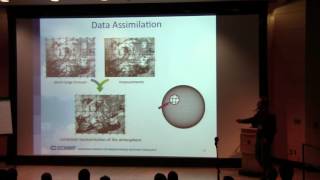
Numerical Weather Prediction - Facing the Future with C++
Explore numerical weather prediction's future with C++, addressing challenges in data processing, scalability, and power efficiency for complex atmospheric modeling and forecasting.
Your CPU Is Binary
Explore the potential evolution of CPUs from binary to ternary logic, discussing historical context, current limitations, and future implications for software development and programming languages.
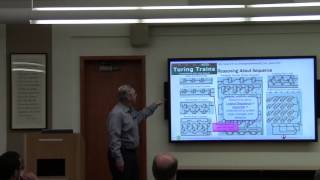
The CPU Cache - Instruction Re-Ordering Made Obvious
Explore CPU cache anatomy, its role in hardware/software design, and how instruction reordering impacts performance. Gain insights into modern system implementation and parallelism considerations.
C++ Performance in Practice - Align, Vectorise, Cache, Jump!
Explore hardware-driven C++ performance optimization techniques including memory alignment, SIMD, cache-friendliness, and branch prediction with code examples and benchmarks.
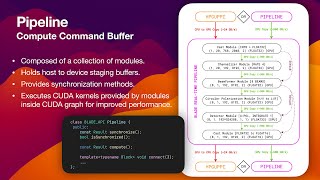
BLADE - The Allen Telescope Array CUDA-Accelerated Real-Time DSP Library
Explore GPU-accelerated real-time DSP for radio astronomy, focusing on BLADE software's innovative techniques for processing massive data streams from the Allen Telescope Array.
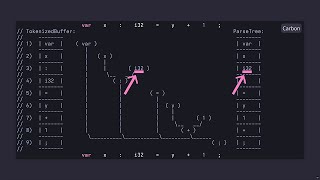
Modernizing Compiler Design for Carbon Toolchain
Explore modern compiler design for Carbon, focusing on data-oriented approaches and innovative techniques to achieve unprecedented compile times for C++-like languages.

Implementing Fast Calendar Algorithms - Speeding Date
Optimizing calendar algorithms for modern CPUs: strength reduction, data dependency breaking, and historical insights. Faster implementations for leap year checks and last day of month calculations.
Under the Hood - Assembly, System Calls, and Hardware in C++
Explore assembly, system calls, and hardware in C++. Dive deep into low-level computer operations, covering x86-64/Linux, Arm, and other systems. Gain insights into the underlying mechanics of C++ programming.
Scalene - A High-Performance, High-Precision CPU+GPU+Memory Profiler for Python
Discover Scalene: a revolutionary Python profiler offering unparalleled speed and precision for CPU, GPU, and memory analysis, with unique features like GPU profiling and memory leak detection.