Supporting TEE on x86 Client Platforms with pKVM
Explore x86 pKVM implementation for isolated TEE VMs, covering design, requirements, and integration with host OS. Learn about architecture, performance, and future developments.
AMD x86 Memory Encryption Technologies - Secure Memory Encryption and Virtualization
Explore AMD's x86 memory encryption technologies: Secure Memory Encryption for physical access protection and Secure Encrypted Virtualization for isolated encrypted virtual machines. Learn about architecture, security benefits, and Linux implementation.
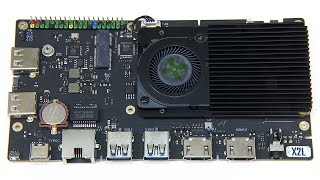
Radxa X2L - Low-Cost x86 SBC with RP2040 Review and Demo
Comprehensive review of Radxa X2L, an x86 single board computer with RP2040 microcontroller. Covers unboxing, specs, performance tests, and unique features like onboard Raspberry Pi Pico functionality.

Screenly's Journey: From Raspberry Pi to x86, BIOS, Coreboot, and RISC-V
Explore Screenly's evolution from Raspberry Pi to x86, BIOS, Coreboot, and RISC-V, uncovering challenges and innovations in digital signage technology.
x86/8086 Assembly Tutorial - The Stack - Lesson 4
Explore the fundamental concept of the stack in x86/8086 assembly, covering its importance, usage for temporary data storage, and practical applications in programming.
Learn 8086 Assembly Programming - Lesson 1: Introduction for Beginners
Learn 8086 assembly programming from scratch, covering basics like binary, compiling, and register operations. Ideal for beginners interested in creating games and programs using free software.
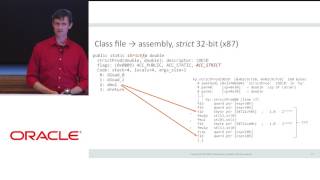
Forward to the Past: The Case for Uniformly Strict Floating Point Arithmetic on the JVM
Explore the evolution of Java's floating-point semantics and the case for returning to strict arithmetic, addressing historical challenges and future benefits for the JVM.
A Handy Guide for Migrating to ARM and Graviton Architecture
Discover the essential strategies and technical considerations for migrating to ARM64 architecture, with practical insights from a successful AWS Graviton implementation and industry-wide architectural shifts.
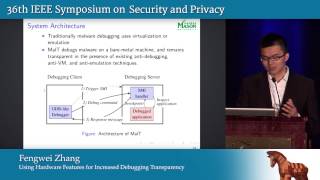
Using Hardware Features for Increased Debugging Transparency
Explore hardware-based debugging techniques for enhanced malware analysis transparency, leveraging System Management Mode to overcome limitations of virtualization and emulation methods.
CPU Flags Register - Understanding Processor Status Indicators
Explore the intricacies of CPU flags registers, their functionality, and significance in computer architecture. Gain insights into how these registers impact processor operations and performance.
Zero-Overhead Virtualization - Challenges and Pitfalls Across Architectures
Explore zero-overhead virtualization challenges in embedded systems, comparing ARM, x86, and RISC-V architectures. Learn about Jailhouse hypervisor and architectural limitations for real-time performance.
Standardizing CPUID Data for the Open-Source x86 Ecosystem
Proposal to standardize CPUID information for x86 architecture, addressing challenges in feature identification and data redundancy across open-source projects. Aims to improve accuracy and efficiency in CPU feature detection.
Exploring an Architecture-neutral KVM MMU
Dive into the architecture-neutral KVM MMU, exploring its scalability improvements, performance tuning, and potential application to ARM VMs for enhanced cloud computing capabilities.
PREEMPT_RT - How Not to Break It
Explore PREEMPT_RT patch set challenges, future development considerations, and addressing limitations to maintain low latencies in real-time Linux systems.
Integral Atomic Stack Switching for IST Exceptions
Explore advanced techniques for handling IST exceptions through integral atomic stack switching in Linux kernel development.

PreVice - Static Detection of Hooking Capabilities in Machine Code
Explore static analysis techniques for detecting hooking capabilities in Windows executables, including Detours, import, and syscall hooking, with insights from scanning millions of files.
Exec ASLR - Abusing Intel Branch Predictors to Bypass ASLR
Explore a new Spectre v2 technique to bypass ASLR on Intel CPUs by abusing branch predictors, with demos on x86 internals, side-channel attacks, and speculative execution.
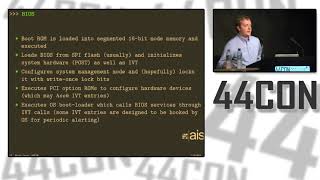
Bootstrapping an Architectural Research Platform
Explore x86 architecture for security research: privileges, events, hypervisors, and emerging tech. Gain foundational knowledge to streamline your research setup and focus on key questions.
Inter VM Data Exfiltration - The Art of Cache Timing Covert Channel on x86 Multi-Core
Explore cache timing covert channels in x86 multi-core systems, learning techniques for inter-VM data exfiltration and reverse shell establishment using shared resources and architecture imperfections.
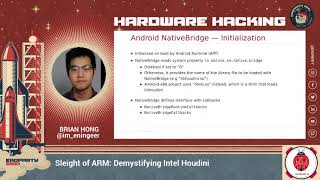
Sleight of ARM- Demystifying Intel Houdini - Brian Hong - Ekoparty 2021- Hardware Hacking Space
Explore Intel's Houdini binary translator for running ARM on x86, its inner workings, security weaknesses, and potential exploits. Gain insights into cross-architecture execution and its implications for Android security.
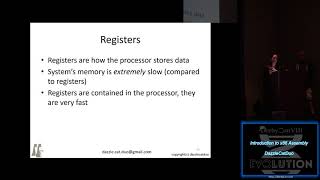
Introduction to x86 Assembly
Learn x86 assembly basics, including registers, memory access, instructions, and system calls. Gain practical skills through examples and a Makefile for assembly programming.