
Digital Circuits and Systems
Comprehensive exploration of digital circuits, from basic logic to advanced systems. Covers combinational and sequential circuits, arithmetic operations, state machines, and programmable logic devices.
Digital Electronic Circuits
Digital systems represent and manipulate digital signals. Such signals represent only finite number of discreet values. A signal can be discreet by nature whereas, a continuous signal can be discretized for digital processing and then converted back.

Digital Circuits
Comprehensive exploration of digital circuits, covering number systems, Boolean algebra, logic gates, arithmetic circuits, sequential circuits, finite state machines, data converters, memory, FPGA, VHDL, and microprocessors.
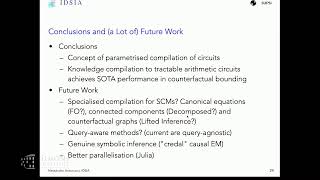
Tractable Bounding of Counterfactual Queries by Knowledge Compilation
Explores bounding partially identifiable queries in causal models using knowledge compilation, offering computational advantages for inference in Bayesian networks with shared structures.
Tensor Decomposition Algorithms via Algebraic Complexity
Explorez les algorithmes de décomposition tensorielle et leur lien avec les circuits arithmétiques, en examinant les cas moyens et les pires scénarios pour les tenseurs de faible rang.
Applications of Algebraic Complexity to Unsupervised Learning
Delve into advanced algebraic complexity theory and its applications in unsupervised learning algorithms, exploring computational hardness of multivariate polynomials and efficient learning techniques.
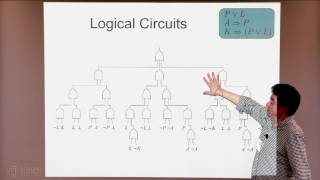
Tractable Learning in Structured Probability Spaces
Explore tractable learning in structured probability spaces, focusing on logical circuits, probabilistic inference, and learning algorithms for complex datasets with constraints.
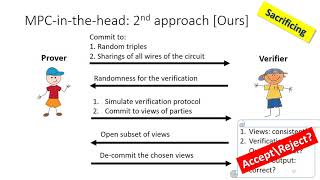
Concretely-Efficient Zero-Knowledge Arguments for Arithmetic Circuits and Their Application
Explore efficient zero-knowledge arguments for arithmetic circuits, their applications, and novel approaches to MPC-in-the-head protocols, with a focus on improving performance and reducing communication costs.
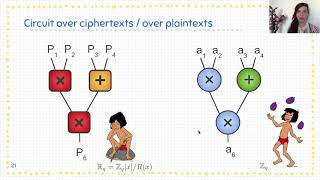
Boosting Verifiable Computation on Encrypted Data
Explore verifiable computation on encrypted data, covering homomorphic encryption, SNARKs, and polynomial commitments for secure and private delegation of computation.
Homomorphic Encryption in the SPDZ Protocol for MPC
Explore homomorphic encryption in SPDZ protocol for secure multi-party computation, covering threshold encryption, distributed decryption, and zero-knowledge proofs for improved security and efficiency.
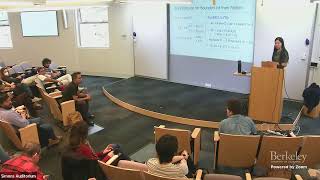
New Ways to Garble Arithmetic Circuits
Explores innovative techniques for garbling arithmetic circuits, improving efficiency, modularity, and functionality. Presents constant-rate schemes for large integers and modular computation, with enhanced capabilities for mixed arithmetic-Boolean opera…
ITC Conference - Line Point Zero Knowledge and Its Applications
Explore line-point zero knowledge proofs, their efficiency in arithmetic circuit satisfiability, and applications in non-interactive secure computation and vector oblivious linear evaluation.
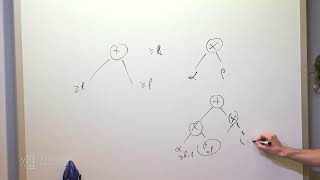
Lower Bounds for Tractable Arithmetic Circuits
Explores techniques for proving size lower bounds on tractable arithmetic circuits, focusing on structural restrictions and their impact on circuit complexity in probabilistic reasoning.
Automated Detection of Under-Constrained Circuits in Zero-Knowledge Proofs
Discover a novel technique for detecting vulnerabilities in zero-knowledge proof circuits, combining SMT solving with uniqueness inference to enhance security in blockchain applications.
Wolverine - Fast, Scalable, and Communication-Efficient Zero-Knowledge Proofs for Boolean and Arithmetic Circuits
Explore fast, scalable zero-knowledge proofs for Boolean and arithmetic circuits, covering applications, existing systems, tradeoffs, and innovative protocols like SVLE and Cotton Bucketing.
On the Untapped Potential of Encoding Predicates by Arithmetic Circuits and Their Applications
Explores innovative encoding techniques for predicates using arithmetic circuits, discussing their potential applications and implications for cryptographic systems.
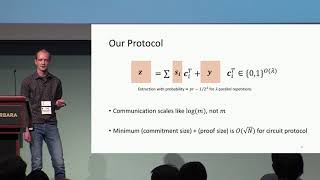
Sub Linear Lattice Based Zero Knowledge Arguments for Arithmetic Circuits
Explore cutting-edge cryptographic techniques for zero-knowledge proofs in arithmetic circuits, focusing on sub-linear lattice-based approaches presented at Crypto 2018.
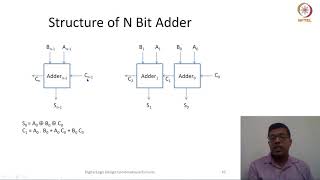
Ripple Carry Adder: Design, Delay, and Area Analysis
Learn about ripple carry adders, including their design, delay analysis, and area considerations in digital circuit implementation.
Fast Adder: Carry Select Adder
Explore the carry select adder, a fast addition technique, and understand its principles and implementation in digital circuit design.

Zero Knowledge Proofs and ZK Programming in Blockchain Application Development
Explore zero knowledge proofs and implement a zkRollup system in Circom. Learn SNARK technology, Circom programming, and integrate with Hyperledger Besu or Fabric for blockchain applications.

Probabilistic Circuits
Explore probabilistic circuits with Antonio Vergari, covering foundational concepts and advanced applications in AI and machine learning.