
Where Does the Real World End - The Blurring of the Physical and Digital
Exploring the convergence of physical and digital realms through IoT, sensors, and computing advancements, examining implications for business, society, and emerging applications.
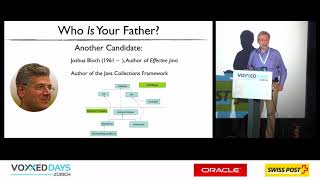
Not Your Father's Complexity - Performance in a New Machine Age
Explore memory layout's impact on Java program performance, challenging traditional complexity analysis and showcasing alternative collection implementations for optimized code execution.
Java Performance Puzzlers 2018 - New Performance Puzzles
Explore surprising Java performance issues, comparing new and old language features to understand JVM complexity. Gain insights into optimizing code and improving efficiency.
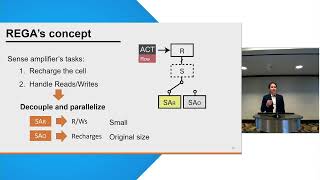
REGA - Scalable Rowhammer Mitigation with Refresh-Generating Activations
Explore a scalable solution for Rowhammer attacks in DRAM, focusing on Refresh-Generating Activations to enhance memory security and system reliability.
Massive Acceleration through the Many-core Processor
Explore the potential of graphics cards for massive hardware acceleration, from historical developments to future prospects, with insights on production code and best practices.

x86 Internals for Fun and Profit
Explore x86 processor internals to optimize code efficiency. Gain insights into modern CPU architecture for better performance and understanding of low-level programming concepts.

Microservice Message Routing on Kubernetes
Explore advanced message routing in microservices on Kubernetes, covering command-query segregation, domain-driven design, and distributed event buses for efficient, scalable architectures.

Imagining the Future - The Transformation of Humanity
Explore humanity's future transformation into a "Meta-Intelligence" through brain-to-cloud connectivity, examining driving forces and steps towards this evolutionary leap in cognition and collaboration.
Supercomputing Spotlights - Supercomputing Software for Moore and Beyond
Explore supercomputing software evolution, data locality challenges, and innovative solutions for post-Moore era. Learn about multicore architectures, heterogeneous computing, and emerging trends in high-performance computing.
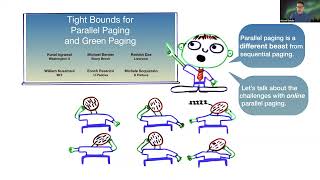
Online Parallel Paging and Green Paging
Explore optimal algorithms for parallel paging, addressing cache sharing among processors. Discover connections to green paging and learn about O(log p)-competitive algorithms for both problems.
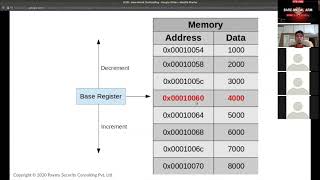
Writing Bare-Metal ARM Shellcode
Learn to write ARM shellcode for IoT devices, covering ARM architecture, system calls, and techniques for creating compact, reliable payloads. Includes hands-on labs and a demo of exploiting an ARM-based IoT device.
God Mode Unlocked - Hardware Backdoors in x86 CPUs
Unveiling a critical hardware backdoor in x86 CPUs allowing unprivileged users to bypass security checks and escalate to kernel-level access. Explores detection, prevention, and broader implications for processor security.
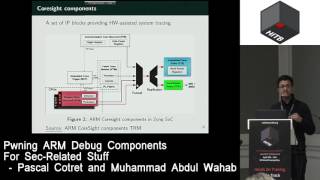
Pwning ARM Debug Components
Exploring ARM debug components for security primitives and information flow tracking. Demonstrates a portable approach to enhance runtime security monitoring in ARM-based systems.
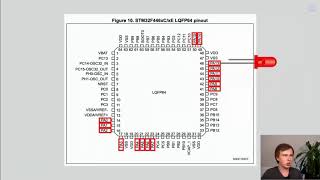
Firmware Hacking With Ghidra
Hands-on firmware hacking workshop using Ghidra for reverse engineering ARM Cortex-M architecture, followed by live demonstration of hardware glitching attacks on microcontrollers.
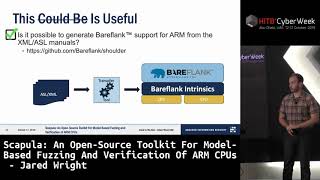
An Open-Source Toolkit for Model-Based Fuzzing of ARM CPUs
Explore model-based fuzzing for ARM CPUs using machine-parsable reference manuals. Learn about Scapula, an open-source tool for detecting specification violations in ARM-based platforms.
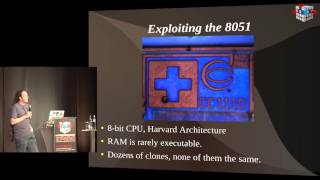
Nifty Tricks and Sage Advice for Shellcode on Embedded Systems
Clever tricks for writing exploits on embedded systems, including tiny shellcode for ARM, memory corruption on 8-bit micros, and developing without debuggers or firmware images.
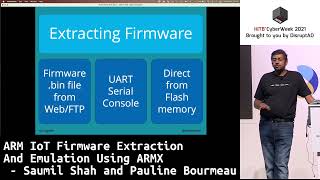
ARM IoT Firmware Extraction and Emulation Using ARMX
Hands-on workshop on extracting and emulating ARM IoT firmware using ARMX. Covers firmware extraction, unpacking, file system analysis, and device emulation. Practical experience with real IoT devices and tools.
Return-Oriented Flush-Reload Side Channels on ARM and Their Implications for Android Devices
Explore ARM-based side-channel attacks using Return-Oriented Flush-Reload techniques and their potential impact on Android device security.
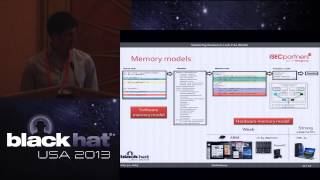
Shattering Illusions in Lock-Free Worlds - Compiler - Hardware Behaviors in OSes - VMs
Explores memory access issues in multi-threaded environments, focusing on compiler/hardware behaviors that can lead to security vulnerabilities in OSes, VMs, and applications.
Blue to Red - Traversing the Spectrum
Explore the importance of foundational security skills and an adversarial mindset in navigating diverse InfoSec roles, from forensics to red teaming, in this insightful keynote by Amanda Rousseau.
Reverse Engineering the M1
Explore Apple's M1 chip architecture, including ARM variant quirks, memory access issues, and the AMX vector instruction set. Gain insights into reverse engineering proprietary hardware.