Designing the Next Billion Chips - How RISC-V is Revolutionizing Hardware
Explore how RISC-V and open-source hardware are transforming chip design economics for IoT, edge computing, and AI applications, revolutionizing the semiconductor industry.
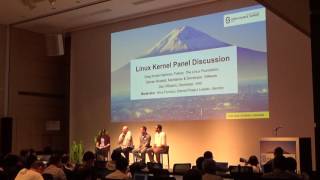
Linux Kernel Development - Panel Discussion
Expert panel discussion on Linux kernel development, featuring insights from leading developers on various aspects of kernel maintenance and innovation.
Persistent Memory Usage within Linux Environment
Explore persistent memory usage in Linux, covering hardware, software, programming models, and applications. Learn about NVML library and its impact on system performance and data handling.
Persistent Memory Extensions to C++ Standard Libraries
Explore persistent memory extensions for C++ libraries, covering design decisions, implementation challenges, and interactions with existing standards. Learn about NVM technology and its impact on software development.
ARM64 SoC Linux Support Checklist
Comprehensive guide for integrating ARM64 SoC support into the Linux kernel, covering essential steps, ARM64-specific requirements, and updates for both ARM32 and ARM64 architectures.

Apache Commons Crypto - Optimized Cross-Platform Cryptographic Library
Explore Apache Commons Crypto, a high-performance cryptographic library optimized with AES-NI and hardware random number generation, offering Java developers strong and efficient AES encryption/decryption capabilities.

Anatomy of Cross-Compilation Toolchains for Embedded Linux Development
Comprehensive exploration of cross-compilation toolchains for embedded Linux, covering components, build process, configurations, and practical implications for developers.
How Dealing with Modern Interrupt Architectures Can Affect Your Sanity
Explore the evolution of interrupt architectures in Linux, from simple wires to complex hierarchies, and learn how the kernel adapts to support modern hardware complexities.
Developing ARM 64-bit Board - Samsung TM2 with Exynos5433
Explore ARM 64-bit development on Samsung TM2 with Exynos5433. Learn challenges and solutions for running Tizen OS on 64-bit platforms, covering kernel issues and device driver development.
No, It's Never Too Late to Upstream Your Legacy Linux-Based Platform
Discover strategies for upstreaming legacy Linux platforms, overcoming challenges, and reaping long-term benefits. Learn practical tips for efficient upstream work and community engagement.
Effectively Measure and Reduce Kernel Latencies for Real-time Constraints
Learn techniques to measure and minimize kernel latencies for real-time systems, exploring scheduler latency, execution methods, and task priorities on Intel and ARM architectures.
Linux Cryptographic Acceleration on an i.MX6
Explore cryptographic acceleration on i.MX6, covering CAAM enablement, userspace connectivity, and performance comparisons of different approaches for securing IoT devices.
OpenEmbedded/Yocto on RISC-V - New Architecture Support and Challenges
Explore OpenEmbedded/Yocto support for RISC-V architecture, covering current status, challenges, and essential package ports. Learn about infrastructure, SOC layers, and future developments in embedded Linux for RISC-V.
An Overview of the Linux Kernel Crypto Subsystem
Comprehensive exploration of Linux kernel's cryptographic subsystem, covering its components, interfaces, hardware acceleration, and best practices for kernel and driver development.
Packet, Qualcomm, and Mesos - Development of the Armv8 Ecosystem
Explore the development of Armv8 ecosystem through Packet, Qualcomm, and Mesos. Learn about innovative hardware, cloud-native technologies, and the challenges of integrating new architectures with existing software.
Scaling KVM and Its Community
Explore KVM's growth, challenges, and future prospects in cloud computing, including new ports, increased complexity, and strategies for scaling contributors and use cases.
How ARM Systems are Booted - An Introduction to the ARM Boot Flow
Explore ARM system boot processes, from reset vector to Linux startup, covering ARM Trusted Firmware, CPU power management, and system services like PSCI and SCMI.
RISC-V: The Inevitable Open Standard Architecture for Processors
Explore RISC-V's rapid growth as an open standard architecture, driving innovation in processors across industries. Discover its momentum and opportunities for software from embedded to enterprise applications.
Exploring an Architecture-neutral KVM MMU
Dive into the architecture-neutral KVM MMU, exploring its scalability improvements, performance tuning, and potential application to ARM VMs for enhanced cloud computing capabilities.
What's New in Virtio 1.2 and Future Developments
Explore virtio 1.2's new features, devices, and future developments. Learn about its applications, upcoming proposals, and potential use cases for future versions.
AIA Virtualization in KVM RISC-V - Advanced Interrupt Architecture Overview
Explore RISC-V's Advanced Interrupt Architecture (AIA) and its virtualization features in KVM, covering MSIs, IPIs, and wired interrupts for scalable CPU support.