
Segmentation and Quantification of Breast Arterial Calcifications - Xiaoyuan Guo
Explore innovative techniques for segmenting and quantifying breast arterial calcifications in mammograms, aiming to improve cardiovascular risk assessment for women through non-invasive methods.
Few-Shot Chest X-Ray Diagnosis Using Clinical and Literature Images
Explore innovative few-shot learning methods for chest X-ray diagnosis using clinical and literature images, enhancing radiology image analysis with advanced machine learning techniques.
Opioid Use Disorder Prediction Using AI and Existing Risk Models
Comparative study on AI models for predicting opioid use disorder, showcasing superior performance of transformer-based AI over existing clinical tools and other machine learning approaches.

Denoising Diffusion Models for Denoising Diffusion MRI - Tiange Xiang
Explore innovative self-supervised denoising techniques for diffusion MRI using denoising diffusion models. Learn about a three-stage framework integrating statistic-based theory for improved medical imaging quality.
Explaining Model Decisions and Fixing Them Through Human Feedback
Explore algorithms for explaining deep network decisions, building user trust, incorporating domain knowledge, learning grounded representations, and correcting unwanted biases in AI models.
Fairness in Representation Learning - Natalie Dullerud
Explore fairness in deep metric learning, evaluating bias in representations and its impact on minority subgroups. Learn about a novel approach to mitigate bias and improve fairness in machine learning models.
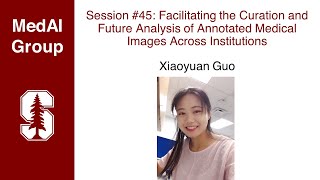
Curation and Analysis of Annotated Medical Images Across Institutions - Xiaoyuan Guo
Explore techniques for curating and analyzing annotated medical images across institutions, focusing on data sharing challenges, anomaly detection, and OOD-aware image retrieval for improved dataset quality and future analysis.
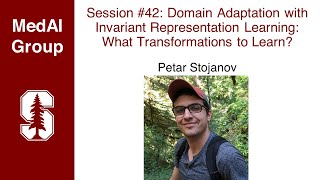
Domain Adaptation with Invariant Representation Learning - What Transformations to Learn?
Explore domain adaptation in machine learning, focusing on invariant representation learning and its challenges. Learn about novel techniques for optimal feature mapping across domains.
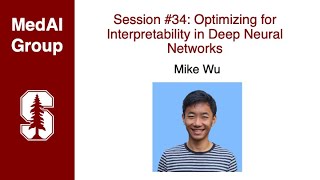
Optimizing for Interpretability in Deep Neural Networks - Mike Wu
Explore techniques for making deep neural networks more interpretable through regularization, focusing on medical applications in critical care and HIV treatment. Insights on balancing model performance with human-understandable decision processes.
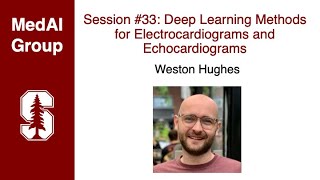
Deep Learning Methods for Electrocardiograms and Echocardiograms
Explore cutting-edge deep learning methods for ECG and echocardiogram analysis, outperforming traditional algorithms and offering insights into cardiovascular imaging interpretation.
GANs in Medical Image Synthesis, Translation, and Augmentation - Jason Jeong
Explore GANs in medical imaging for synthetic data generation, addressing scarcity and imbalance issues. Learn about applications in CT, MRI, and disease detection, with insights on challenges and future directions.
Observational Supervision for Medical Image Classification
Exploring gaze data as a novel supervision source for training deep learning models in medical image classification, focusing on chest X-rays and brain MRI scans for improved efficiency and accuracy.
Multimodal Medical Research of Vision and Language - Jean-Benoit Delbrouck
Explore multimodal medical research combining vision and language, focusing on innovative tasks like Medical Visual Question Answering and Radiology Report Generation using advanced AI architectures and pre-training techniques.
Self-Training - Weak Supervision Using Untrained Neural Nets for MR Reconstruction - Beliz Gunel
Exploring untrained neural networks for MR reconstruction, comparing self-training and weak supervision methods to improve performance with limited data while addressing slow inference times.
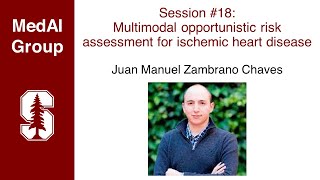
Multimodal Opportunistic Risk Assessment for Ischemic Heart Disease - Juan Manuel
Innovative approach integrating body composition biomarkers from CT scans with electronic medical records to enhance ischemic heart disease risk assessment, outperforming current clinical risk scores.
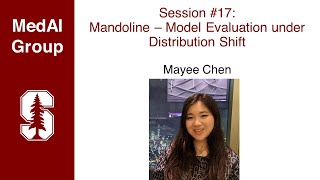
Mandoline - Model Evaluation under Distribution Shift
Explores a novel framework for evaluating machine learning models under distribution shifts, using slice-based reweighting to improve performance estimation on target distributions.
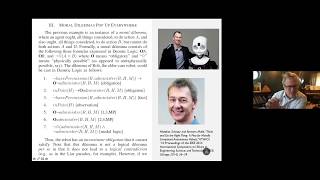
Against Ethical Robots with Ron Chrisley
Explore AI ethics challenges, avoiding complacency and inflation while balancing reactive systems and robotic obligations in this thought-provoking seminar by Ron Chrisley.

Vision, Touch & Sound for Robustness & Generalizability in Robotic Manipulation
Exploración de representaciones de datos perceptuales para mejorar el aprendizaje y desempeño de robots en manipulación, combinando visión, tacto y sonido para mayor robustez y generalización.

Amy Zegart - Spies, Lies, and Algorithms
Explore the evolving landscape of intelligence in the digital age, examining challenges, emerging technologies, and the democratization of espionage in our interconnected world.
The Artful Design of Interactive AI Systems
Explore the intersection of AI, design, and human interaction in technology, focusing on creating meaningful experiences and balancing automation with human engagement.
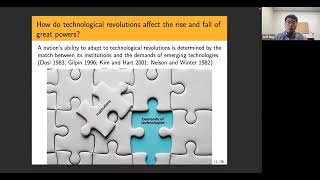
HAI Weekly Seminar with Jeff Ding - The Rise and Fall of Great Technologies and Powers
Explore the impact of technological revolutions on global power dynamics, focusing on the US-China AI race and drawing insights from historical technological shifts.