Modeling Bottom-Up and Top-Down Visual Attention in Humans and Monkeys - 2009
Explore computational models of visual attention combining bottom-up and top-down influences, comparing predictions to human and monkey behavior, with applications to real-world vision challenges.
Integrating Evidence Over Time: Conditional Models for Speech and Audio Processing
Explore conditional random fields for speech recognition and auditory scene analysis, integrating local acoustic evidence over time sequences to improve event detection and classification.
Semantic Lexicons and Semantic Tagging: Towards Content Interoperability
Explore large-scale language resources, computational lexicons, and semantic tagging for content interoperability. Learn about European initiatives, challenges, and future paradigms in language technology.

When Will Computers Understand Shakespeare?
Explore computational challenges in understanding Shakespeare's 64th sonnet and potential solutions, examining progress in AI language comprehension.
Speech, Language, and Machine Learning
Explore speech, language, and machine learning concepts with Jeff A. Bilmes from the University of Washington in this comprehensive lecture.

Empowering Responsible Use of Large Language Models
Explore watermarking techniques for text and models to identify AI-generated content and protect LLM intellectual property. Learn theoretical foundations and empirical evidence for responsible AI use.
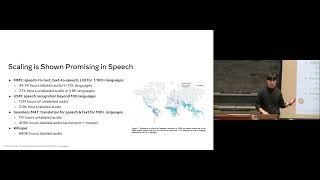
Large Scale Universal Speech Generative Models
Explore cutting-edge speech generative models, including Voicebox, and their applications in multilingual TTS, style conversion, and content editing. Learn about scalable approaches for audio AI.
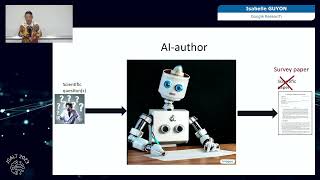
Peer-Reviewed Journal of AI-Agents: A Challenging LLM Competition - Lecture
Explore a challenging LLM competition for AI agents in this talk by Isabelle Guyon, discussing peer-reviewed journals and innovative approaches in the field.
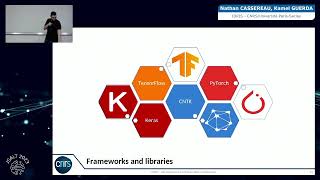
Introduction to Artificial Neural Networks - JSALT 2023
Explore artificial neural networks: fundamentals, architectures, and applications in this comprehensive introduction from JSALT 2023 workshop.
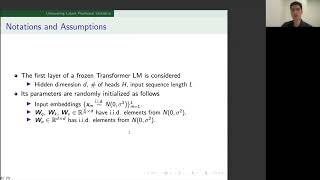
Toward Length Extrapolatable Transformers
Explore innovative techniques for enhancing transformer models' ability to handle longer sequences, improving their performance and scalability in natural language processing tasks.

Probabilistic Models of Relational Domains
Explore probabilistic models for relational domains with Stanford's Daphne Koller, covering advanced techniques for representing and reasoning about complex, interconnected data structures.

CDG-Based Language Models - 2009
Explore context-dependent grammar-based language models and their applications in natural language processing and speech recognition.
Machine Learning - Finding Patterns in the World
Explore patterns in data using machine learning techniques. Gain insights into real-world applications and methodologies presented by a Johns Hopkins expert.
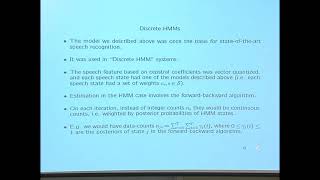
UBM-based Acoustic Modeling for ASR - 2009
Explore advanced UBM-based acoustic modeling techniques for automatic speech recognition, enhancing ASR system performance and accuracy.

Speech Recognition - 2000
Explore fundamental concepts and techniques of speech recognition, including acoustic modeling, language modeling, and decoding algorithms.

Sequence Kernels for Speaker and Speech Recognition
Explore sequence kernels for speaker and speech recognition, focusing on generative kernels and their applications in feature extraction and classification using HMMs, GMMs, and SVMs.

AI and the Impending Revolution in Brain Sciences - 2002
Explore the synergy between AI and brain sciences, examining how AI architectures interpret brain activity data and how machine learning discovers patterns in neurological research.

Speech and Language Processing: Where Have We Been and Where Are We Going - 2003
Explore the past, present, and future of speech and language processing with insights on technological trends, data mining, and shifting priorities in the field.

3D Human Body Modeling - From Basics to Advanced Techniques
Explore 3D human body modeling techniques, from basic 3D vision to advanced pose estimation and motion synthesis using LLMs, for applications in surveillance and human-computer interaction.
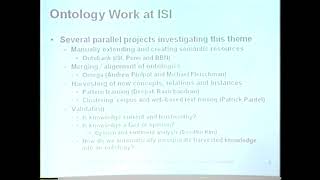
Towards Automatic Acquisition of Ontological Knowledge - 2004
Explore methods for extracting semantic relations between verbs and ontologizing lexical resources. Learn about VerbOcean and techniques for disambiguating grammatical templates in ontologies.
An Overview and Challenges of Interactive HMI for Realizing Human-Like Interaction - 2024 JSALT
Explore interactive human-machine interfaces, their history, and recent advancements. Delve into HMI components, text-to-speech research, and future challenges in realizing human-like interactions.