Clinical Informatics, AI, and Multi-modal Analyses in Healthcare - Grand Rounds 2/9/23
Explore AI, predictive biomarkers, and data integration in clinical informatics with Dr. Joel Saltz, discussing cutting-edge tools for investigators in biomedical research.
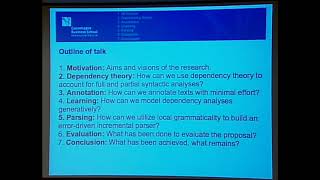
Modelling Human Syntax by Means of Probabilistic Dependency Grammars - 2007
Explore probabilistic dependency grammars for modeling human syntax, addressing linguistic phenomena beyond context-free grammars and discussing generative models and parsing algorithms.
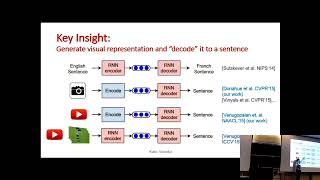
Connecting Vision and Language End-to-End - 2018
Explore neural models for vision-language understanding, focusing on End-to-End Module Networks and dense video captioning. Learn about interpretable, compositional approaches to visual question answering.
Reducing Confusions and Ambiguities in Speech Translation - 2005
Explore techniques to enhance speech translation by addressing accent-related confusions, named entity recognition, and semantics-based disambiguation for improved accuracy and understanding.
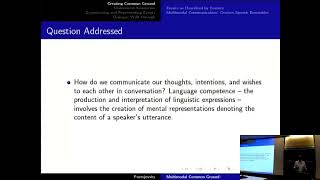
Modeling Common Ground for Multimodal Communication - 2018
Explore multimodal communication in human-machine interactions using a 3D simulation platform. Learn about VoxML modeling language for encoding objects and actions in shared task environments.
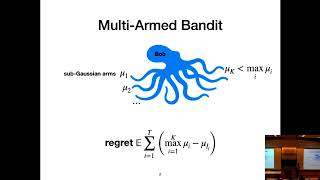
Adversarial Machine Learning: Beyond Manipulating Pixels and Words
Explore vulnerabilities in sequential machine learning and challenge assumptions about imperceptible attacks on image classification through human behavioral studies.
Syntactic Language Modeling for Machine Translation and Speech-Repair Detection - 2005
Explore syntactic language modeling techniques for improving machine translation and detecting speech repairs in natural language processing.
Tutorial on Hidden Markov Models - Part 2
Explore advanced concepts of Hidden Markov Models, including applications and algorithms, in this in-depth continuation of Jason Eisner's tutorial series.
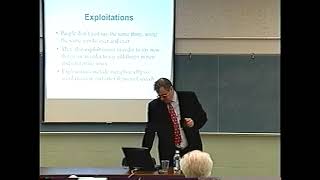
Norms and Exploitations: Mapping Meaning onto Use
Explore Corpus Pattern Analysis to map word meanings to typical contexts, reducing lexical entropy and linking patterns to applications like synonym sets or translations.
Vocal Tract Modeling and Vocal Aging - Part 1
Explore vocal tract modeling and vocal aging concepts in this comprehensive lecture, focusing on key principles and research findings in speech processing.
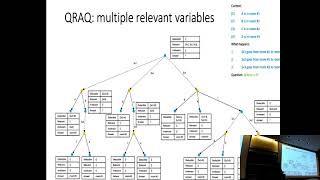
Deep Reinforcement Learning for Sequential Decision Making Tasks with Natural Language Interaction
Explore deep reinforcement learning applications in natural language tasks, focusing on querying ambiguous texts and navigating 3D mazes with unseen instructions using hierarchical architectures.
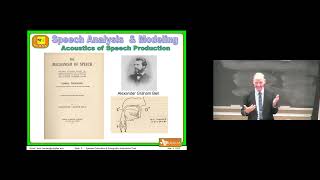
Challenges and Advancements in Speaker Diarization and Recognition for Naturalistic Data
Explore advancements in speech technology for analyzing human interactions, focusing on child learning spaces and NASA APOLLO missions. Gain insights into ML-based audio processing and diarization techniques.
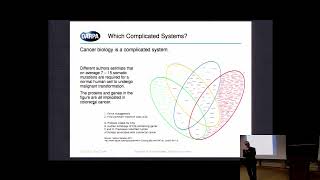
Acquiring Big Mechanisms by Reading Primary Literature - 2015
Explore machine learning techniques for extracting causal models from scientific literature, focusing on Ras-driven cancers and systemic effects of interventions.
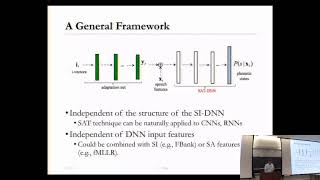
Visual Features for Context-Aware Speech Recognition - 2016
Explore visual features for context-aware speech recognition, improving transcription of consumer-generated multimedia content by adapting acoustic and language models to detected objects and scenes.
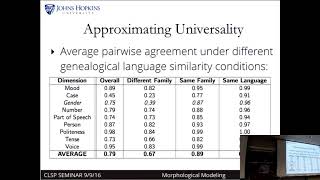
Rich Morphological Modeling for Multi-lingual HLT Applications - 2016
Explore advanced morphological modeling techniques for diverse languages, enhancing HLT applications through innovative approaches like neural networks and cross-lingual projection.
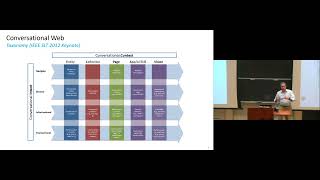
Improving Conversational Interactions through Visually Situated Context
Explore how visual context enhances conversational AI accuracy. Learn about augmentation strategies, grounding techniques, and recent advancements in language models for more effective human-machine interactions.
Practical Linguistically Motivated Parsing
Explore linguistically motivated parsing techniques with Stephen Clark, focusing on practical applications and advanced methodologies in natural language processing.
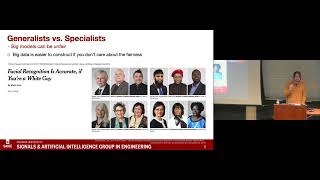
Personalized Speech Enhancement: Data- and Resource-Efficient Machine Learning
Explore data-efficient machine learning techniques for personalized speech enhancement, focusing on modularized models and self-supervised learning to achieve user-specific improvements with minimal data.
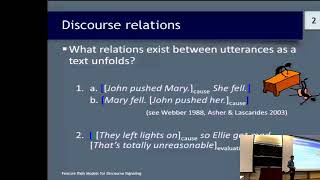
Feature Rich Models for Discourse Signaling - 2018
Explore computational models for discourse relations using rich annotations beyond text, including syntactic and semantic information, to capture complex discourse structures.
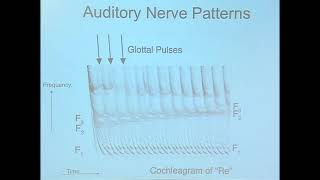
Top-Down Auditory Processing and Why Yahoo Cares - 2008
Explore top-down auditory processing, its importance in noisy environments, and applications in internet data analysis. Gain insights from visual and auditory perception examples.

Text Geolocation and Dating: Light-Weight Language Grounding - 2012
Explore geolocation and dating of texts to identify latitude-longitude pairs and time periods related to documents. Learn about computational models of word meaning beyond standard word vectors.