
Stanford Seminar - The Future of Edge Computing from an International Perspective
Explore international perspectives on edge computing, covering 5G integration, federated learning, AI processing, and IoT systems for smart applications across Asia and the U.S.

Stanford Seminar - Emerging Risks and Opportunities From Large Language Models
Explore privacy concerns, disinformation risks, and discriminatory shortcuts in large language models. Gain insights on potential harms and brittleness through case studies presented by Stanford's CS professor.
Stanford Seminar - Deploying Autonomous Service Mobile Robots, and Keeping Them Autonomous
Explore challenges and solutions in deploying autonomous mobile robots in dynamic environments, covering robustness, failure anticipation, and efficient adaptation to user needs through advanced perception and learning techniques.
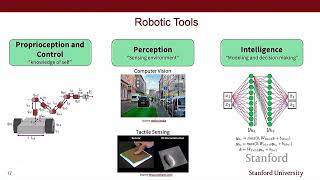
Considerations for Human-Robot Collaboration
Explore the future of human-robot collaboration, focusing on effective teamwork, contextual understanding, and the unique challenges of integrating robots into human-configured environments.
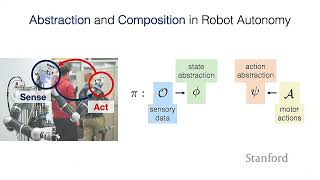
Stanford Seminar - Objects, Skills, and the Quest for Compositional Robot Autonomy
Explore compositional robot autonomy through state-action abstractions, object representations, and sensorimotor skills. Discover innovative approaches for building scalable and generalizable autonomous systems.

Design & AI - Envisioning AI-Augmented Products
Explore AI's impact on product design, human-centered techniques for ideation, and future AI-powered innovations with Stanford's Michael Bernstein in this insightful webinar on the intersection of design and artificial intelligence.
Investing in Robotics, Cybersecurity, and Enterprise IT
Explore robotics, cybersecurity, and enterprise IT investment trends with insights from a venture capital expert, covering emerging technologies and industry challenges.
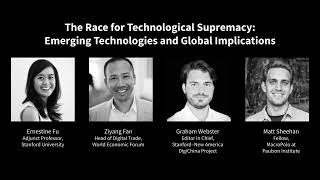
The Race for Technological Supremacy - Emerging Technologies and Global Implications
Explore global tech competition, emerging technologies' impact, and policy challenges with experts discussing AI, data privacy, and US-China dynamics in the digital age.
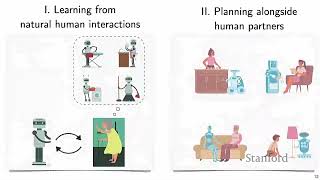
Interactive Imitation Learning: Planning Alongside Humans
Interactive imitation learning for robots: tackling feedback-driven covariate shift and predicting human intent using graph neural networks, with applications in self-driving vehicles.
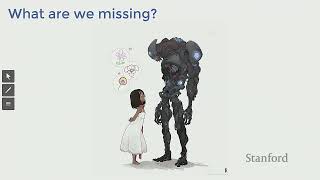
Stanford Seminar - Perceiving, Understanding, and Interacting through Touch
Explore the emerging field of touch processing in AI and robotics, its challenges, and potential applications. Learn about recent advances in tactile sensing hardware and their implications.
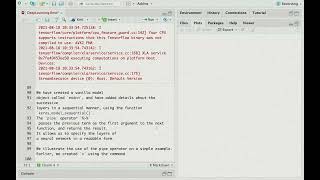
Neural Networks in R and the MNIST Data - Lecture 10.R.1
Explore neural networks using R and MNIST data, learning practical implementation of deep learning techniques for image recognition and statistical analysis.

Artificial Intelligence for Business Leaders
Discover key AI concepts, trends, and strategies for business leaders. Learn about AI capabilities, limitations, and how to develop effective AI solutions for commercial applications.

Stanford Seminar 2022 - Transformer Circuits, Induction Heads, In-Context Learning
Explore reverse engineering of transformer language models, focusing on induction head circuits and their role in in-context learning. Gain insights into neural network interpretability and AI safety.

Stanford Seminar 2022 - Self Attention and Non-Parametric Transformers
Explore self-attention and Non-Parametric Transformers with PhD students discussing Transformer origins, intuitions, and recent advancements in neural network architecture.

Stanford Seminar 2022 - DeepMind's Perceiver and Perceiver IO: New Data Family Architecture
Exploring DeepMind's Perceiver architecture for flexible AI processing across diverse data types, offering domain-general solutions comparable to specialized models in various tasks.
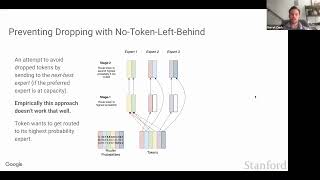
Stanford Seminar - Mixture of Experts Paradigm and the Switch Transformer
Explore the Mixture of Experts paradigm and Switch Transformer, revolutionizing deep learning with sparsely-activated models for improved efficiency and performance in language processing tasks.

Stanford Seminar 2022 - Transformers in Vision: Tackling Problems in Computer Vision
Explore how transformers revolutionize computer vision with Lucas Beyer, covering innovative applications and advancements in representation learning for visual AI tasks.
Lessons From Evaluating and Debugging Healthcare AI in Deployment
Explore challenges in translating AI to healthcare: data curation, model testing, and human-AI interactions. Learn insights from real-time AI trials and FDA-approved medical AI systems analysis.
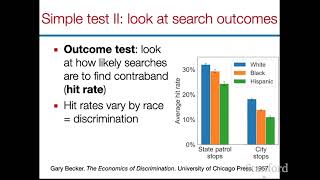
Inequality in Healthcare: Using AI and Data Science to Reduce Disparities
Exploring AI and data science applications to address healthcare inequality, featuring insights from experts on challenges and potential solutions in improving healthcare access and outcomes.

AI and Law: Implications for Society and Legal Systems
Explore AI's impact on law, society, and decision-making with insights from experts. Gain perspective on AI's evolution, policy implications, and potential for social good.
How Can You Trust Machine Learning?
Explore a framework for trustworthy AI based on Clarity, Competence, and Alignment. Learn about explainable ML, rigorous model evaluation, and aligning AI behaviors with human values.