Thoughts on Rational Inference - Is Information Theoretic Inference Rational?
Exploring rational inference approaches for incomplete information in complex sciences. Discusses defining and implementing rational methods, handling misspecifications, and addressing model uncertainty and robustness.
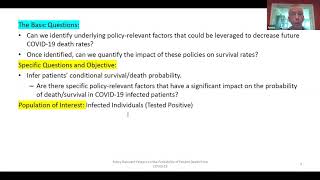
Effect of Universal TB Vaccination and Other Factors on Probability of Patient Death from COVID-19
Explore how universal TB vaccination, air pollution, and health expenditure impact COVID-19 survival rates across countries, with quantified probability changes by age and sex using information-theoretic methods.

Statistical Workflow and the Fractal Nature of Scientific Revolutions
Explore AI's role in statistical workflow, focusing on model building, checking, and revision. Discover how automated inference and best practices can enhance quantitative data analysis across various fields.
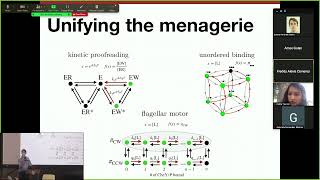
The Laws of Sensitivity for Small Nonequilibrium Systems
Explore laws constraining sensitivity in small, nonequilibrium systems. Uncover mechanisms behind biochemical switches, sensors, and molecular discrimination, with implications for gene regulation models.
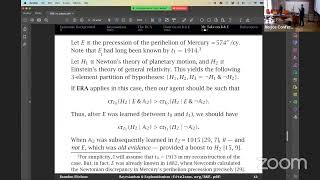
Bayesianism and Explanationism in Scientific Reasoning
Explore the philosophical approaches of Bayesianism and Explanationism, examining their principles, applications, and implications for scientific reasoning and knowledge acquisition.
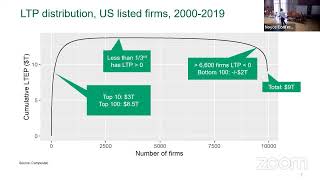
A Simple Law for the Distribution of Long-term Profits
Explore the distribution of long-term profits among US firms, examining statistical models and their implications for understanding economic dynamics and 'superstar' effects.
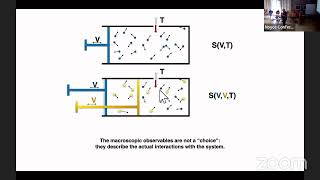
What Makes the Past Different from the Future?
Explore the fundamental differences between past and future, examining scientific concepts and philosophical implications in this thought-provoking lecture on time's arrow.
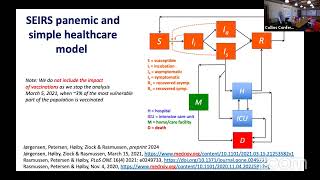
SARS-CoV-2 Infection Tracing Efficiency in Denmark Before Vaccine Impacts
Explore Denmark's pre-vaccine SARS-CoV-2 infection tracing strategies, analyzing their effectiveness and impact on pandemic control measures.
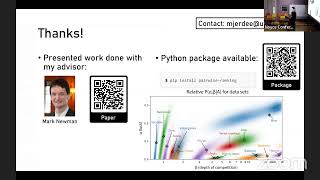
Luck, Skill, and Inequality in Games and Social Hierarchies
Explore the interplay of luck, skill, and inequality in games and societal structures, examining their impact on hierarchies and outcomes.

Probability and Statistics
Comprehensive exploration of probability and statistics concepts, covering fundamental principles, algebraic structures, and advanced topics through 79 detailed lectures.

Financial Derivatives and Risk Management
Comprehensive exploration of financial derivatives, risk management, and option pricing, covering forwards, futures, hedging strategies, portfolio theory, interest rates, and stochastic processes.
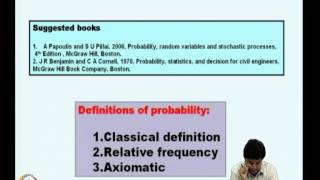
Stochastic Structural Dynamics
Comprehensive exploration of probability, random variables, processes, and vibrations in structural dynamics, covering theory and applications in earthquake engineering and system failure analysis.

Essentials of Data Science With R Software - Probability and Statistical Inference
The main objective of statistics is to work on a small sample of data but provide conclusions for the whole population. Such results cannot be obtained without learning the concepts and tools of theory of probability and statistical inference.
Manufacturing Systems Technology Part II
Explore quality engineering, design experiments, and statistical tools for manufacturing. Learn robust design, control charts, and probability distributions to enhance product quality and process efficiency.
Advanced Probability Theory
The course introduces the concept of probability through Kolmogorov’s Axioms. It develops the concept of probability density function, cumulative distribution function, and introduces the concept of a random variable.
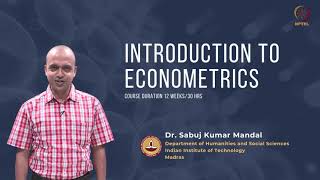
Introduction to Econometrics
Comprehensive exploration of econometric analysis, covering linear regression, hypothesis testing, STATA applications, and advanced models like logit, probit, and tobit.
The Counting Project - How Data Built the Modern World
Explore how data shaped our world and its potential to create a better future with economist Tim Harford in this insightful inaugural lecture honoring Vicky Neale's contributions to mathematics education.
From Ronald Ross to ChatGPT: The Birth and Strange Life of the Random Walk
Explore the fascinating history of random walks in mathematics, from mosquito control to AI, and their impact on various fields including physics, finance, and theology.
Advanced Topics in Probability and Random Processes
Explore advanced probability concepts, from random variables to Markov chains and martingale processes, enhancing your understanding of stochastic systems and their applications.

Digital Signal Processing and Its Applications
Explore digital signal processing fundamentals, including sampling, Fourier transforms, discrete systems, filters, and various transform techniques. Gain practical skills in filter design and implementation.
Learning Representations Using Causal Invariance
Explore causal invariance in AI with Leon Bottou, delving into proxy problems, correlations, and environments to enhance prediction and address real-world challenges like hiring biases.