
Stanford CS109 - Future of Probability - Lecture 28
Explore the future of probability in computer science with Stanford's expert insights, covering advanced concepts and their applications in emerging technologies.

Data Compression I - Lecture 5: Asymptotic Equipartition Property
Explore the Asymptotic Equipartition Property in data compression, a fundamental concept for understanding information theory and efficient coding techniques.
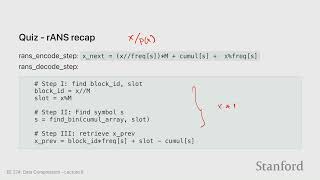
Stanford EE274: Data Compression - Beyond IID Distributions: Conditional Entropy - Lecture 8
Explore conditional entropy and advanced data compression techniques beyond IID distributions in this Stanford lecture, enhancing understanding of complex information theory concepts.

Efficient Markets Hypothesis and Its Limitations - Financial Markets Lecture 7
Explore the Efficient Markets Hypothesis, its implications for stock prices, and critiques of the theory through empirical evidence and alternative models of market behavior.

Technology and Invention in Finance - Financial Markets
Explore financial technology's societal impact, from limited liability corporations to inflation indexation and swap contracts, emphasizing the evolution and importance of financial inventions in managing risks.

Risk and Financial Crises - Probability Theory in Financial Markets
Explore probability theory in financial crises context, covering expected value, variance, covariance, and regression analysis. Learn about risk decomposition and the limitations of normal distribution assumptions in finance.

Durkheim and Social Facts - Foundations of Modern Social Thought
Explore Durkheim's sociological methodology, examining social facts, collective representations, and the challenges of objectively studying society's values and sentiments.
The Universal Principle of Risk Management - Pooling and Hedging Risks
Explore probability theory, statistics, and financial analysis methods essential for risk management and understanding the time value of money in financial markets.

Portfolio Diversification and Supporting Financial Institutions - CAPM Model
Explore portfolio diversification, efficient frontiers, and the Capital Asset Pricing Model to maximize returns and manage risk in financial markets.

Efficient Markets vs. Excess Volatility - Financial Markets
Explore theories of stock price analysis, including efficient markets and random walk, and their implications for predicting market behavior and beating the market.

Insurance: The Archetypal Risk Management Institution - Financial Markets
Explore insurance as a risk management tool, its historical development, regulatory aspects, and current challenges in this comprehensive lecture on financial markets.
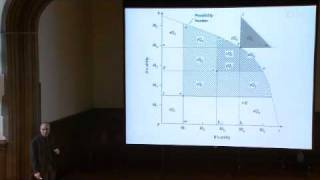
From Classical to Neoclassical Utilitarianism - Moral Foundations of Politics
Explore neoclassical utilitarianism's economic foundations, comparing it with classical utilitarianism. Examine key concepts like Pareto principle and indifference curves, and their implications for redistribution and status quo.

Introduction to the Four-Vector in Special Relativity - Lecture 14
Explore the four-vector concept in physics, unifying space-time coordinates and energy-momentum, with emphasis on Lorentz transformations and the invariant space-time interval.
Causal Inference Bootcamp - Your Guide to Experiments
Comprehensive guide to causal inference, covering experimental design, analysis, and real-world applications. Explores controlled experiments, natural experiments, and key issues in research methodology.

Statistics Fundamentals
Comprehensive overview of statistical concepts, from basic distributions to advanced topics like maximum likelihood, providing a solid foundation for data analysis and interpretation.
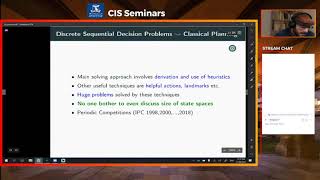
Tractable Novelty Exploration Over Continuous and Discrete Sequential Decision Problems
Explore cutting-edge width-based planning algorithms for sequential decision problems, covering continuous dynamics, polynomial approximations of novelty, and comparisons with deep reinforcement learning.

Linear Regression and Linear Models
Learn powerful statistical tools: linear regression and models. Predict continuous values using various data types. Covers least squares, multiple regression, t-tests, ANOVA, and R implementation.

Logistic Regression
Learn to predict discrete outcomes using logistic regression, covering coefficients, maximum likelihood, R-squared, p-values, deviance, and practical implementation in R.

Probability & Random Variables
Comprehensive exploration of probability theory, random variables, and stochastic processes, covering fundamental concepts to advanced topics like spectral analysis and adaptive filtering.

Big Data Analytics
Comprehensive exploration of big data analytics, covering programming, databases, statistics, machine learning, visualization, and cloud computing for practical applications.

Mathematics - Probability and Statistics
Comprehensive exploration of probability and statistics, covering set theory, probability laws, distributions, sampling, descriptive statistics, estimation, and hypothesis testing.