A Tale of Tails: Asymptotics and Non-asymptotics in Load Balancing
Delve into queueing systems analysis, exploring asymptotic regimes, load balancing techniques, and non-asymptotic tail bounds through transform methods and shortest-queue algorithms.
Quickest Fault Detection over Lossy Networks for Industrial Machinery
Explore advanced fault detection techniques for industrial machinery monitoring over lossy networks, focusing on efficient CUSUM algorithms and statistical methods for early fault identification.
Flipped Huber - A New Additive Noise Mechanism for Differential Privacy
Discover a novel additive noise mechanism for differential privacy that combines Laplace and Gaussian distributions, offering enhanced privacy protection while maintaining data accuracy in query responses.
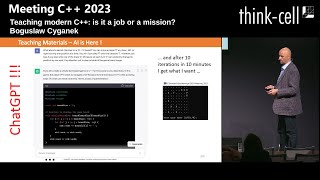
Teaching Modern C++: Is It a Job or a Mission? - Lecture
Explore effective strategies for teaching modern C++, focusing on key topics to maximize learning efficiency. Discover methods to avoid common pitfalls and foster professional development in students.
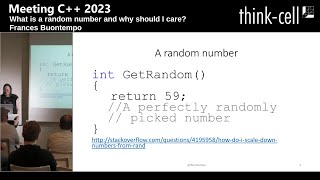
What is a Random Number and Why Should I Care - Understanding Pseudorandom Number Generators
Explore random number generation, distributions, and applications in C++. Learn about PRNGs, chaos theory, and visualize concepts through blob racing simulations.
Combining Wolfram Language and R - Integrating R Workflows into Wolfram's Unified Computation Platform
Integrate Wolfram Language and R workflows, leveraging RLink to expand computational capabilities beyond statistics and access Wolfram's extensive algorithm base.
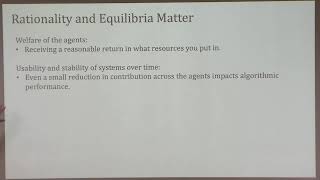
A Theory of Multi-objective Machine Learning
Explore multi-objective learning as a unifying paradigm for robustness, collaboration, and fairness in machine learning, with technical tools and empirical evidence.
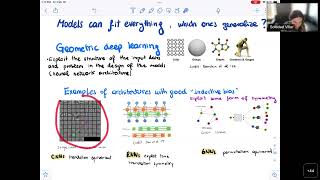
The Passive Symmetries of Machine Learning
Explore passive symmetries in machine learning, their implications, and implementation as group equivariances. Gain insights on generalization and links to causal modeling.
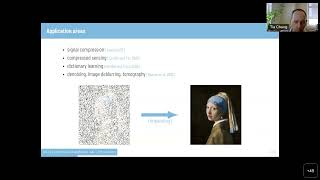
Big Data Inverse Problems - Promoting Sparsity and Learning to Regularize
Explore novel methods for solving big data inverse problems, focusing on sparse representation and L1 regularization. Learn about variable projection and deep neural networks for parameter optimization.
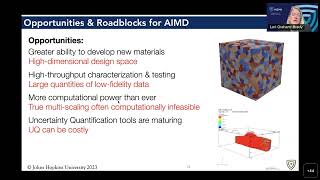
ML-driven Models for Material Microstructure and Mechanical Behavior - DDPS
Explore ML-driven approaches for generating microstructures and accelerating material behavior analysis. Learn transfer learning techniques and rapid assessment methods for materials design optimization.
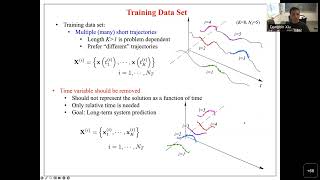
Data-Driven Modeling of Unknown Systems with Deep Neural Networks
Explore data-driven modeling of unknown systems using deep neural networks. Learn to discover and approximate evolution operators for predictive analysis across various problem domains.
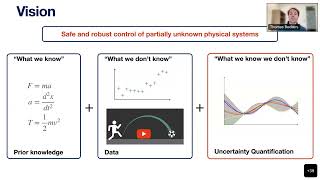
Physics-Enhanced Gaussian Processes for Learning of Electromechanical Systems
Explore physics-enhanced Gaussian processes for modeling electromechanical systems. Learn about GP-PHS and physics-enhanced variational autoencoders to improve data efficiency and ensure physical correctness.
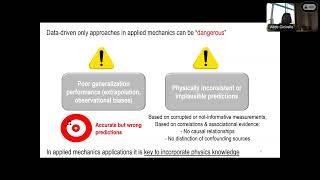
Challenges and Opportunities for Integrating Physics-Knowledge in Machine Learning Strategies
Explore integrating physics knowledge into machine learning algorithms for improved generalization and physics-consistent predictions. Examine biases and strategies through a friction identification case study.
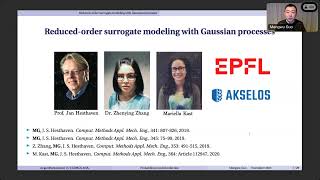
Probabilistic Methods for Data-Driven Reduced-Order Modeling
Explore probabilistic methods for data-driven reduced-order modeling, including Gaussian process regression, deep kernel learning, and Bayesian reduced-order operator inference for efficient multi-query simulations and digital twinning.
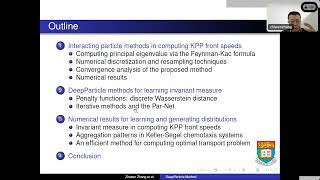
DeepParticle: Learning Invariant Measure by Deep Neural Network Minimizing Wasserstein Distance
Explore DeepParticle: an integrated approach combining deep learning, optimal transport, and interacting particles to solve high-dimensional PDEs, demonstrated through Fisher-Kolmogorov-Petrovsky-Piskunov front speeds in incompressible flows.

AutoEncoders for Aerodynamic Predictions
Explore autoencoders for aerodynamic predictions, focusing on flow past wing geometries. Learn about non-linear compression, latent representations, and uncertainty quantification in data-driven modeling.
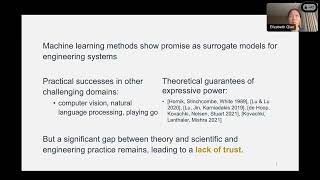
Multi-fidelity Linear Regression for Scientific Machine Learning from Scarce Data
Explore multi-fidelity linear regression for scientific machine learning, addressing data scarcity challenges in complex engineering systems through innovative training approaches.
WEAVE: Building Complex HPC Workflows - Tutorials 2024
Explore WEAVE's integrated tools for building complex HPC workflows, enhancing productivity and scientific quality through common infrastructure and tool integration.
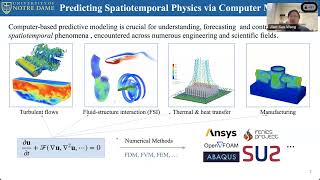
Neural Differentiable Physics: Unifying Numerical PDEs and Deep Learning for Data-Augmented Computational Physics
Explore Neural Differentiable Physics, unifying numerical PDEs and deep learning for enhanced computational modeling of complex physical systems. Learn innovative SciML approaches integrating physics principles with AI.

Advanced Techniques for Online Advertisement Spend Optimization
Explore advanced techniques for optimizing online ad spend using Reinforcement Learning, Bayesian statistics, and Thompson sampling to improve budget allocation and maximize returns.

Introduction to Data Exploration Using Microsoft Excel
Explore data using Excel: Learn importing, cleaning, basic functions, and statistical analyses for valuable insights from a Mars Petcare Data Engineer.