Bridging the Gap: Deep Learning and Causality
Explore the intersection of deep learning and causality, focusing on bridging the gap between these fields. Gain insights into recent advancements and their applications in computational genomics.

Categorization of 31 Computational Methods to Detect Spatially Variable Genes from Spatially Resolved Transcriptomics Data
Explore 31 computational methods for detecting spatially variable genes in transcriptomics data, categorized for effective analysis and application in genomics research.
Predictive Inference and Material World in Cognitive Processes
Explore the interplay between predictive inference and the material world in cognitive processes, delving into complex systems and interdisciplinary physics perspectives.
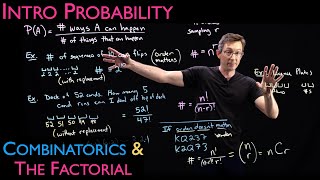
Counting Probabilities with Combinatorics and the Factorial
Master combinatorics and factorial concepts in probability. Learn to count event occurrences, analyze sampling methods, and apply formulas for various probability scenarios, including coin flips and poker hands.
The Fundamental Group of Random 3-Manifolds and Other Random Objects
Dive into the fundamental group of random 3-manifolds, exploring probability distributions and their applications to various categories in mathematics.
Mathematical Snippets From Developments in AI
Explore mathematical insights arising from AI developments in this colloquium by Lek-Heng Lim, examining key observations and their implications for the field.
Stochastic Quantisation of Yang-Mills
Dive into stochastic processes and Yang-Mills theory with Martin Hairer's talk on building a process admitting the 3D Yang-Mills measure as its invariant measure, exploring gauge-covariance and UV regularization.
A Descriptive Approach to Pointwise Ergodic Theorems
Dive into a descriptive approach to pointwise ergodic theorems, exploring their applications in dynamical systems, probability, and number theory.
Random Planar Geometry and the Directed Landscape
Dive into random planar geometry and the directed landscape, exploring universal scaling limits in random metrics and interface growth models with Duncan Dauvergne.
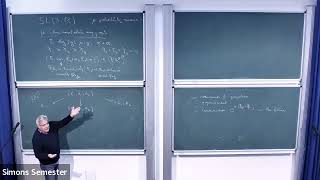
Dimension of Stationary Measures - Lecture 3
Delve into the dimension of stationary measures in random walks on matrix groups, exploring flag spaces, Oseledets measures, and configuration space dynamics. Gain insights into entropy and dimension addition.
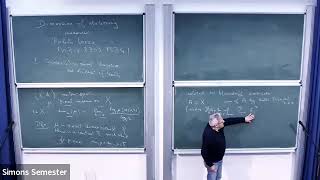
Dimension of Stationary Measures in Random Walks on Matrix Groups - Lecture Series
Explore the dimension of stationary measures in random walks, focusing on matrix group actions over flag spaces. Gain insights into exact dimensions, partial answers, and the intricate structure of flag spaces.
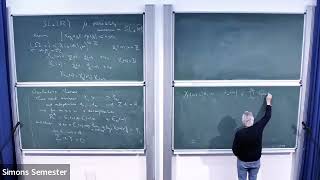
Dimension of Stationary Measures - Lecture 2
Explore the dimension of stationary measures in random walks, focusing on matrix group actions over flag spaces. Gain insights into exact dimensions, partial answers, and the intricate structure of flag spaces.
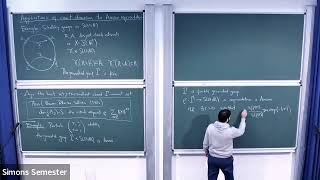
Dimension of Stationary Measures - Lecture 4
Delve into the dimension of stationary measures in random walks on matrix groups, exploring flag spaces, Oseledets measures, and configuration space dynamics.
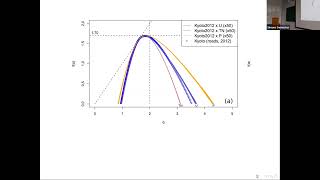
Integral Means Spectrum: Examples of Exact Computation
Explore the multifractal spectrum of harmonic measure and integral-means spectrum of Riemann maps through explicit computations in deterministic and random cases.
Entropy and Gibbs Measures for Hyperbolic Systems - Lecture 1
Explore hyperbolic systems, entropy, and Gibbs measures. Delve into classical examples, SRB measures, mixing speeds, and geodesic flows. Examine random walks in hyperbolic space and related concepts.
Zigzag Strategy for Random Matrices
Dive into the zigzag strategy for random matrices, exploring advanced probability concepts and their applications in matrix theory.
TASEP in Half-Space: Modeling and Analysis of Particle Systems
Dive into the intricacies of TASEP in Half-space with Xincheng Zhang's insightful seminar, exploring advanced concepts in probability theory and statistical mechanics.
Statistics and Probability
Comprehensive exploration of statistical concepts, probability distributions, and analytical techniques, covering key topics from random variables to regression analysis.
Seaborn- Understanding the Weird Parts
Explore advanced data visualization techniques using Seaborn, covering various plot types and statistical analyses for effective data representation and insights.
Seaborn Python Tutorial
Learn data visualization with Seaborn: create scatter plots, line charts, and distribution plots. Master regression models, FacetGrid, and color palettes for effective data analysis and presentation.
UGC NET-JRF - Research Aptitude
Comprehensive preparation for UGC NET/JRF Research Aptitude exam, covering key concepts, methodologies, and practice questions to enhance research skills and exam readiness.