Invariant Measures for KPZ Systems with Boundaries
Explore invariant measures for KPZ systems with boundaries in this mathematical workshop presentation by Ivan Corwin.
Polynuclear Growth and the Toda Lattice
Explore polynuclear growth models in KPZ universality, examining integrable Markov processes and determinantal formulas governed by the non-Abelian 2D Toda lattice.
Exact Results in Non-Equilibrium Statistical Mechanics - Part IV
Explore advanced concepts in non-equilibrium statistical mechanics, including Work Identities, Fluctuation Theorem, and Macroscopic Fluctuation Theory. Learn how integrability techniques yield exact solutions in nonequilibrium physics.
Exact Results in Non-Equilibrium Statistical Mechanics - Part III
Explore advanced concepts in non-equilibrium statistical mechanics, including Work Identities, Fluctuation Theorem, and Macroscopic Fluctuation Theory. Discover how integrability techniques yield exact solutions in nonequilibrium physics.
Integer Quantum Hall Effect on Complex Manifolds - A Probabilistic View
Explore geometric and analytic aspects of the Quantum Hall effect on complex manifolds through a probabilistic lens. Gain insights into advanced quantum physics concepts.
Remarks on the Cosmological Constant as an Initial Condition for Milne-like Spacetimes
Explore Milne-like spacetimes and their implications for the cosmological constant, early universe expansion, and inflationary scenarios in this advanced physics lecture.
Causal Set Kinematics: Reconstructing Spacetime Geometry from Random Posets
Explore causal set quantum gravity, reconstructing spacetime geometry from random posets. Learn dimension estimation, topology, and geometric invariants in discrete orders.
Supertranslation Invariance and Covariance of Lorentz Charges in General Relativity
Explore supertranslation invariance and covariance of Lorentz charges in general relativity, addressing key problems and presenting new covariant formulas for flux calculations.
Propagation of Errors in Measurements - Part 2
Explore error propagation in mathematical operations involving measured values, including sums, differences, products, and functions.
Propagation of Errors in Measurements - Part 1
Explore error propagation in measurements, including sum, difference, product, and functional relationships between values.
Falsifiability and Reproducibility in Research - Part 1
Explore falsifiability in theoretical research and reproducibility in experimental research, crucial concepts for scientific integrity and progress.
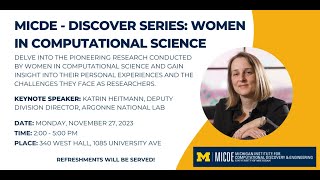
Exploring the Dark Universe - Challenges in Cosmology
Explore the Dark Universe with Dr. Katrin Heitmann, delving into cosmology's exciting phase, dark matter, dark energy, and challenges in data interpretation using supercomputer simulations.
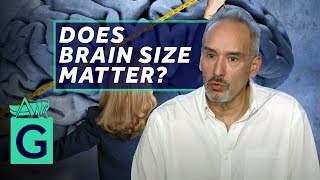
Does Having a Big Brain Make You Smarter?
Explore the mathematical approach to brain size and intelligence, examining scaling laws and statistical principles in humans and animals to uncover connections between brain size and cognitive abilities.
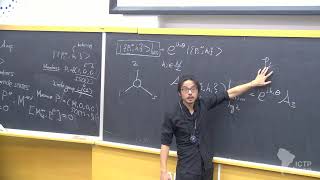
Amplitudes and Applications - Class 1
Explore amplitudes and their applications in particle physics through an in-depth lecture series, focusing on advanced concepts and cutting-edge research.
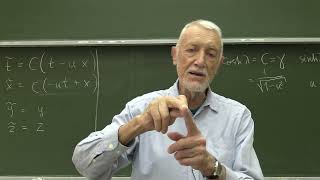
Lorentz Transformation of the Electromagnetic Field - Continued - Lecture 11
Explore advanced concepts in electromagnetic field transformations through Lorentz equations, building on previous knowledge in theoretical physics and relativity.
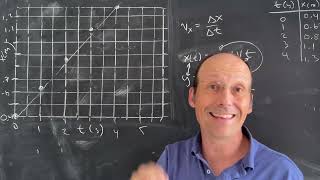
Physics Lab: Using Data to Plot Linear Functions
Learn to create linear graphs for physics labs using Vernier's Graphical Analysis software, enhancing data visualization and analysis skills.
Mean Field Limits of Heterogeneous Networks - Informal Systems Seminar
Explore mean field limits of heterogeneous networks, focusing on interacting particle systems coupled on digraphs and their macroscopic behavior. Gain insights into Vlasov equations and digraph measures.
Exploring Lagrangian Data Assimilation: Methods and Uncertainty - SIAM MPE Community Meeting
Explore Lagrangian data assimilation methods and uncertainty in fluid dynamics. Learn about ensemble techniques, analytical solutions, and optimal tracer deployment for improved state estimation.
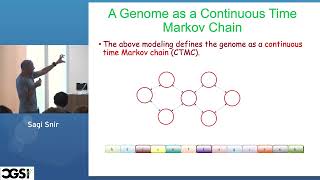
Horizontal Gene Transfer Phylogenetics: A Random Walk Approach
Explore horizontal gene transfer phylogenetics using a random walk approach. Discover innovative methods for analyzing evolutionary relationships in the presence of lateral genetic transfer.
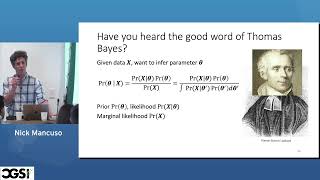
Variational Inference for Large-Scale Genomic Data - CGSI 2022
Explore variational inference techniques for large-scale genomic data analysis, integrating molecular and phenome information to uncover disease mechanisms and enhance genetic association studies.
Timewarp: Transferable Acceleration of Molecular Dynamics by Time-Coarsened Dynamics
Explore Timewarp: a transferable method for accelerating molecular dynamics simulations using normalizing flows, enhancing sampling efficiency for equilibrium properties of molecular systems.