
Past and Future of Nuclear Power - Lecture 22
Explores nuclear energy's global impact, risks, and challenges, including waste storage, proliferation, and disasters like Chernobyl, while comparing it to coal-fired plants' risks.

Chemically Dependent Agriculture - Environmental Politics and Law
Explore the shift to large-scale farming, increased pesticide use, and its impacts on food systems, health, and the environment. Examine relevant laws and the evolving understanding of chemicals like DDT.
Evolutionary Stability: Cooperation, Mutation, and Equilibrium in Game Theory - Lecture 11
Explore evolutionary stability in game theory, examining cooperation, mutation, and equilibrium concepts. Learn how biological strategies relate to economic principles like Nash equilibrium and domination.

Energy and Matter Flow in Ecosystems - Lecture 30
Explore energy and matter flow in ecosystems, from producers to consumers, and learn about biogeochemical cycles of vital compounds like carbon, nitrogen, and phosphorus in this comprehensive lecture.

The Logic of Science - Principles of Evolution, Ecology and Behavior
Explore the evolution of scientific thought, including falsifiability, revolutions, and creativity. Learn how philosophy influences modern scientific approaches and the boundaries of scientific knowledge.

Climate and the Distribution of Life on Earth - Principles of Evolution, Ecology and Behavior
Explore how climate shapes life on Earth, from biomes to weather patterns, and learn about the impact of phenomena like El Niño on global ecosystems and biodiversity.
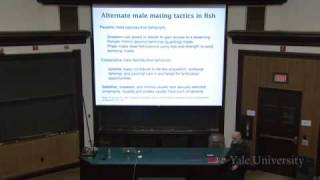
Alternative Breeding Strategies in Evolution and Ecology - Lecture 35
Explore diverse breeding strategies in nature, from bullfrogs to fig wasps. Learn about frequency-dependent strategies, evolutionary equilibrium, and unique reproductive behaviors across species and gametes.
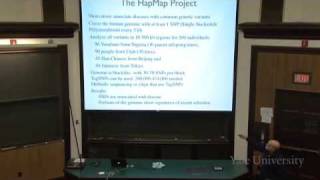
The Origin and Maintenance of Genetic Variation - Lecture 6
Explore genetic diversity's origins through mutations, selection, and recombination. Discover how population size impacts evolution and genetic variation maintenance in different scenarios.
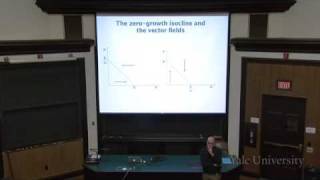
Interspecific Competition in Ecology and Evolution - Lecture 27
Explore interspecific competition's impact on evolution, including classical patterns, experimental evidence, conceptual frameworks, and real-world implications in ecology and biology.
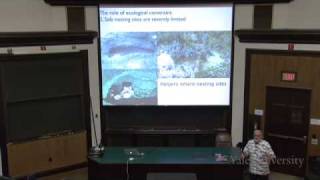
Selfishness and Altruism in Evolution, Ecology, and Behavior - Lecture 36
Explore evolutionary explanations for altruism, including kin selection and ecological constraints, challenging the idea that self-sacrifice contradicts natural selection.

Neutral Evolution - Genetic Drift and Molecular Clocks
Explore genetic drift and neutral evolution, understanding how random changes in genes can impact species over time without affecting reproductive success.

Sexual Selection in Evolution, Ecology, and Behavior - Lecture 13
Explore sexual selection's role in evolution, including intersexual and intrasexual selection, sexual dimorphism, and costly signaling in mate choice and competition.
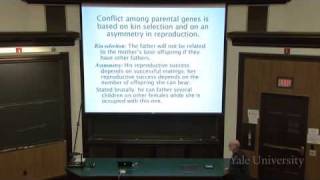
Genomic Conflict in Evolution, Ecology and Behavior - Lecture 10
Explore genomic conflicts within cells, organisms, and between species. Learn about meiosis fairness, uniparental inheritance, and evolutionary strategies to resolve conflicts in sexual species.
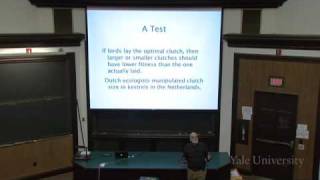
Life History Evolution - Principles of Evolution, Ecology and Behavior
Explore evolutionary tradeoffs in organism traits: maturity, offspring, and lifespan. Understand how genes and environment shape life history strategies for survival and reproduction.

Interactions with the Physical Environment - Principles of Evolution, Ecology and Behavior
Explore how organisms adapt to their environments through thermoregulation, internal regulation, water management, and niche specialization in this ecology and evolution lecture.

Population Growth - Density Effects and Mathematical Models
Explore factors influencing population growth, including density effects, predators, and resources. Learn mathematical models and real-world examples to understand population dynamics and ecological interactions.

Species and Speciation - Principles of Evolution, Ecology and Behavior
Explore the process of speciation, including definitions, mechanisms, and stages. Learn about reproductive isolation, ecological specialization, and genetic factors in species divergence.
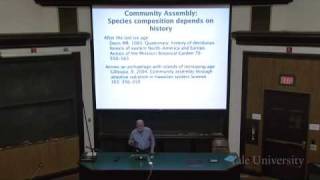
Ecological Communities - Evolution of Concepts and Modern Perspectives
Explore ecological communities: from classical views to modern concepts like trophic cascades and meta-communities. Discover how predation and interconnected ecosystems shape our understanding of nature's complex web.
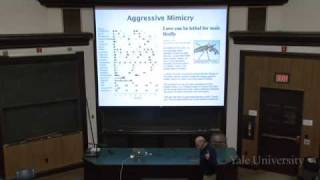
Economic Decisions for the Foraging Individual - Lecture 32
Explore foraging behaviors, from marginal value to group hunting, and how organisms make economic decisions when seeking food or mates. Learn about risk management and predator-prey dynamics in ecology.
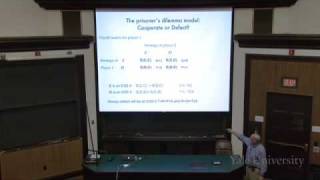
Evolutionary Game Theory: Fighting and Contests - Lecture 33
Explore how game theory applies to evolution and behavior, analyzing encounters between organisms as mathematical games to infer fitness payoffs and strategy proportions in populations.
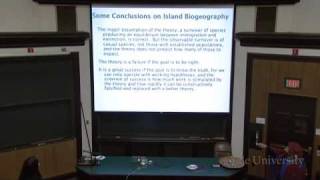
Island Biogeography and Invasive Species - Principles of Evolution, Ecology and Behavior
Explore island biogeography, metapopulations, and their ecological significance. Learn how these concepts apply to species distribution, extinction risks, and even epidemiology in this insightful lecture.