Retaining an Atmosphere - Planetary Conditions and Atmospheric Dynamics
Explore planetary atmospheres, escape velocity, and molecular dynamics. Understand why some planets retain atmospheres while others don't, and learn about atmospheric temperature profiles.
Vertical Structure of the Atmosphere and Residence Time - Lecture 4
Explore atmospheric layers, their properties, and interactions with solar radiation. Learn about ocean and Earth layers, systems analysis, and the hydrologic cycle's residence time.
The Atmosphere, the Ocean and Environmental Change - Review and Overview
Comprehensive review of atmospheric and oceanic processes, covering properties, balances, equilibrium states, transport mechanisms, and hemispheric differences in Earth's environmental systems.
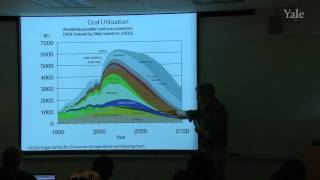
Energy Resources and Renewable Energy - Lecture 33
Explora recursos energéticos actuales, incluyendo carbón, petróleo, gas natural, energía nuclear e hidroeléctrica. Analiza su uso, impacto ambiental y tendencias futuras en la producción de energía.
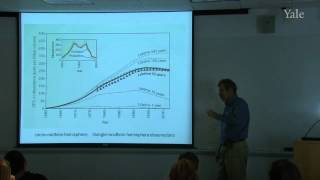
The Ozone Layer - Stratospheric Protection and Environmental Impact
Explore the ozone layer's importance, formation, and depletion. Learn about CFCs, the ozone hole, and global efforts to protect this crucial atmospheric shield through the Montreal Protocol.
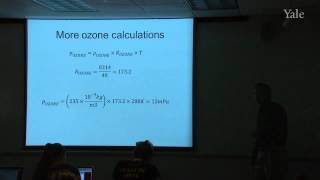
The Two Ozone Problems in the Atmosphere - Tropospheric and Stratospheric
Explore the dual ozone challenges: tropospheric smog and stratospheric depletion. Learn about ozone properties, photochemical reactions, EPA limits, and pollution sources in this atmospheric science lecture.
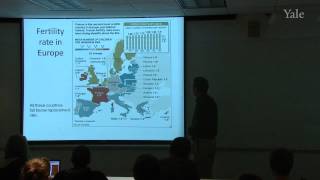
Climate Sensitivity and Human Population - The Atmosphere, Ocean and Environmental Change
Explore climate sensitivity, feedbacks, and global population trends. Analyze sustainable population, urbanization, and demographic transitions in developed vs. developing areas.

Global Warming: Emissions Scenarios and Climate Impacts - Lecture 29
Explore greenhouse gas emissions scenarios, climate warming projections, and potential impacts. Discuss advantages, disadvantages, and mitigation strategies for global warming.

Sex and Violence Among the Apes - Global Problems of Population Growth
Explore primate behavior, focusing on chimpanzee social dynamics, mating strategies, and inter-group violence. Gain insights into evolutionary pressures shaping ape societies and their implications for human behavior.

Population and the Environment - Global Problems of Population Growth
Explore the complex relationship between population growth and environmental challenges, examining projections, impacts, and potential solutions for a sustainable future.

Human and Environmental Impacts of Population Growth
Explore population growth's impact on the environment and global economy, examining overconsumption, poverty, and the challenges of balancing development with sustainability.

Sharpless Oxidation Catalysts and Cycloalkane Conformations - Lecture 34
Nobel laureate Barry Sharpless discusses titanium-based catalysts for stereoselective oxidation, their mechanisms, and applications in drug synthesis. Explores cycloalkane conformations using molecular mechanics.

Introduction to Freshman Organic Chemistry - How Do You Know?
Explore the foundations of scientific inquiry through experimentation and logic, using historical examples to illustrate key principles in organic chemistry and scientific thinking.
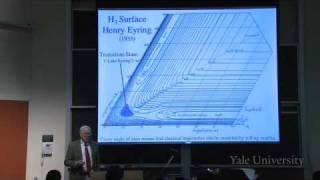
Potential Energy Surfaces, Transition State Theory and Reaction Mechanism - Lecture 37
Explore reaction rates, potential energy surfaces, and transition state theory in organic chemistry. Learn to predict equilibria and rates using bond energies and statistical mechanics principles.
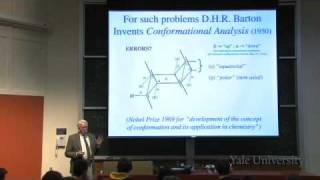
Conformational Energy and Molecular Mechanics - Lecture 33
Explore conformational energy and molecular mechanics in organic chemistry, focusing on cyclohexane structures, conformational relationships, and energy estimation techniques.

Maxwell's Equations and Electromagnetic Waves - Lecture 15
Explore electromagnetic waves, their energy, and connection to relativity. Understand Maxwell's equations' consistency with special relativity and how magnetism can be deduced from relativistic principles.

Quantum Mechanics - Key Experiments and Wave-Particle Duality
Explore quantum mechanics fundamentals: double-slit experiment, wave-particle duality, photoelectric effect, and uncertainty principle. Gain insights into the revolutionary concepts that reshaped our understanding of physics.

Introduction to Electrostatics and Coulomb's Law - Lecture 1
Explore fundamental concepts of electrostatics, including charge, Coulomb's Law, and the principle of superposition. Learn how to calculate electrostatic forces and understand charge distributions.

Smallpox - From Endemic Disease to Eradication - Lecture 2
Explore smallpox's impact on Europe and the New World, public health responses, and the development of inoculation and vaccination techniques in this historical analysis.

Smallpox - The Speckled Monster and Its Impact on Western Society - Lecture 6
Explore the history, transmission, symptoms, and treatments of smallpox in 18th century Western society, from its rise as a feared disease to early attempts at prevention and cure.

Renewable Energy Policies and Challenges - Lecture 23
Explores renewable energy policies, focusing on wind power challenges and benefits. Examines the Cape Wind project, addressing siting issues, environmental impacts, and property rights conflicts.