Creating Synthetic Data with Langchain, OpenAI, and Faker
Generate synthetic data using Langchain, OpenAI, and Faker for data science and machine learning applications. Learn powerful techniques to create realistic datasets.

Langchain: How to Run Sequential and Parallel Chains
Explore sequential and parallel Langchain chains for advanced machine learning workflows. Master techniques to enhance data processing and model performance.

Kaggle Notebooks - Introduction to Cloud-Based Data Science Platforms
Explore Kaggle notebooks for seamless data access, free GPU usage, and efficient machine learning model development without complex local setups.

Robot Framework - Introduction and Demonstration
Learn Robot Framework's keyword-driven approach for easy test automation, suitable for beginners and experienced testers alike.
Real-Time Image Processing AI/ML with Jupyter Notebooks
Explore real-time image processing using AI/ML techniques with Jupiter notebooks, enhancing your skills in cutting-edge technology applications.
Extinguishing the Garbage Fire of ML Testing - Improving Reliability and Quality in Machine Learning
Explore innovative ML testing strategies, focusing on observability, data reliability, and honoring Data Scientists' workflows to improve quality and efficiency in ML development.

Writing Unit Tests for Data Science Code
Discover software engineering best practices for testing data science code, including mocking data and handling complex scenarios in machine learning projects.
Introduction to Databricks Delta Live Tables
Accelerate data pipeline development with Databricks Delta Live Tables. Learn setup, ingestion, table creation, pipeline execution, and data validation for faster, more reliable projects.

Model Creation in Azure AutoML and Ingestion Through Excel
Explore Azure AutoML for machine learning, from model creation to Excel integration via VBA, with a focus on practical applications and time-saving techniques.
Declarative ETL Pipelines with Delta Live Tables - Modern Software Engineering for Data Analysts and Engineers
Modernize ETL pipelines using Delta Live Tables for efficient data management. Learn development, production, and best practices for reliable, testable, and scalable data processing.

Axis IMU - Review of Basic Trigonometry
Review of basic trigonometry concepts for rotating systems in Vpython, focusing on practical applications with Arduino and IMU sensors.

Solving Systems of Differential Equations with Eigenvalues and Eigenvectors
Learn to solve systems of linear ODEs using eigenvalues and eigenvectors. Covers problem setup, solution methods, and intuitive interpretation, with code examples in Python and MATLAB.
Statistics Tutorial with Python - Fundamentals and Data Analysis
Learn Python-based statistics: data types, visualization, measures of central tendency, dispersion, and relationships between variables. Gain practical skills for data analysis.
Statistics Tutorial - T Distribution and Hypothesis Testing
Learn to calculate and interpret T distributions, use T tables, understand degrees of freedom, and perform hypothesis testing with independent and dependent samples in this comprehensive statistics tutorial.
Statistics Tutorial - Real World Example with Python
Explore real-world data analysis using Python to maximize profits for a computer company. Learn to parse data, create functions, and gain insights for targeted marketing and product strategies.
Math4ML Exercises - Calculus
Hands-on calculus exercises for machine learning, covering little-o notation, gradients, linear approximations, and optimization techniques using Python and SymPy.
Formal Mathematics for Mathematicians and Mathematics Students - IPAM at UCLA
Explore formal mathematics' potential to revolutionize mathematical exposition, focusing on benefits beyond proof verification and its impact on mathematicians and students.
Axel Målqvist - Localization of Multiscale Problems
Explore multiscale problem-solving techniques, focusing on Local Orthogonal Decomposition for PDEs. Learn about convergence, high-contrast data, and applications to time-dependent problems.
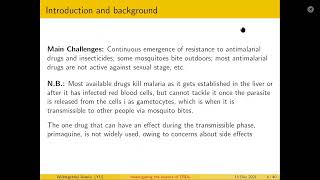
Investigating Transmission-Blocking Anti-malarial Drugs: A Mathematical Modelling Approach
Explore mathematical models assessing transmission-blocking antimalarial drugs' impact on disease control, focusing on treatment coverage, drug efficacy, and protective effects in malaria hotspots.
Pendulum Simulation: In Search of Chaos - Part 6
Explore chaos in double pendulum systems through simulation, analyzing different initial conditions and observing complex behavior patterns.

Why π Is in the Normal Distribution - Beyond Integral Tricks
Explore the mathematical origins of π in the normal distribution through geometric insights, classic proofs, and the Herschel-Maxwell derivation, offering a deeper understanding beyond integral tricks.