Counting Down for CRA - Updates and Expectations
Explore the EU's Cyber Resilience Act: timeline, critical discussions, and new responsibilities for software developers. Learn about PSF's preparations and how to ready your Python projects for increased security liability.
Porting Python to WebAssembly
Explore Python's journey to WebAssembly support, including challenges, improvements, and emerging projects like Pyodide and PyScript in this technical deep dive.

Python Steering Council Panel Discussion - Maintaining and Evolving Python
Python Steering Council members discuss their role in maintaining Python's quality, improving contributor experience, and guiding language evolution through consensus-driven decision-making processes.
Learn CPython by Breaking It
Explore CPython internals, demystify C extensions, and gain insights into Python's inner workings. Suitable for all skill levels, with guided explanations of C code.
Restarting Pyjion - A General Purpose JIT for Python - Is It Worth It?
Explore the revival of Pyjion, a JIT compiler for CPython, and its potential for significant performance gains. Learn about design ideas, optimizations, and future prospects for Python JIT compilation.
Demystifying Python's Internals - Diving into CPython by Implementing a New Operator
Explore CPython's internals by implementing a pipe operator, covering tokenization, grammar, parsing, and bytecode generation for a deeper understanding of Python's core mechanics.
Leveraging a Custom CPython Data Model for High Performance
Explore high-performance microprocessor design using a custom CPython data model for efficient data analysis, visualization, and problem-solving in integrated circuit development.
MQTT - A Pythonic Introduction to the Protocol for Connected Devices
Pythonic introduction to MQTT protocol for connected devices. Learn basic concepts, code examples in CPython and Micropython, and explore use cases in automation and microcontrollers.
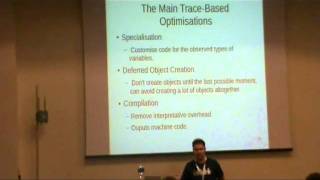
Making CPython Fast Using Trace-Based Optimisations
Explore trace-based optimizations to enhance CPython's performance, covering VM modifications, bytecode challenges, SPAM instructions, and key optimization techniques.

The Cython Compiler for Python
Explore Cython, a powerful static compiler for Python, to speed up code and create fast native extensions. Learn key features, optimization techniques, and C/C++ integration.
Knowing Your Garbage Collector
Explore Python's garbage collection mechanisms, including reference counting and cycle detection in CPython, and the MiniMark GC in PyPy. Gain insights into memory management and potential issues.
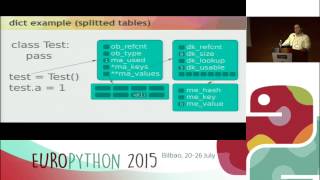
Playing with CPython Objects Internals
Explore CPython object internals, from simple to complex types. Learn to manipulate instance data using ctypes and perform unconventional operations on Python objects.

Exploring Our Python Interpreter
Dive into CPython's inner workings, from command line to interpreter. Explore project structure, lexing, parsing, bytecode generation, and the virtual machine's main loop for aspiring contributors.

The Gilectomy
Explore CPython's Global Interpreter Lock removal, its impact on performance, and potential solutions for multi-core utilization in this technical deep dive.

CFFI - Calling C from Python
Learn to call C libraries from Python using CFFI, a simpler alternative to C extension modules. Explore its advantages, including cross-implementation compatibility and direct C access, with practical demos and examples.
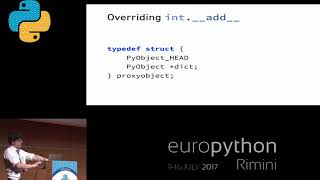
Monkey-Patching CPython with Ctypes to Conform to Party Doctrine
Explore CPython internals by modifying integer addition at runtime using only Python and ctypes. Gain insights into Python's data model, compilation, and execution process.
Fast Python! Coding Competitions with CPython and PyPy
Discover strategies for winning coding competitions using Python, exploring problem-solving techniques, stress management, and the advantages of PyPy over raw processing speed.
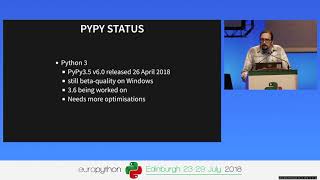
Adventures in Compatibility - Emulating CPython's C API in PyPy
Explore PyPy's emulation of CPython's C API, focusing on the cpyext layer that bridges implementation differences and enables compatibility with C extensions and Cython-based libraries.
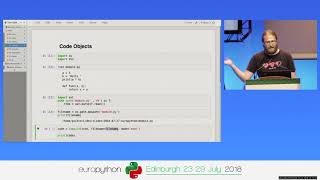
Bytecodes and Stacks - A Look at CPython’s Compiler and Its Execution Model
Explore CPython's inner workings: from code compilation to execution. Learn about tokenization, parsing, bytecode, and the stack-based virtual machine, suitable for Python developers of all levels.
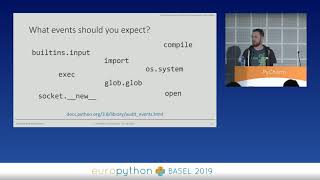
Auditing Hooks and Security Transparency for CPython
Explore CPython's new security features: auditing hooks and verified open call. Learn how to detect and prevent malicious use of Python, integrating with OS security frameworks.
Status Quo of Virtual Environments
Explore the inner workings of Python virtual environments, their importance in dependency management, and how they function across different Python interpreters.