Commutative Algebra
Comprehensive exploration of commutative algebra concepts through 60 lectures, covering fundamental principles and advanced topics for a deep understanding of algebraic structures.

Statistical Mechanics
The course provides a fundamental understanding of Thermodynamics and Statistical Mechanics. It starts with the fundamental concepts of thermodynamics and builds on its foundation, the principles of statistical mechanics. It does not require a prior expo…

Basic Calculus 1 and 2
Topics of continuity, differentiability, integrability of a real-valued function will be discussed with their applications. Also, series representations of some functions will be discussed.
Advanced Thermodynamics and Molecular Simulations
Explore advanced thermodynamics and molecular simulations, covering probability distributions, ensembles, phase equilibria, and computational methods for analyzing complex molecular systems.

Advanced Green Manufacturing Systems
This course provides an overview of realizing Green Manufacturing Systems. Compared to conventional manufacturing process that is purely productivity driven; various strategies and applicationsare necessary to improve the ecology first focus of green man…

Computational Commutative Algebra
This is an introductory course in computational commutative algebra. Topics in a typical first course in commutative algebra are developed along with computations in Macaulay2. The emphasis will be on concrete computations, more than on giving complete p…
Introductory Non-Linear Dynamics
This course is designed to introduce students to the basic ideas of Dynamical systems, Stability, and chaos, largely using Iterative mappings as the model. The course will focus on qualitative ideas and will require students to explore dynamics through s…
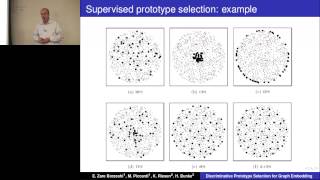
Discriminative Prototype Selection for Graph Embedding
Explore graph embedding techniques, focusing on discriminative prototype selection methods for improved graph representation and matching in various applications.
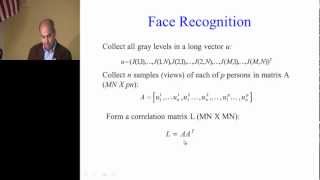
Face Recognition Techniques and Applications - Lecture 14
Explore face recognition techniques, from simple approaches to advanced methods like PCA and Linear Discriminant Analysis. Learn about eigenvectors, image compression, and scatter matrices.
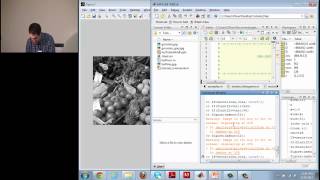
Matlab Tutorial
Learn MATLAB basics for computer vision: variables, vectors, matrices, image operations, filters, and more. Practical tutorial for beginners and intermediate users.
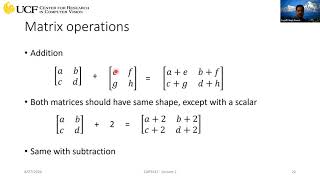
Linear Algebra Basics for Computer Vision - Lecture 2
Explore essential linear algebra concepts including vectors, matrices, transformations, and SVD, with practical applications in computer vision and machine learning.
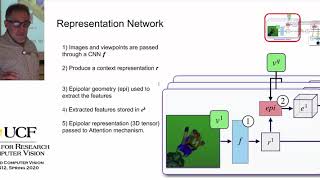
Geometry-Aware Neural Rendering for Novel View Synthesis
Explore novel view synthesis techniques and epipolar extraction in neural rendering, with a focus on geometry-aware approaches and their practical applications.
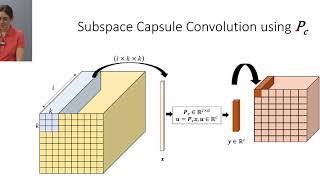
Subspace Capsule Network
Explore Subspace Capsule Networks: a novel approach to neural networks that preserves information, norms, and angles. Learn about its principles, applications, and advantages in image classification and generation.
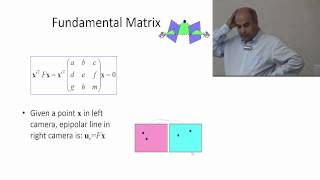
Fundamental Matrix and Stereo Vision - Lecture 13
Explore fundamental matrices, stereo photosynthesis, and random sampling consensus in image processing and computer vision applications.
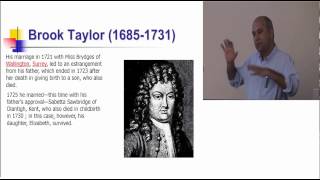
Interest Point Detection in Computer Vision - Lecture 4
Explore interest point detection techniques, including Harris Corner Detector and auto-correlation, with applications in computer vision and image processing.
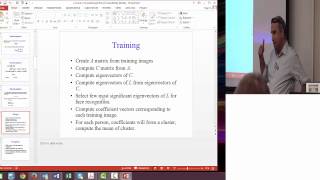
Facial Recognition: Eigenvectors and Covariance Matrices - Lecture 14
Explore facial recognition technology, from simple approaches to advanced techniques using eigenvectors and covariance matrices. Learn about challenges and solutions in this field.
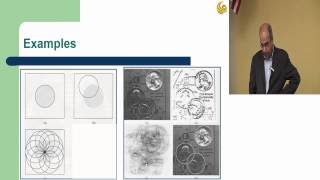
Hough Transform for Image Feature Extraction - Lecture 17
Explore image feature extraction, line fitting techniques, and the Hough Transform for shape detection in computer vision, including practical applications and challenges.
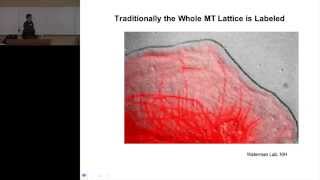
Analysis of Fluorescently Labeled Contractile Subcellular Structures - Instantaneous Flow Tracking
Explore advanced techniques for analyzing fluorescently labeled cellular structures, focusing on instantaneous flow tracking to measure cytoskeletal dynamics and its applications in cancer research.
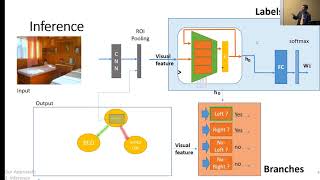
Contextual Image Understanding and Scene Identification in Videos - Thesis Defense
Explore image understanding using context, focusing on scene identification and object detection in videos through innovative techniques like Top-Down Visual Tree representation and Random Walk incorporation.
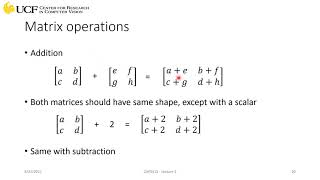
Basics of Linear Algebra for Computer Vision - Part II - Lecture 3
Explore essential linear algebra concepts for computer vision, including matrix operations, determinants, and transformations, enhancing your understanding of image processing fundamentals.

Advanced Data Mining with Weka
Explore advanced data mining techniques using Weka, covering time series forecasting, incremental learning, integration with R and Python, and distributed processing for big data analysis.